


























Views
Downloads
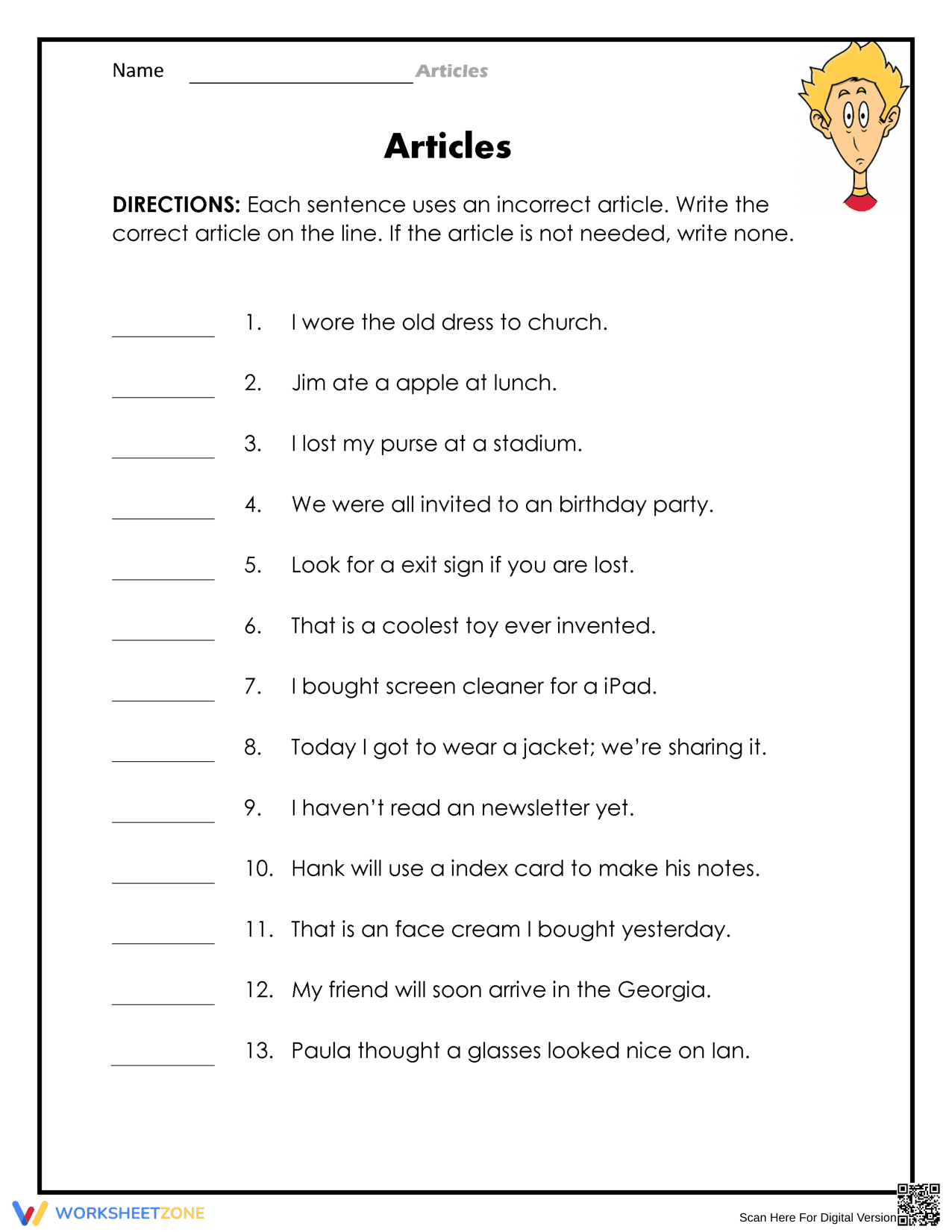

Essential Articles Grammar Worksheet | Grades 1-4
Paste this activity's link or code into your existing LMS (Google Classroom, Canvas, Teams, Schoology, Moodle, etc.).
Students can open and work on the activity right away, with no student login required.
You'll still be able to track student progress and results from your teacher account.
Ensure your students master the nuances of English grammar with this focused practice page on articles. This worksheet targets the correct application of "a," "an," and "the," while also challenging learners to identify instances where no article is required. By correcting broken sentences, students develop a stronger intuition for sentence structure and formal writing standards.
At a Glance
- Grade: 1-4 · Subject: English Language Arts
- Standard:
CCSS.ELA-LITERACY.L.1.1.H— Use determiners including articles to produce and expand complete sentences- Skill Focus: Identifying and Correcting Articles
- Format: 1 page · 13 problems · Answer key included · PDF
- Best For: Quick grammar checks or independent review
- Time: 10–15 minutes
Inside this resource, you will find a cleanly formatted single-page activity containing thirteen individual sentence-correction tasks. Each item presents a common grammatical error related to article usage, such as "a apple" or "an birthday party." Students are prompted to write the correct article on the provided line or indicate "none" for cases where an article is unnecessary. A full answer key is included to facilitate rapid grading or student self-correction.
The zero-prep workflow for this resource minimizes teacher overhead. First, print the single-page PDF in less than thirty seconds. Next, distribute the sheets for immediate engagement; clear directions ensure no additional verbal explanation is required. Finally, review the answers as a class or use the provided key for feedback. Total teacher preparation time remains under two minutes, making this an ideal choice for morning work or emergency sub plans.
This resource is aligned to CCSS.ELA-LITERACY.L.1.1.H, requiring students to use determiners correctly. Exercises target the phonological rules for 'a' versus 'an' and the specific versus non-specific distinction of 'the.' This standard code can be copied directly into lesson plans or IEP goals to ensure compliance with educational frameworks. Both standard codes can be copied directly into lesson plans, IEP goals, or district curriculum mapping tools.
Use this worksheet as a formative assessment during a grammar unit or as a 'do-now' to reinforce instruction. One effective tip is to observe students working on items involving 'none'; these reveal a deeper understanding of noun types. The expected completion time is fifteen minutes, allowing it to fit into a busy ELA block or a specialized small-group intervention session.
This practice page is intended for elementary students in grades 1-4 developing foundational literacy skills. It is beneficial for English Language Learners (ELLs) who may struggle with the inconsistent rules of English determiners. This resource pairs naturally with an anchor chart on vowel sounds or a short reading passage, providing a comprehensive approach to grammar instruction within a literacy-rich classroom environment.
According to the RAND AIRS 2024 report on elementary literacy, targeted grammar interventions that focus on discrete syntax elements, such as article usage, significantly improve sentence-level writing fluency in early learners. This worksheet addresses CCSS.ELA-LITERACY.L.1.1.H by providing thirteen specific instances for students to practice the use of determiners (a, an, the, none) in varied contexts. Research indicates that frequent, low-stakes practice with these foundational components helps students internalize the rhythmic patterns of the English language. By engaging with these tasks, learners move beyond rote memorization and toward a functional mastery of grammar that translates directly to their original compositions. This evidence-based approach ensures students are not only identifying errors but are actively reconstructing sentences to convey solid thoughts. The 'none' category further deepens the cognitive demand, aligning with standards for linguistic complexity in elementary education.


