


























Views
Downloads

Essential Coral Reef Reading Comprehension | Grade 3 ELA
Paste this activity's link or code into your existing LMS (Google Classroom, Canvas, Teams, Schoology, Moodle, etc.).
Students can open and work on the activity right away, with no student login required.
You'll still be able to track student progress and results from your teacher account.
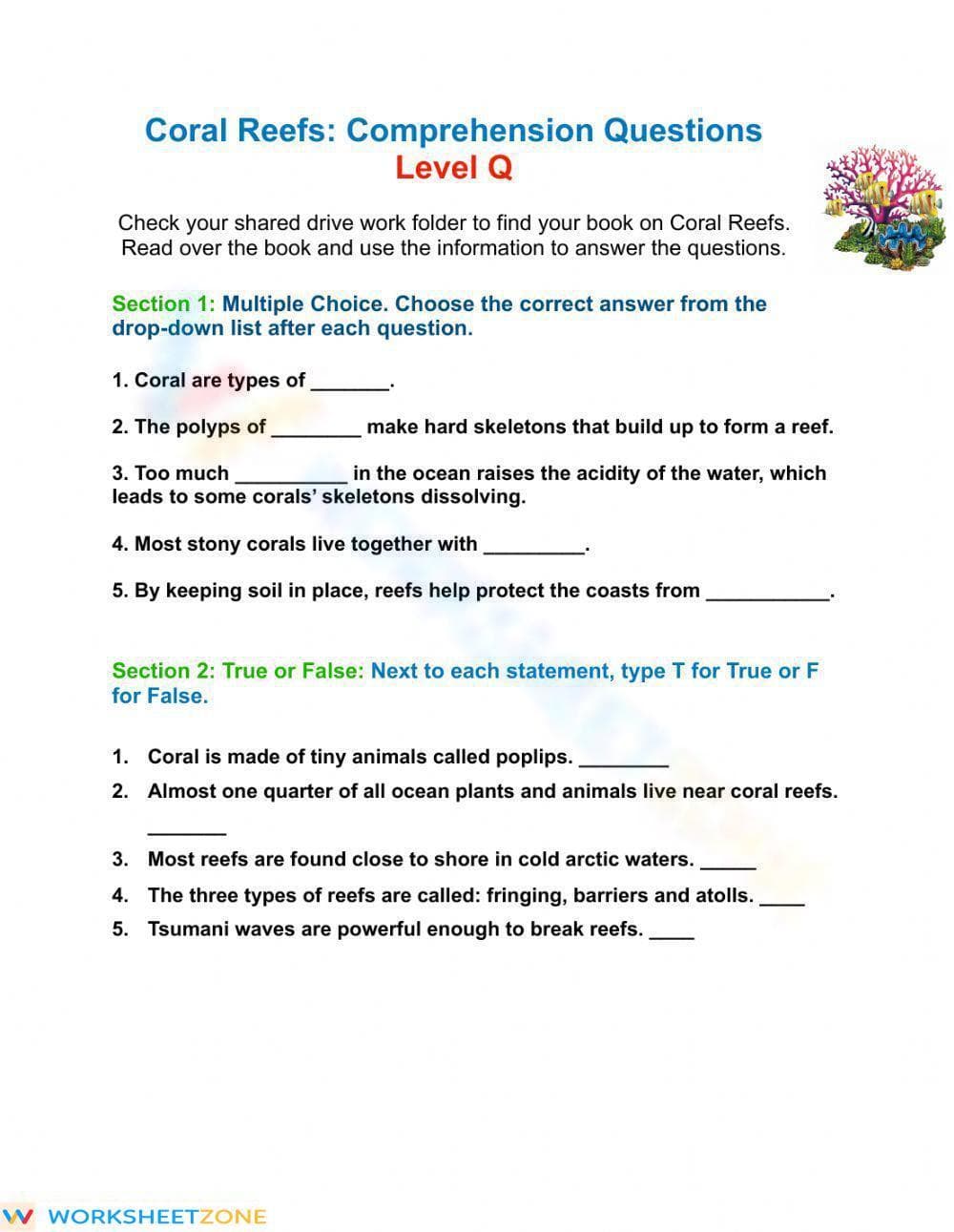
Improve literacy outcomes with this targeted reading comprehension worksheet focused on coral reef ecosystems. Designed for Grade 3 and 4, this resource facilitates evidence-based answering by requiring students to reference informational text to complete multiple-choice and true-or-false tasks. It provides a structured environment for mastering scientific concepts through accessible, high-interest language.
At a Glance
- Grade: 3 · Subject: English Language Arts
- Standard:
CCSS.ELA-LITERACY.RI.3.1— Ask and answer questions using evidence from the text to show understanding.- Skill Focus: Informational Text Comprehension
- Format: 1 page · 10 problems · Answer key included · PDF
- Best For: Independent practice or quick formative assessment
- Time: 15–20 minutes
This single-page PDF contains ten strategically designed questions to test marine biology knowledge. The worksheet features five multiple-choice questions and five true-or-false statements. The layout engage visual learners with a professional reef graphic while maintaining focus on academic rigor. A full answer key is included for rapid grading and feedback.
The zero-prep workflow is optimized for busy educators. First, print the single-page document (30 seconds). Second, distribute it alongside a coral reef text (1 minute). Finally, use the answer key to review responses (5 minutes). Total prep time is under two minutes, making it ideal for substitute plans or morning work.
Aligned to CCSS.ELA-LITERACY.RI.3.1, this resource requires students to "Ask and answer questions to demonstrate understanding of a text." By engaging with facts about polyps and ocean acidity, students build the rigor to move from literal to inferential reasoning. This code can be copied directly into lesson plans or IEP goals.
Use this worksheet as a formative assessment after a science lesson. A concrete use case involves having students highlight the sentence in their passage that provides the answer. Teachers should observe if students are returning to the text; if students struggle with the True/False section, it indicates a need for keyword-scanning instruction.
This worksheet is for grades 3 through 4 and serves as an excellent scaffold for English Language Learners. It pairs naturally with non-fiction books or anchor charts detailing informational text structures. The inclusion of technical vocabulary like "acidity" makes it a valuable tool for cross-curricular science and literacy instruction.
According to the RAND AIRS 2024 report on literacy instruction, providing students with structured, evidence-based tasks significantly improves their ability to retain complex scientific information. This worksheet targets the CCSS.ELA-LITERACY.RI.3.1 standard by requiring students to extract specific details about coral reefs, such as the role of polyps and the impact of ocean acidity on skeletal structures. By completing these 10 tasks, students move beyond surface-level reading and develop the critical thinking skills necessary for advanced informational text analysis. Research from the NAEP consistently shows that students who engage in frequent, focused comprehension practice score higher on standardized reading assessments. This resource offers a high-utility, low-barrier entry point for developing these essential skills in a classroom setting, ensuring that every learner has the opportunity to achieve mastery through supported practice while maintaining high expectations for scientific literacy.


