




























Views
Downloads
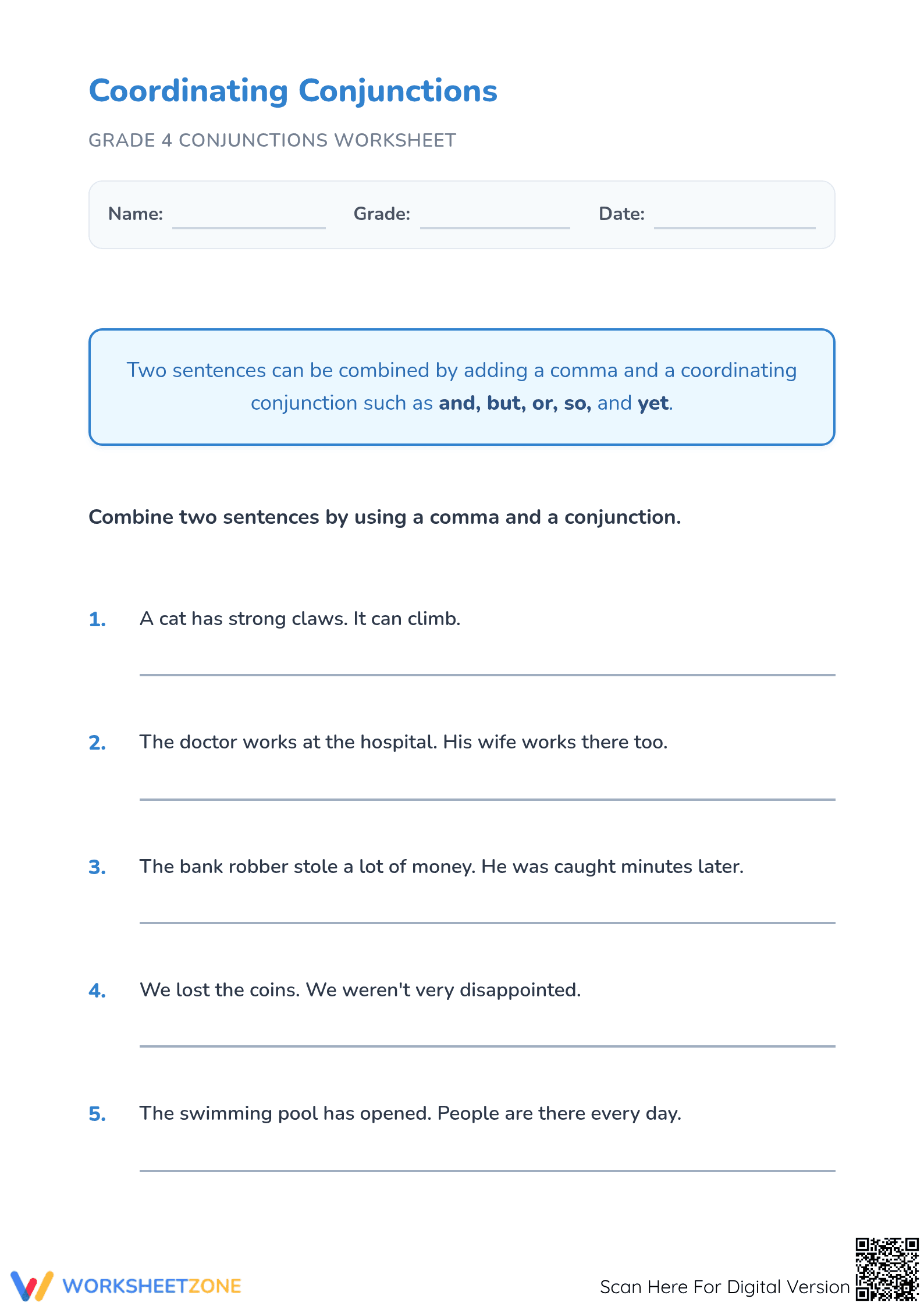
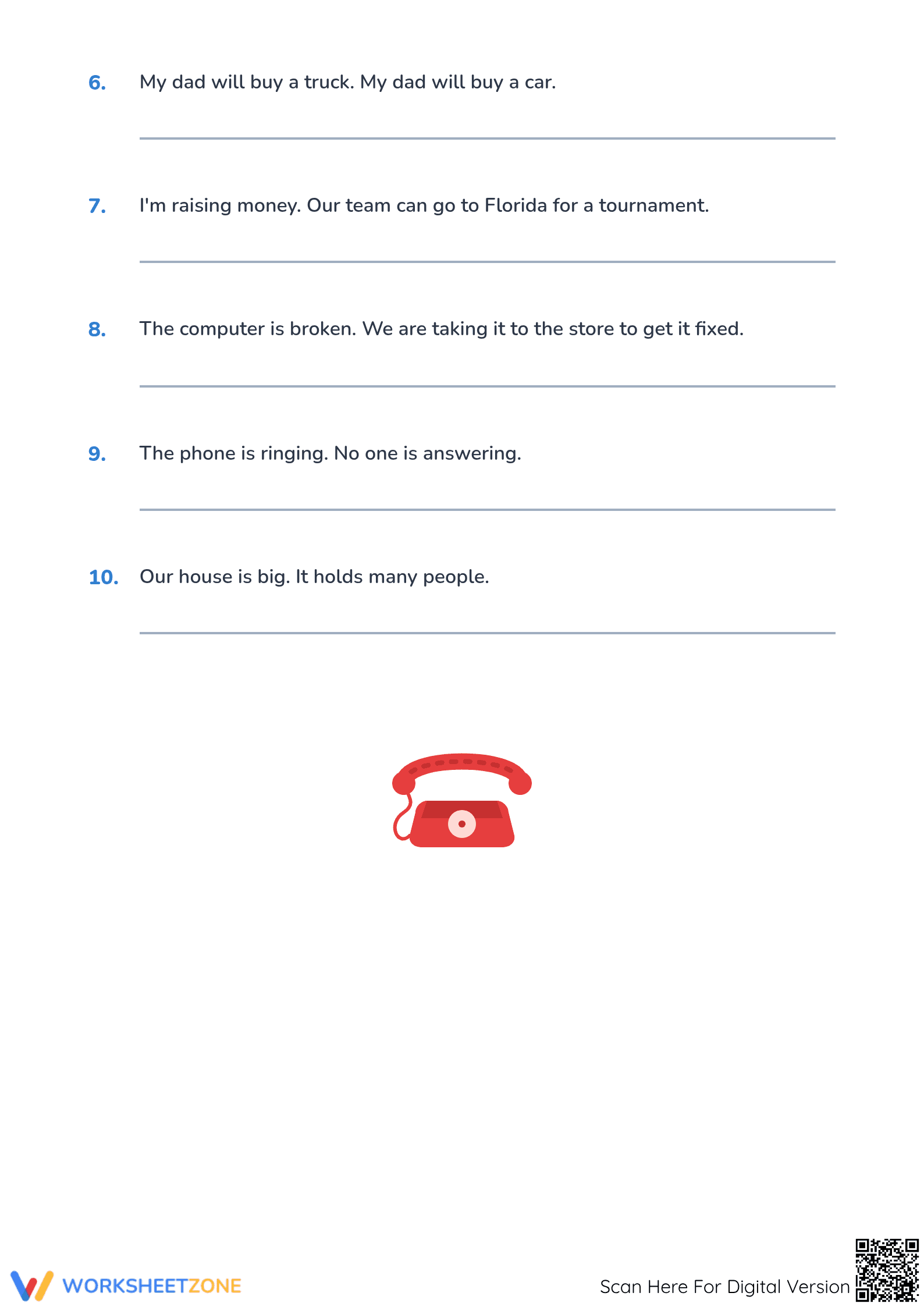

Grade 3 Conjunctions — Printable No-Prep Worksheet

Paste this activity's link or code into your existing LMS (Google Classroom, Canvas, Teams, Schoology, Moodle, etc.).
Students can open and work on the activity right away, with no student login required.
You'll still be able to track student progress and results from your teacher account.
This Grade 3 ELA worksheet gives students focused, high-quality practice combining sentences using coordinating conjunctions. By connecting related ideas with commas and conjunctions like and, but, or, so, and yet, students will actively improve their sentence variety and overall writing fluency. This foundational grammar skill is essential for young writers learning to construct compound sentences.
At a Glance
- Grade: 3 · Subject: ELA
- Standard:
CCSS.ELA-LITERACY.L.3.1.H— Combine sentences using coordinating conjunctions- Skill Focus: Coordinating conjunctions
- Format: 2 pages · 10 problems · Answer key included · PDF
- Best For: Independent practice and grammar review
- Time: 10–15 minutes
This comprehensive resource includes a two-page printable worksheet featuring 10 distinct sentence-combining tasks. At the top of the first page, a clear, student-friendly instructional box reminds learners of the target conjunctions and the required comma placement rules. A complete, easy-to-read answer key is also provided to ensure accurate grading, facilitate peer review, and offer immediate feedback to students.
Zero-Prep Workflow
This worksheet is designed for immediate classroom use, requiring under two minutes of total teacher prep time. It is an excellent addition to any emergency sub plan.
- Print (1 minute): Download the PDF and print double-sided to save paper. The clean layout ensures high-quality copies.
- Distribute (1 minute): Hand out to students after a brief mini-lesson on conjunctions. The built-in instructions allow students to begin working immediately.
- Review (5 minutes): Use the included answer key to quickly check student work or project it on the board for whole-class self-correction.
Standards Alignment
This worksheet is directly aligned to CCSS.ELA-LITERACY.L.3.1.H: Use coordinating and subordinating conjunctions. It also supports broader writing standards by encouraging students to produce simple, compound, and complex sentences. Both standard codes can be copied directly into lesson plans, IEP goals, or district curriculum mapping tools.
How to Use It
Independent Practice: Assign this worksheet immediately following direct instruction on compound sentences. The clear examples at the top of the page allow students to work independently for 10 to 15 minutes while the teacher circulates.
Formative Assessment: Use these 10 problems as a quick check for understanding. Observe whether students are correctly placing the comma before the coordinating conjunction, which is a common stumbling block for third graders.
Who It's For
This resource is ideal for third-grade students who are actively developing their foundational grammar and writing skills. The straightforward, distraction-free format provides the necessary repetition for students who frequently struggle with sentence boundaries or run-on sentences. It pairs perfectly with a classroom anchor chart displaying the FANBOYS acronym or a direct instruction lesson on compound sentence structures.
Mastering CCSS.ELA-LITERACY.L.3.1.H to combine sentences using coordinating conjunctions is a critical step in developing long-term writing fluency. According to Fisher & Frey (2014), providing students with targeted, sentence-level combining exercises significantly improves their ability to construct complex, coherent paragraphs over time. By explicitly practicing how to link related ideas with appropriate conjunctions and punctuation, young writers successfully transition from drafting choppy, simple sentences to utilizing more sophisticated syntactic structures that directly enhance overall reading comprehension and written expression across all academic subjects.


