


























Views
Plays




Coordinating Conjunctions Worksheet | Grade 2 Essential
Paste this activity's link or code into your existing LMS (Google Classroom, Canvas, Teams, Schoology, Moodle, etc.).
Students can open and work on the activity right away, with no student login required.
You'll still be able to track student progress and results from your teacher account.
This Grade 2 coordinating conjunctions worksheet helps students master the use of connecting words to join ideas within sentences. By identifying the correct relationship between clauses, learners improve their sentence variety and grammatical precision. This resource provides immediate practice with "and," "but," "or," and "so" to ensure foundational writing mastery.
At a Glance
- Grade: 2 · Subject: ELA
- Standard:
CCSS.ELA-LITERACY.L.2.1.G— Use coordinating and subordinating conjunctions to connect words and phrases- Skill Focus: Coordinating Conjunctions
- Format: 5 pages · 15 problems · Answer key included · PDF
- Best For: Independent practice or quick grammar assessment
- Time: 15–20 minutes
What's Inside
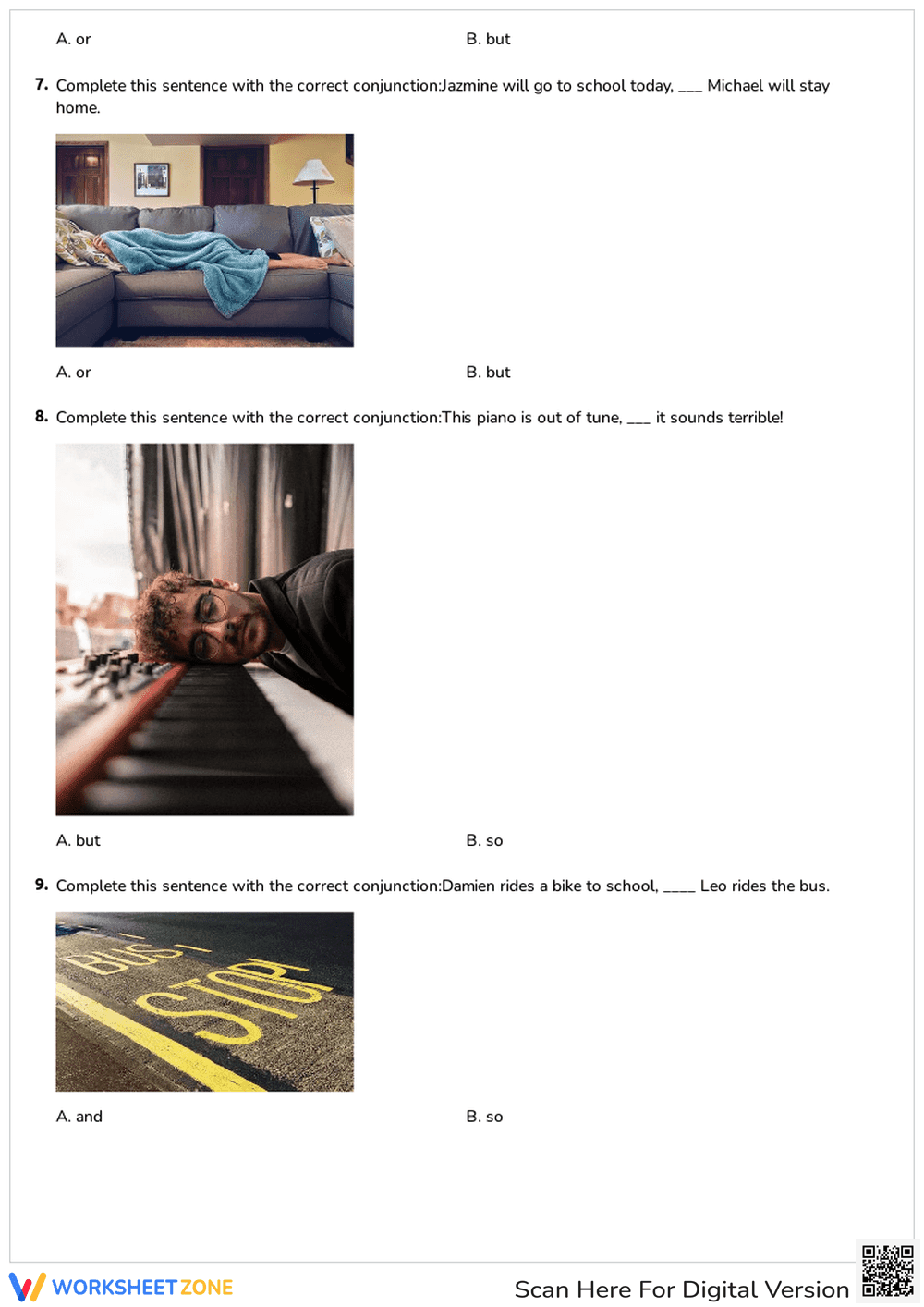
This comprehensive 5-page PDF contains 15 multiple-choice questions designed for second-grade learners. Each question features a high-quality visual aid to provide context for the sentence, helping students visualize the relationship between the two joined ideas. The worksheet focuses on the four primary coordinating conjunctions, providing a clear structure for student responses and ensuring they understand how to link related thoughts effectively.
Zero-Prep Workflow
- Print: Select the pages and print the document for your class in under 30 seconds.
- Distribute: Hand out the sheets for independent work, a morning warm-up, or a timed quiz.
- Review: Use the included answer key to provide immediate feedback or allow for student self-correction.
Total teacher preparation time is under two minutes, making this an ideal resource for emergency sub plans or last-minute grammar reinforcements.
Standards Alignment
The primary focus is `CCSS.ELA-LITERACY.L.2.1.G`, which requires students to use coordinating and subordinating conjunctions. This worksheet specifically targets the coordinating aspect, ensuring students can distinguish between addition (and), contrast (but), choice (or), and cause/effect (so). Both standard codes can be copied directly into lesson plans, IEP goals, or district curriculum mapping tools.
How to Use It
Use this worksheet during the independent practice phase of a lesson on sentence structure. It serves as an excellent formative assessment tool; teachers should observe if students struggle specifically with "so" versus "but," as these often indicate a misunderstanding of logical relationships. The expected completion time range is 15 to 20 minutes, depending on the student's reading level.
Who It's For
This resource is tailored for Grade 2 students but works well for Grade 3 review or English Language Learners (ELL) needing visual support for grammar. Pair this worksheet with a mentor text or an anchor chart that defines the FANBOYS acronym to reinforce the conceptual framework of conjunctions before students begin the tasks.
According to the RAND AIRS 2024 report, structured grammar practice that utilizes visual cues significantly enhances the retention of syntactic rules in early elementary learners. This worksheet aligns with those findings by providing 15 contextualized tasks that target CCSS.ELA-LITERACY.L.2.1.G. By focusing on coordinating conjunctions like "and," "but," "or," and "so," the material helps students move beyond simple sentences toward more complex, compound structures. Research from Fisher & Frey (2014) emphasizes that the use of multiple-choice formats with visual scaffolding allows teachers to isolate specific grammatical deficits without the cognitive load of full sentence construction. This targeted approach ensures that Grade 2 students develop the necessary linguistic foundations for later narrative and informational writing tasks. The inclusion of an answer key facilitates rapid feedback, a critical component of effective formative assessment in modern ELA instruction.


