


























Views
Downloads




Printable Worksheet: Decimals to Fractions | Grade 5
Paste this activity's link or code into your existing LMS (Google Classroom, Canvas, Teams, Schoology, Moodle, etc.).
Students can open and work on the activity right away, with no student login required.
You'll still be able to track student progress and results from your teacher account.
This comprehensive Math worksheet focuses on the essential skill of converting decimals to fractions in their simplest form. By providing structured practice and a dedicated challenge section, it ensures students bridge the gap between decimal notation and rational numbers. This resource is designed to build procedural fluency while reinforcing the underlying concept of place value.
At a Glance
- Grade: 5 · Subject: Math
- Standard:
CCSS.MATH.CONTENT.4.NF.C.6— Use decimal notation for fractions with denominators 10 or 100 and simplify- Skill Focus: Decimal to Fraction Conversion
- Format: 4 pages · 24 problems · Answer key included · PDF
- Best For: Classroom practice, homework, or formative assessment
- Time: 20–30 minutes
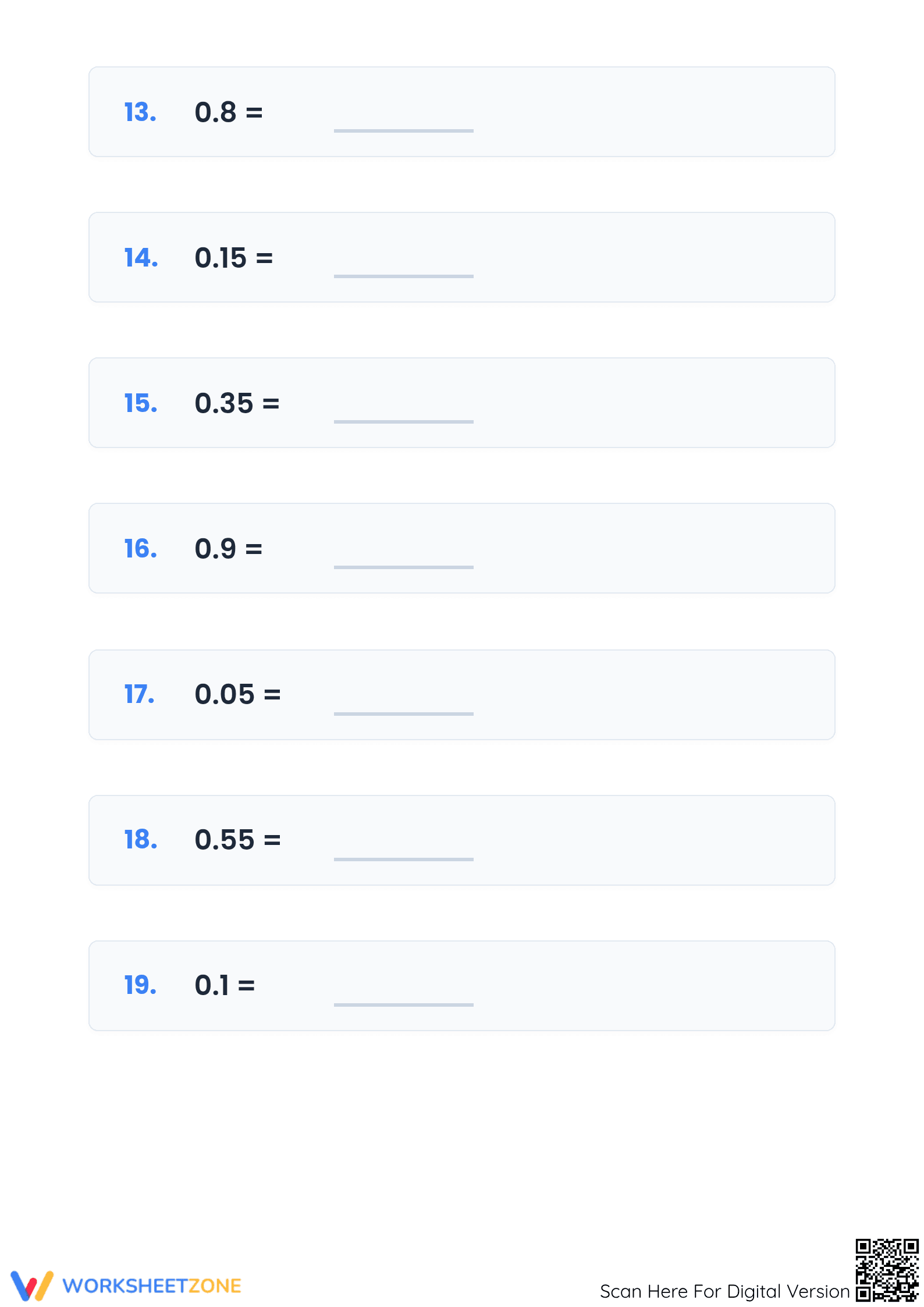
Inside this four-page printable, you will find 20 standard practice problems and 4 challenge tasks. The layout is clean and focused, providing ample space for students to show their work as they find common factors to simplify their fractions. A full answer key is included at the end of the document, making it easy for teachers to grade or for students to self-check their progress.
The worksheet follows a clear instructional path.
- Guided practice: The first five problems use familiar decimals like 0.2 and 0.45 to build immediate confidence.
- Supported practice: Items 6 through 20 introduce thousandths (0.875) and varied place values to broaden student understanding.
- Independent practice: The challenge section requires students to apply their knowledge to less common decimals, ensuring they can generalize the skill.
This resource is strictly aligned to `CCSS.MATH.CONTENT.4.NF.C.6`. This standard requires students to use decimal notation for fractions and understand the relationship between these two mathematical representations. Additionally, it supports 5.NF.A.1 by requiring fraction simplification. Both standard codes can be copied directly into lesson plans, IEP goals, or district curriculum mapping tools.
Integrate this worksheet during your direct instruction phase as a guided practice activity, or assign it as a high-quality homework task to reinforce the day's lesson. For a formative assessment observation, watch how students handle the transition from tenths to thousandths in Part 1. Most students will complete all four pages in approximately 25 minutes, though the challenge section may take longer for some learners.
This worksheet is ideal for 4th and 5th-grade students who are mastering place value and fraction operations. It also serves as an excellent remedial tool for middle school students who need a refresher on simplification. For best results, pair this with a physical or digital place value chart to help students visualize the "tenths" and "hundredths" positions before they begin the conversion process.
According to the EdReports 2024 analysis of high-quality instructional materials, the ability to fluently navigate between decimal and fraction representations is a critical milestone for success in middle school algebra and statistics. This worksheet addresses that need by providing targeted, repetitive practice that builds the cognitive pathways necessary for numerical fluency. The inclusion of simplifying fractions ensures students are not just identifying equivalents but are performing the operations required for standardized testing and real-world application. By focusing on simplest form, the resource forces students to interact with divisibility rules and common factors, deepening their overall number sense. Research from NAEP suggests that students who struggle with these conversions often find higher-order mathematical modeling more difficult later in their academic careers. This resource provides the necessary scaffold to prevent those gaps from forming, offering a clear and measurable way to track student progress toward decimal mastery.


