


























Views
Downloads




Essential Decimal to Fraction Worksheet | Grade 7 Aligned
Paste this activity's link or code into your existing LMS (Google Classroom, Canvas, Teams, Schoology, Moodle, etc.).
Students can open and work on the activity right away, with no student login required.
You'll still be able to track student progress and results from your teacher account.
This high-level worksheet masters the conversion of decimals into simplest-form fractions across 64 rigorous problems. Students progress through standard conversions, thousandths-place values, and real-world word problems to solidify their understanding of rational number representations. Learners bridge the gap between decimal notation and fractional relationships in varied contexts.
At a Glance
- Grade: 7 · Subject: Math
- Standard:
CCSS.7.NS.A.2.D— Convert rational numbers to decimals and understand terminating or repeating decimal forms- Skill Focus: Decimal to simplest fraction conversion
- Format: 5 pages · 64 problems · Answer key included · PDF
- Best For: Independent practice and middle school mastery
- Time: 45–60 minutes
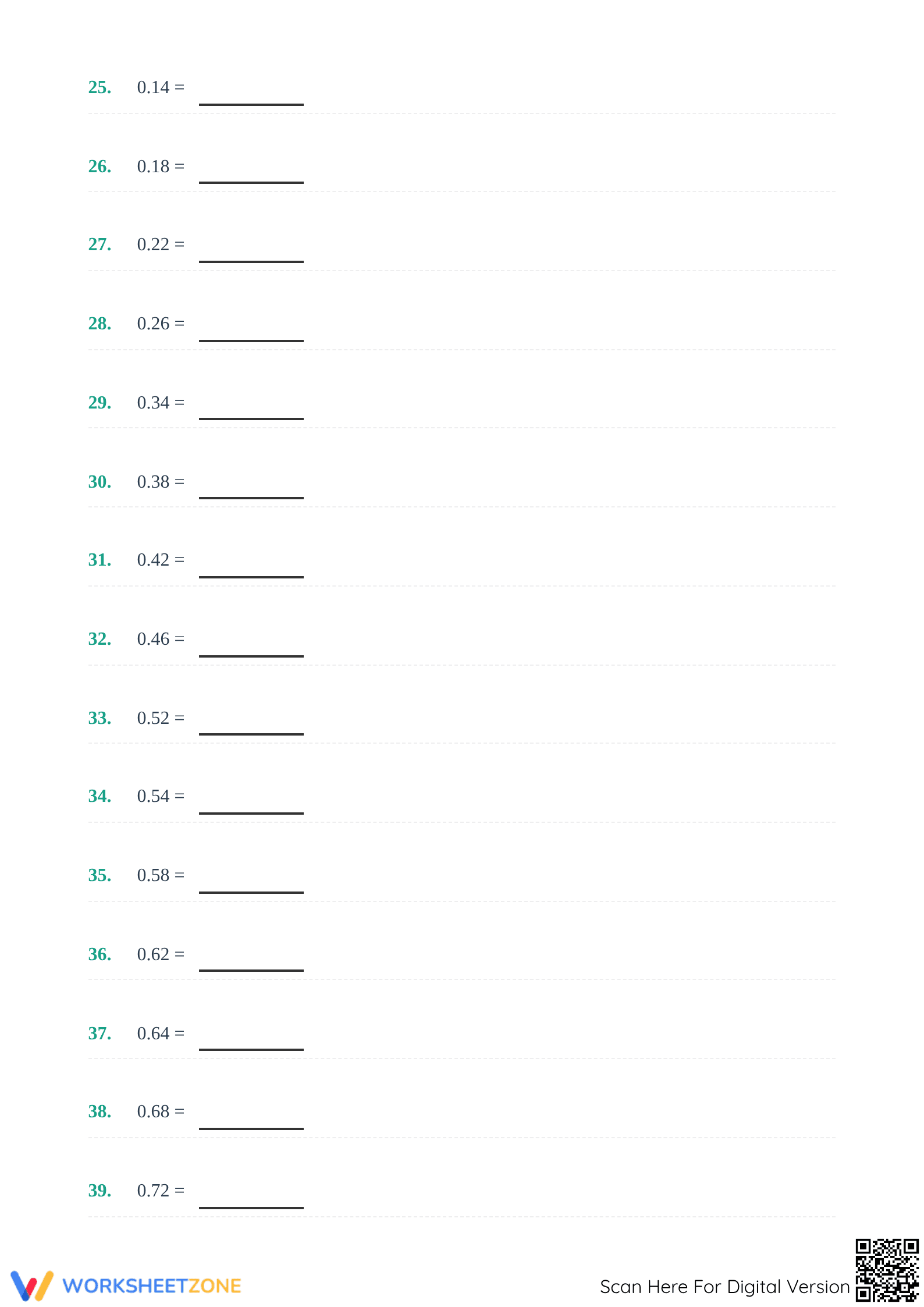
The five-page PDF features a structured layout designed for deep engagement. It includes five distinct sections: Standard Conversions, Higher Level Practice (thousandths), Applied Math Problems (real-world scenarios), Precise Conversions (up to four decimal places), and a final Summary Matrix. Each section provides ample workspace, and a comprehensive answer key is provided to facilitate rapid grading and immediate student feedback.
Skill Progression
- Guided Practice: Section 1 provides 20 standard conversions using familiar tenths and hundredths to build initial confidence and recall.
- Supported Practice: Sections 2 and 4 introduce higher-precision values, including thousandths and ten-thousandths, requiring complex simplification techniques.
- Independent Application: Section 3 presents eight unique word problems requiring students to extract data and convert it into simplified fractional equivalents.
This gradual-release model moves students from basic procedural fluency to complex conceptual application through the I Do, We Do, You Do instructional sequence.
Standards Alignment
This resource is directly aligned with CCSS.7.NS.A.2.D: "Convert a rational number to a decimal using long division; know that the decimal form of a rational number terminates in 0s or eventually repeats." While focused on the inverse (decimal to fraction), it reinforces the core understanding of rational number equivalence required for 7th-grade mastery. Both standard codes can be copied directly into lesson plans, IEP goals, or district curriculum mapping tools.
How to Use It
Use this worksheet as a summative assessment after a unit on rational numbers to gauge student mastery of multi-step conversions. Alternatively, assign the Applied Math section as a collaborative activity to spark discussion on how fractions represent physical quantities like distance and density. Teachers should observe students during Section 4 to identify those struggling with prime factorization when simplifying complex fractions. Completion typically takes 50 minutes.
Who It's For
This collection is ideal for 7th and 8th-grade students pursuing pre-algebra or general mathematics. It is particularly useful for students who need additional practice with simplifying fractions or those preparing for standardized assessments that emphasize rational number properties. Pair this resource with a visual place-value anchor chart to support students who struggle with identifying the correct denominator for decimals extending to the ten-thousandths place.
The ability to transition between numerical representations is a critical predictor of secondary math success. According to the NAEP framework, students who demonstrate fluency in converting decimals to fractions perform significantly better in algebraic reasoning tasks involving ratios and proportions. This worksheet addresses the common misconception that decimals and fractions are separate entities by focusing on standard CCSS.7.NS.A.2.D. Research from Fisher & Frey (2014) highlights that scaffolding from simple procedural tasks to applied word problems, as seen in these 64 problems, is essential for the gradual release of responsibility. By requiring simplest-form answers, the resource also reinforces division and common factor identification, skills foundational for high school mathematics. The inclusion of precise conversions up to the ten-thousandths place ensures that students are challenged beyond basic hundredths-place rote memorization, supporting a deeper understanding of the Base-10 system.


