


























Views
Downloads
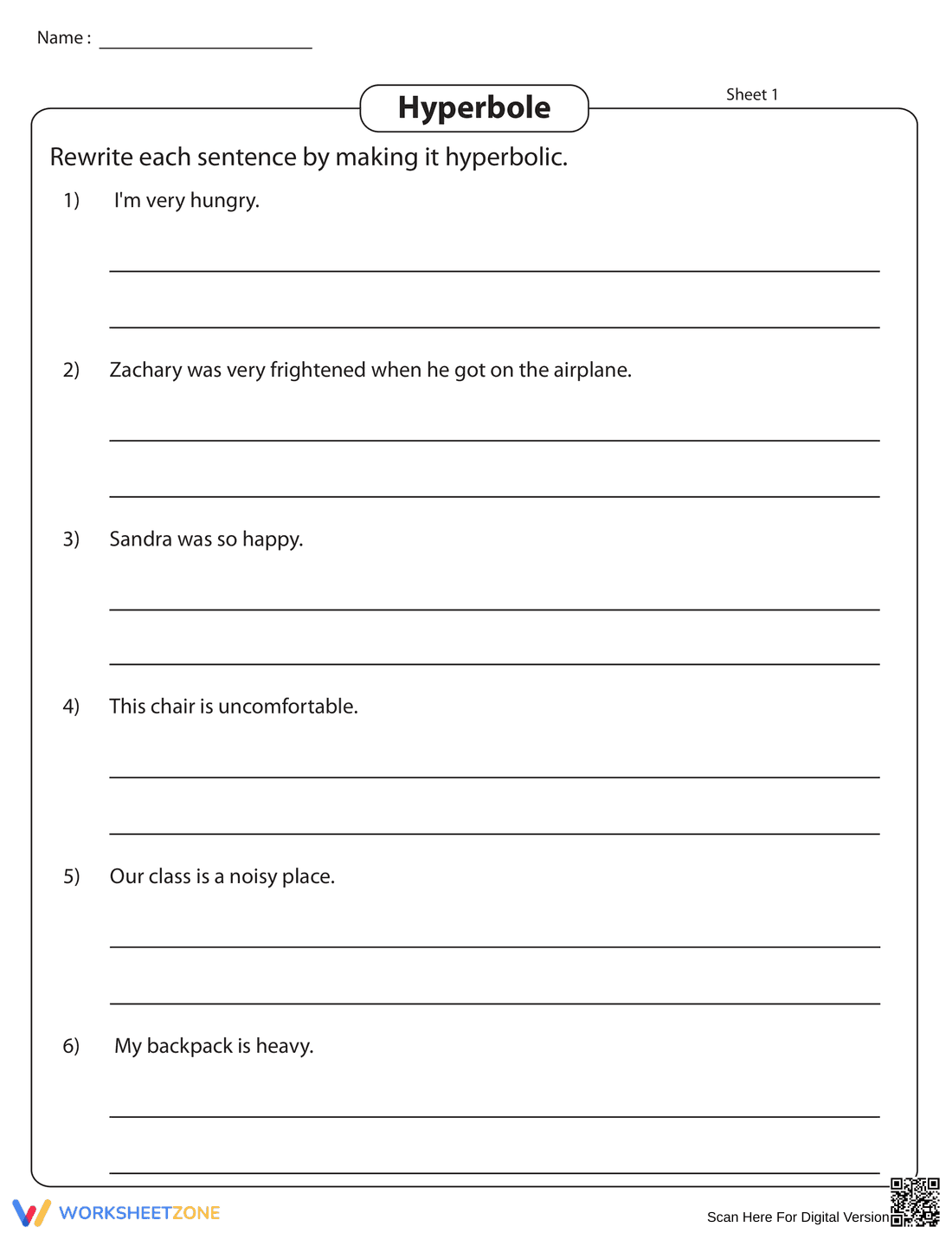

Hyperbole Worksheet Printable | Grade 5 Aligned Essential
Paste this activity's link or code into your existing LMS (Google Classroom, Canvas, Teams, Schoology, Moodle, etc.).
Students can open and work on the activity right away, with no student login required.
You'll still be able to track student progress and results from your teacher account.
Mastering figurative language is a key milestone for upper elementary students. This printable hyperbole worksheet provides focused practice in converting literal sentences into creative, exaggerated statements. By engaging with these six targeted exercises, learners develop a deeper understanding of how authors use dramatization to intensify meaning in literature.
At a Glance
- Grade: 5 · Subject: ELA - Figurative Language
- Standard:
CCSS.ELA-LITERACY.L.5.5— Interpret figurative language, including similes, metaphors, and hyperboles, in context- Skill Focus: Converting literal ideas to hyperbolic exaggerations
- Format: 1 page · 6 problems · Answer key included · PDF
- Best For: Homework, quick assessment, or bell-ringer activity
- Time: 10–15 minutes
What's Inside
This PDF features six literal prompts ranging from physical sensations like hunger to descriptive observations about environment and difficulty. Each prompt is followed by writing space, allowing students to craft unique exaggerations. The uncluttered layout ensures students stay focused on the creative task. A comprehensive answer key is included to facilitate rapid grading and provide immediate student feedback.
Zero-Prep Workflow
- Print (30s): Generate the single-page PDF for your entire class with no complex settings.
- Distribute (1m): Assign the worksheet as a transition activity, independent center, or homework.
- Review (3m): Discuss the creative responses using the answer key to spark classroom engagement.
Total teacher preparation time is under two minutes, making it an ideal choice for busy classrooms or unexpected sub plans.
Standards Alignment
This resource aligns with CCSS.ELA-LITERACY.L.5.5, requiring students to "demonstrate understanding of figurative language, word relationships, and nuances in word meanings." This worksheet specifically targets interpreting and producing hyperboles as a stylistic choice. The standard code can be copied directly into lesson plans, IEP goals, or district curriculum mapping tools to ensure instructional compliance.
How to Use It
Use this during the "Independent Practice" phase of a figurative language lesson. It serves as an excellent formative-assessment tool; observe if students are simply adding the word "very" or if they are employing creative, non-literal imagery. Expect a completion time of 10 minutes. Use student responses to create a "Hyperbole Wall" for visual reinforcement of the concept.
Who It's For
This is designed for fifth-grade students, but works well for fourth-grade enrichment or sixth-grade remediation. The open-ended response lines provide natural differentiation; advanced learners can craft complex hyperboles while others focus on basic comparisons. It pairs perfectly with an anchor chart or a short literary passage featuring character descriptions.
According to the RAND AIRS 2024 report on literacy instruction, providing students with explicit opportunities to manipulate language structures significantly improves their overall reading comprehension and expressive writing capabilities. This worksheet directly addresses this need by prompting students to analyze literal meanings and synthesize them into hyperbolic forms. By focusing on standard CCSS.ELA-LITERACY.L.5.5, educators ensure that students are meeting rigorous national expectations for understanding figurative language and linguistic nuances. Research by Fisher & Frey (2014) emphasizes that the gradual release of responsibility—moving from teacher modeling to independent application in tasks like these—is crucial for long-term mastery of complex literary devices. This structured approach allows students to internalize the mechanics of exaggeration, transforming a technical skill into a creative tool. The format provides sufficient repetition to build confidence without overwhelming the learner, aligning with cognitive load theories in educational design.


