


























Views
Plays
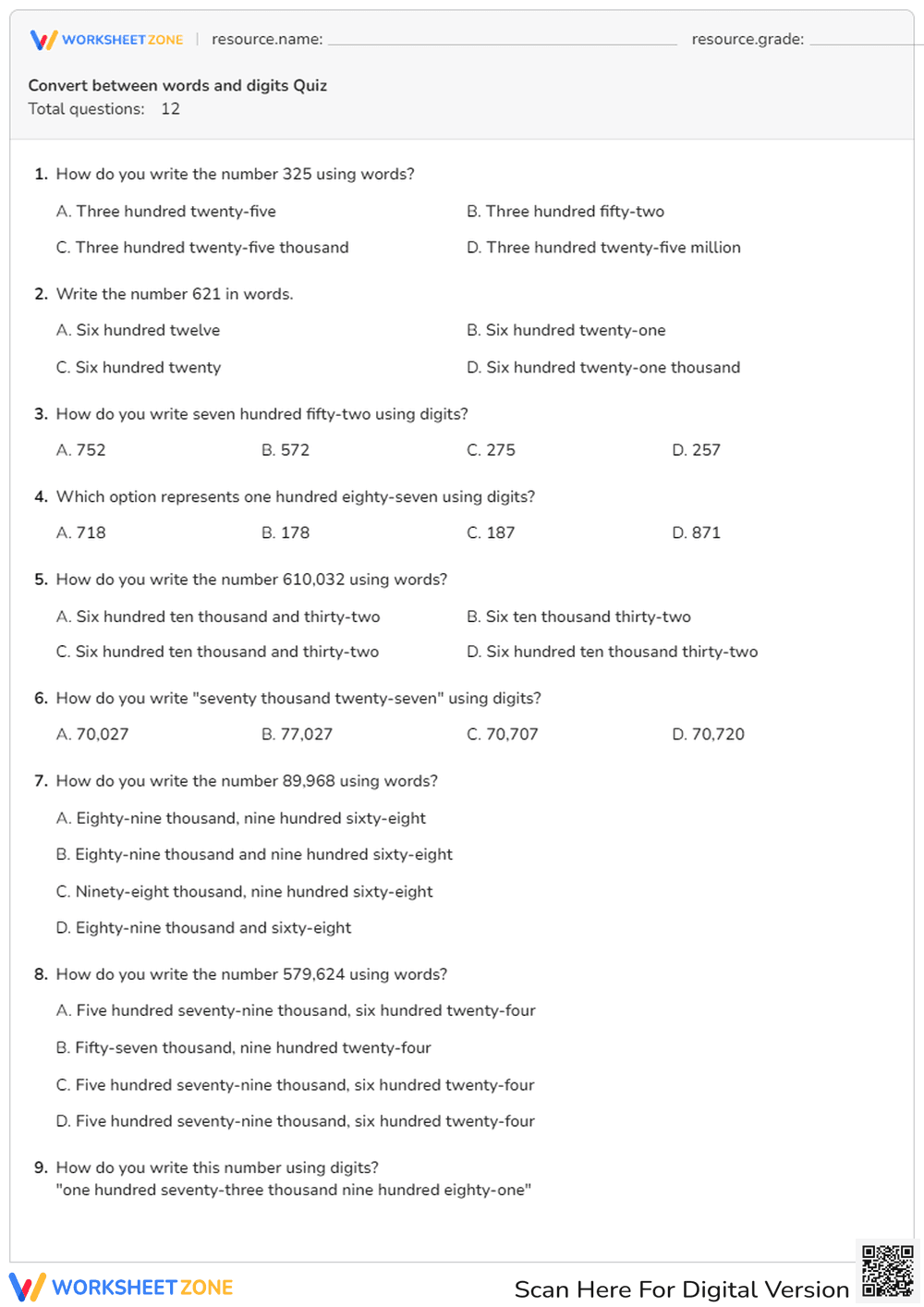
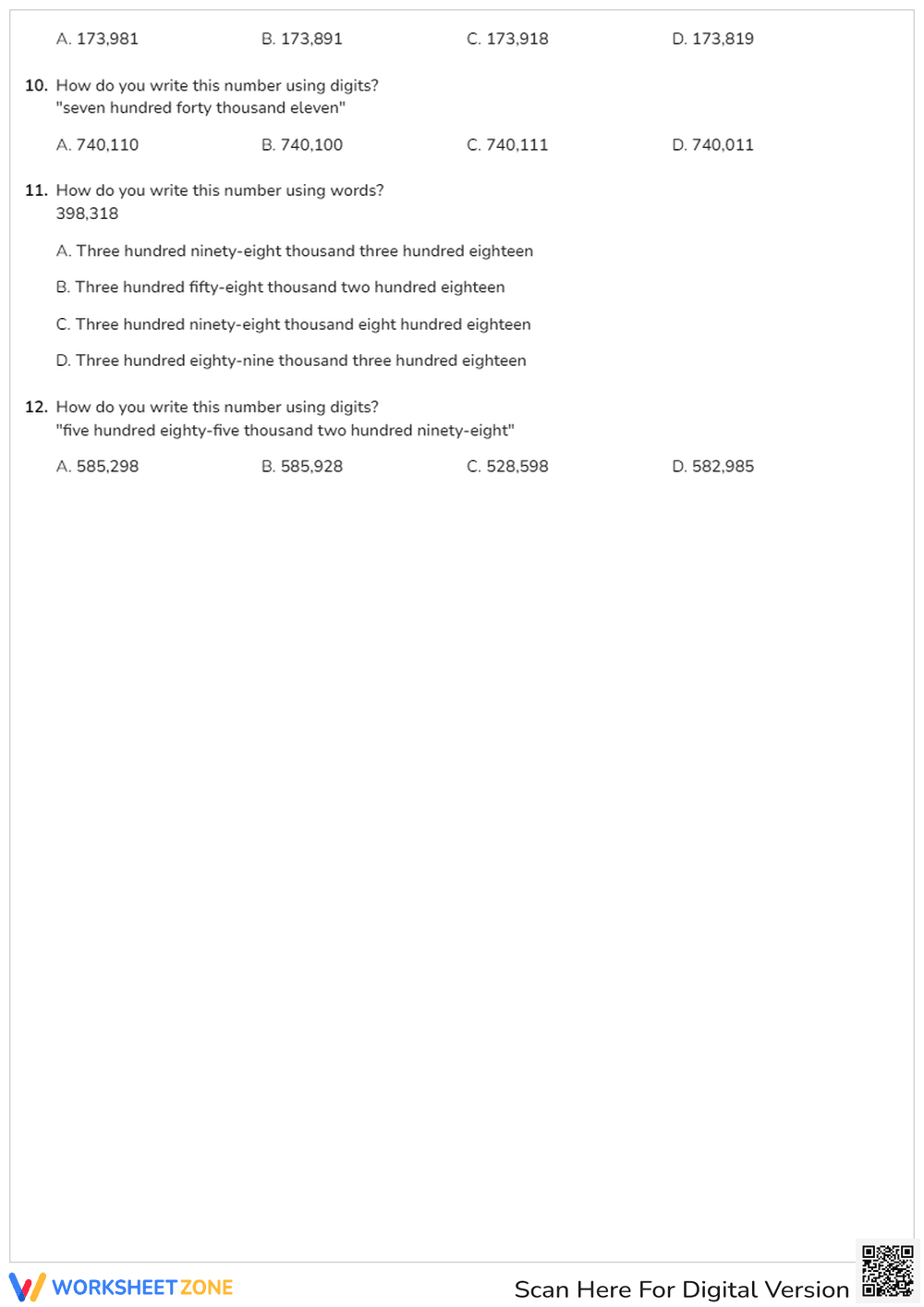

Grade 4 Words and Digits — Printable No-Prep Worksheet
Paste this activity's link or code into your existing LMS (Google Classroom, Canvas, Teams, Schoology, Moodle, etc.).
Students can open and work on the activity right away, with no student login required.
You'll still be able to track student progress and results from your teacher account.
This Grade 4 math worksheet provides immediate, focused practice on converting multi-digit numbers between word form and standard form. Translating written phrases into base-ten numerals solidifies foundational place value skills and builds numerical fluency for advanced arithmetic.
At a Glance
- Grade: 4 · Subject: Math
- Standard:
CCSS.MATH.CONTENT.4.NBT.A.2— Read and write multi-digit whole numbers- Skill Focus: Converting between words and digits
- Format: 2 pages · 12 problems · Answer key included · PDF
- Best For: Formative assessment and independent practice
- Time: 15–20 minutes
Inside this resource, educators will find a streamlined, two-page multiple-choice quiz featuring 12 targeted questions. The layout is clean, presenting numbers up to the hundred thousands. Students select the correct standard digit format for a written number name, and vice versa. A complete answer key ensures rapid grading.
Zero-Prep Workflow
This assessment requires under two minutes of total teacher prep time, making it ideal for emergency sub plans.
- Print (1 minute): Simply download the PDF and print the two-page student assessment alongside the single-page answer key.
- Distribute (1 minute): Hand out the worksheets as a warm-up, exit ticket, or independent center activity without needing any additional setup.
- Review (3 minutes): Use the provided answer key to quickly score the 12 multiple-choice questions, instantly identifying which students need intervention.
Standards Alignment
This worksheet aligns to CCSS.MATH.CONTENT.4.NBT.A.2: Read and write multi-digit whole numbers using base-ten numerals, number names, and expanded form. It isolates a critical component of fourth-grade place value mastery. Both standard codes can be copied directly into lesson plans, IEP goals, or district curriculum mapping tools.
How to Use It
This quiz functions perfectly as a formative assessment after direct instruction on place value. Teachers can assign it as independent seatwork while pulling small groups. Observation tip: watch for students who select distractors with missing place value zeros; this indicates a need to review place value charts. Expected completion time is 15 to 20 minutes.
Who It's For
Designed for fourth-grade students, this also serves as review material for fifth graders needing place value reinforcement. The multiple-choice format provides scaffolding for students who struggle with spelling number words, making it accessible. It pairs naturally with a classroom place value anchor chart.
Mastering the translation between verbal and symbolic number representations is a critical milestone in elementary mathematics. According to a recent EdReports 2024 analysis of foundational math curricula, explicit practice with multiple number forms significantly improves students' overall conceptual understanding of base-ten systems. This worksheet directly supports CCSS.MATH.CONTENT.4.NBT.A.2 by requiring students to read and write multi-digit whole numbers accurately across different formats. When learners repeatedly convert between words and digits, they strengthen the cognitive pathways necessary for advanced mathematical reasoning and complex problem-solving. The multiple-choice structure of this 12-question assessment not only provides immediate data on student comprehension but also exposes learners to common place-value misconceptions through carefully designed distractors. By integrating this targeted practice into regular classroom instruction, educators can ensure students build the robust numerical fluency required for success in upper elementary mathematics and beyond.


