




























Views
Downloads



Printable Homographs Worksheet | Grade 3 ELA

Paste this activity's link or code into your existing LMS (Google Classroom, Canvas, Teams, Schoology, Moodle, etc.).
Students can open and work on the activity right away, with no student login required.
You'll still be able to track student progress and results from your teacher account.
This comprehensive worksheet helps third graders master context-dependent homographs by using surrounding words to determine correct meanings. Students will analyze multiple-meaning words in various sentences, strengthening their vocabulary and reading comprehension skills through targeted, engaging practice that builds confidence in decoding tricky vocabulary.
At a Glance
- Grade: 3 · Subject: ELA
- Standard:
CCSS.ELA-LITERACY.L.3.4.A— Use sentence context to determine word meaning- Skill Focus: Homographs and Context Clues
- Format: 4 pages · 14 problems · Answer key included · PDF
- Best For: Independent practice and vocabulary building
- Time: 20–30 minutes
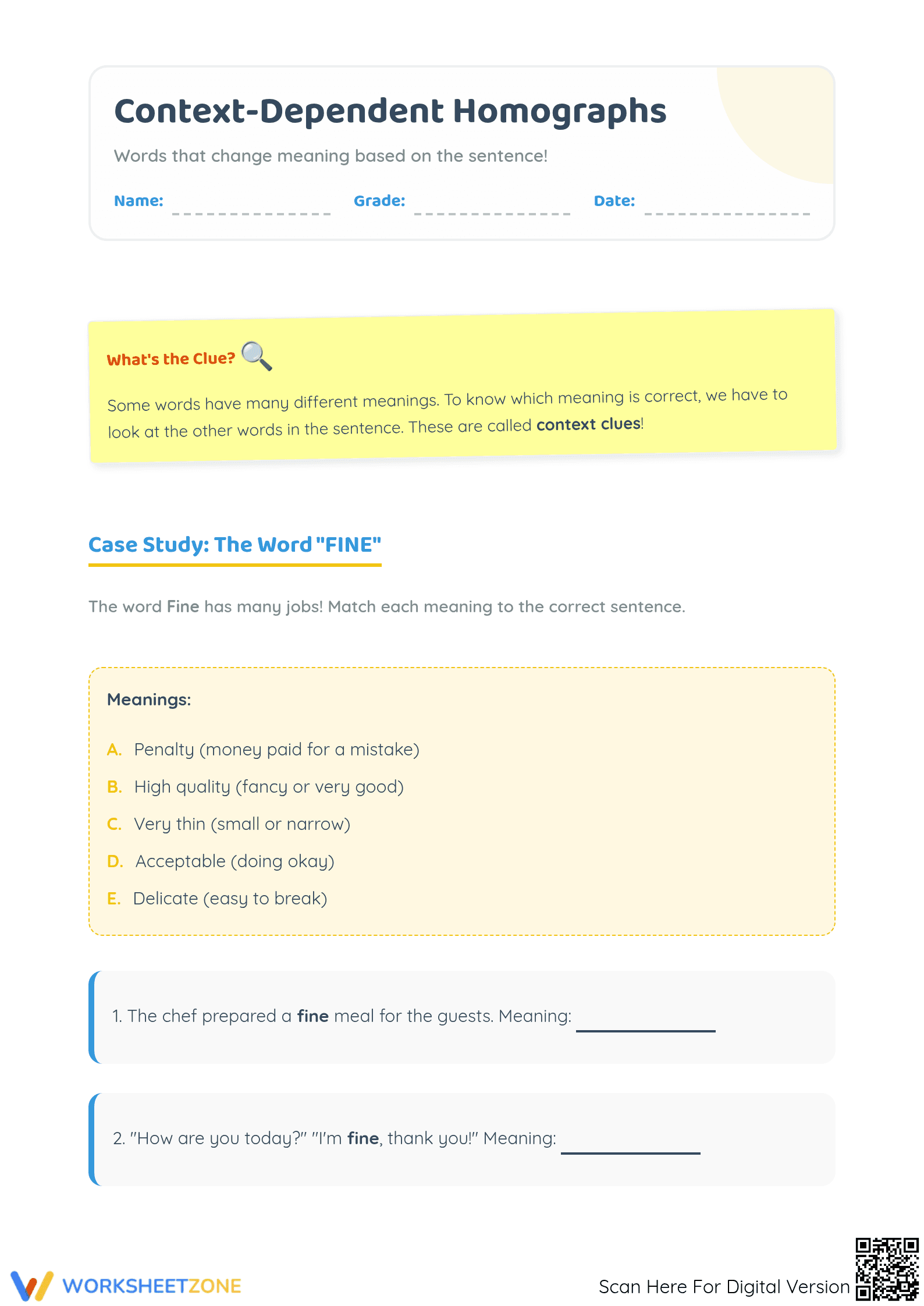
This four-page resource features four distinct sections designed to systematically build vocabulary skills. It includes a matching "Case Study" on the word "fine," a multiple-choice "Context Detective" section, a creative "Write Your Own" sentence generation task, and a final "Multiple Meaning Challenge" where students write out definitions based on context. A complete four-page answer key is provided for quick grading.
- Guided practice: The first section introduces the concept with a specific case study, providing five explicit definitions for a single word and asking students to match them to heavily contextualized sentences.
- Supported practice: The middle sections transition to multiple-choice questions and a word bank, offering structured choices that help students identify correct meanings without generating them from scratch.
- Independent practice: The final challenge requires students to independently read a sentence and write out the meaning of the underlined homograph using their own words.
This gradual-release approach ensures students build confidence before tackling the more rigorous independent tasks.
This resource is directly aligned to CCSS.ELA-LITERACY.L.3.4.A, requiring students to use sentence-level context as a clue to the meaning of a word or phrase. It also supports broader vocabulary acquisition goals by exposing learners to common homographs. Both standard codes can be copied directly into lesson plans, IEP goals, or district curriculum mapping tools.
Deploy this worksheet during your literacy block after a mini-lesson on multiple-meaning words. It works exceptionally well as a primary independent practice activity while the teacher pulls small groups. Alternatively, assign the first two pages as classwork and the final two pages as meaningful homework. While students work, observe how they underline or circle context clues in the sentences—this provides excellent formative assessment data on their active reading strategies. Expect students to complete the full packet in 20 to 30 minutes.
This resource is ideal for third-grade general education students, as well as fourth graders needing a foundational review of context clues. The clear layout and segmented tasks make it highly accessible for students with accommodations who benefit from chunked assignments. Pair this worksheet with a classroom anchor chart on homographs or a read-aloud focused on wordplay to reinforce the concepts.
Mastering multiple-meaning words is a critical component of reading comprehension in the elementary grades. This resource aligns with CCSS.ELA-LITERACY.L.3.4.A, focusing on the ability to use sentence context to determine word meaning. According to Fisher & Frey (2014), explicit vocabulary instruction that emphasizes context clues significantly improves students' ability to independently decode complex texts. When learners practice identifying homographs in varied sentences, they develop cognitive flexibility and a deeper understanding of syntax. This targeted practice moves students beyond rote memorization, equipping them with the analytical tools necessary for advanced literacy tasks. By integrating structured exercises that require students to justify their word choices based on surrounding text, educators can foster more resilient and adaptable readers who are prepared for the rigorous demands of upper elementary reading assessments.


