


























Views
Downloads



Printable Consonant Letter Cards | Kindergarten ELA
Paste this activity's link or code into your existing LMS (Google Classroom, Canvas, Teams, Schoology, Moodle, etc.).
Students can open and work on the activity right away, with no student login required.
You'll still be able to track student progress and results from your teacher account.
This printable Kindergarten consonant worksheet set builds foundational phonics skills by pairing lowercase letters with clear initial-sound illustrations. Students practice letter recognition and letter-sound correspondence across multiple pages of interactive mats. This resource ensures early readers establish the core phonetic connections necessary for decoding words and developing early literacy confidence.
At a Glance
- Grade: Kindergarten · Subject: English Language Arts (ELA)
- Standard:
CCSS.ELA-LITERACY.RF.K.3.A— Associate lowercase consonant letters with their primary phonetic sounds.- Skill Focus: Initial consonant sounds and letter recognition
- Format: 4 pages · 20 problems · Visual cues included · PDF
- Best For: Small group phonics and literacy centers
- Time: 10–15 minutes
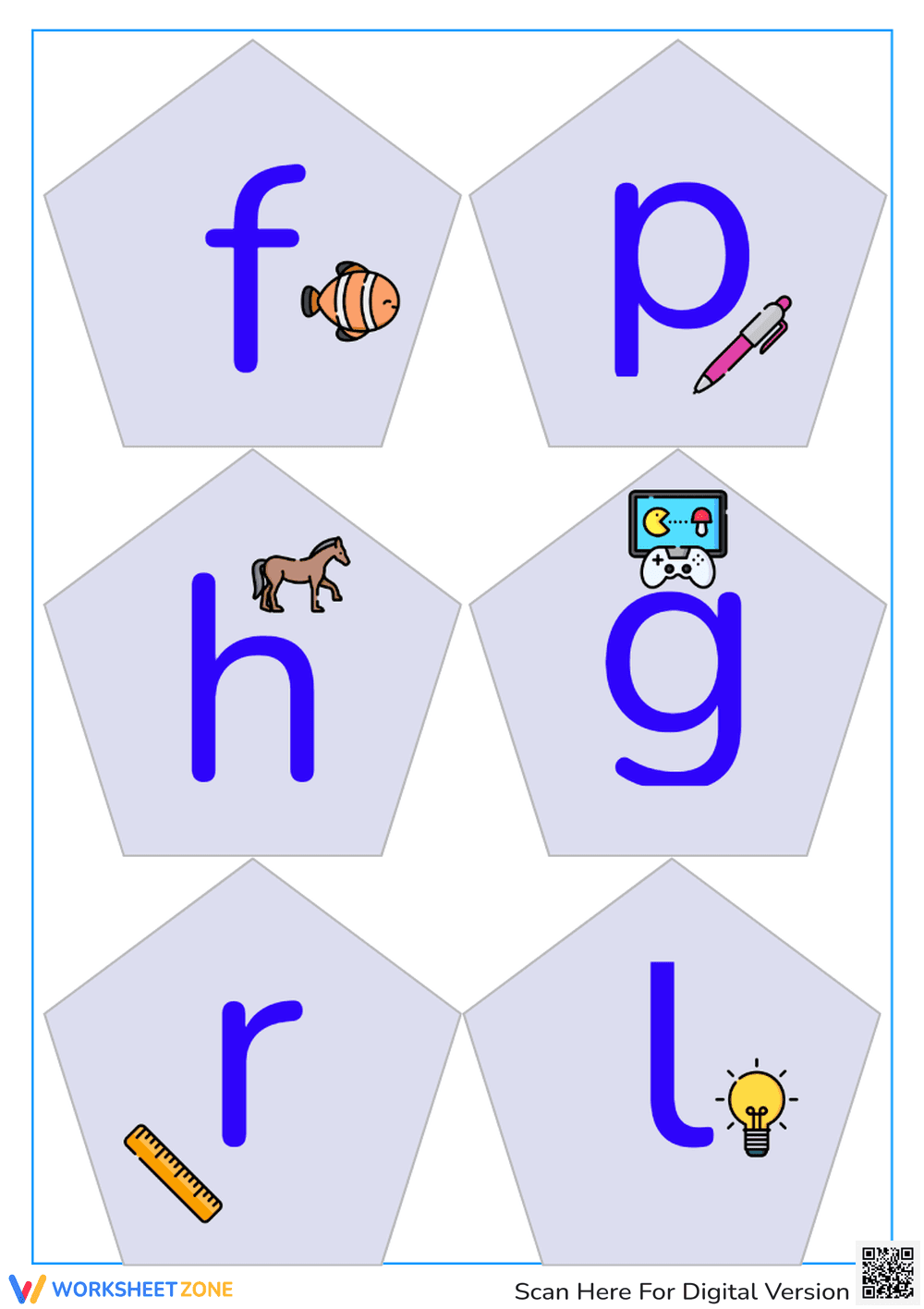
This comprehensive resource contains 4 pages featuring 20 distinct pentagonal letter mats. Each mat highlights a specific lowercase consonant in a bold, high-contrast blue font, accompanied by a colorful, kid-friendly icon representing the corresponding initial sound. Featured pairings include 'm' for music, 'b' for bird, and 'z' for zipper. The clean layout minimizes visual clutter, making it highly accessible for young learners.
Zero-Prep Classroom Workflow
This resource is engineered for immediate deployment with zero teacher preparation. First, print the 4 pages in under 1 minute. Second, distribute the sheets directly to students as mats, or cut along borders in less than 2 minutes to create flashcards. Third, review the letter sounds during center rotations. This efficient setup makes the collection an excellent option for emergency substitute plans.
Standards Alignment
This activity aligns directly with the Common Core State Standard CCSS.ELA-LITERACY.RF.K.3.A, which requires students to demonstrate basic knowledge of one-to-one letter-sound correspondences by producing the primary sound for each consonant. Additionally, it supports uppercase and lowercase letter identification goals. Both standard codes can be copied directly into lesson plans, IEP goals, or district curriculum mapping tools.
How to Use It
Incorporate these mats during small-group direct instruction immediately after introducing a new letter sound. Have students place a counter on the card as they vocalize the letter name and its corresponding picture sound. For a formative assessment observation, watch whether students can independently identify the initial sound of the icon without teacher prompting, noting any confusion between similar letter shapes like 'b' and 'd'. This targeted intervention requires approximately 10 to 15 minutes.
Who It's For
This resource is tailored specifically for Kindergarten students, English language learners, and older students receiving tier-two reading interventions. The clear visual scaffolds benefit pre-readers who require explicit phonetic reinforcement. Pair these cards naturally with an alphabet anchor chart or a shared reading text to maximize instructional impact during daily literacy blocks.
According to foundational reading research compiled by Fisher & Frey (2014), explicit instruction pairing visual icons with graphemes significantly accelerates letter-sound correspondence in early childhood education. This 4-page printable resource operationalizes that evidence-based approach by providing 20 structured consonant cards that align with CCSS.ELA-LITERACY.RF.K.3.A. By isolating individual lowercase consonants alongside clear initial-sound graphics, the material helps young learners build the phonemic awareness necessary for future decoding success. The clean, distraction-free design supports cognitive load management, ensuring that Kindergarten students focus entirely on the target phonetic relationship. Teachers can confidently integrate these mats into daily phonics routines, small-group interventions, or independent literacy centers to track student progress, manage classroom workflows efficiently, and achieve measurable benchmarks in early reading development across the entire academic school year.


