


























Views
Downloads


Essential Conservation of Energy Worksheet
Paste this activity's link or code into your existing LMS (Google Classroom, Canvas, Teams, Schoology, Moodle, etc.).
Students can open and work on the activity right away, with no student login required.
You'll still be able to track student progress and results from your teacher account.
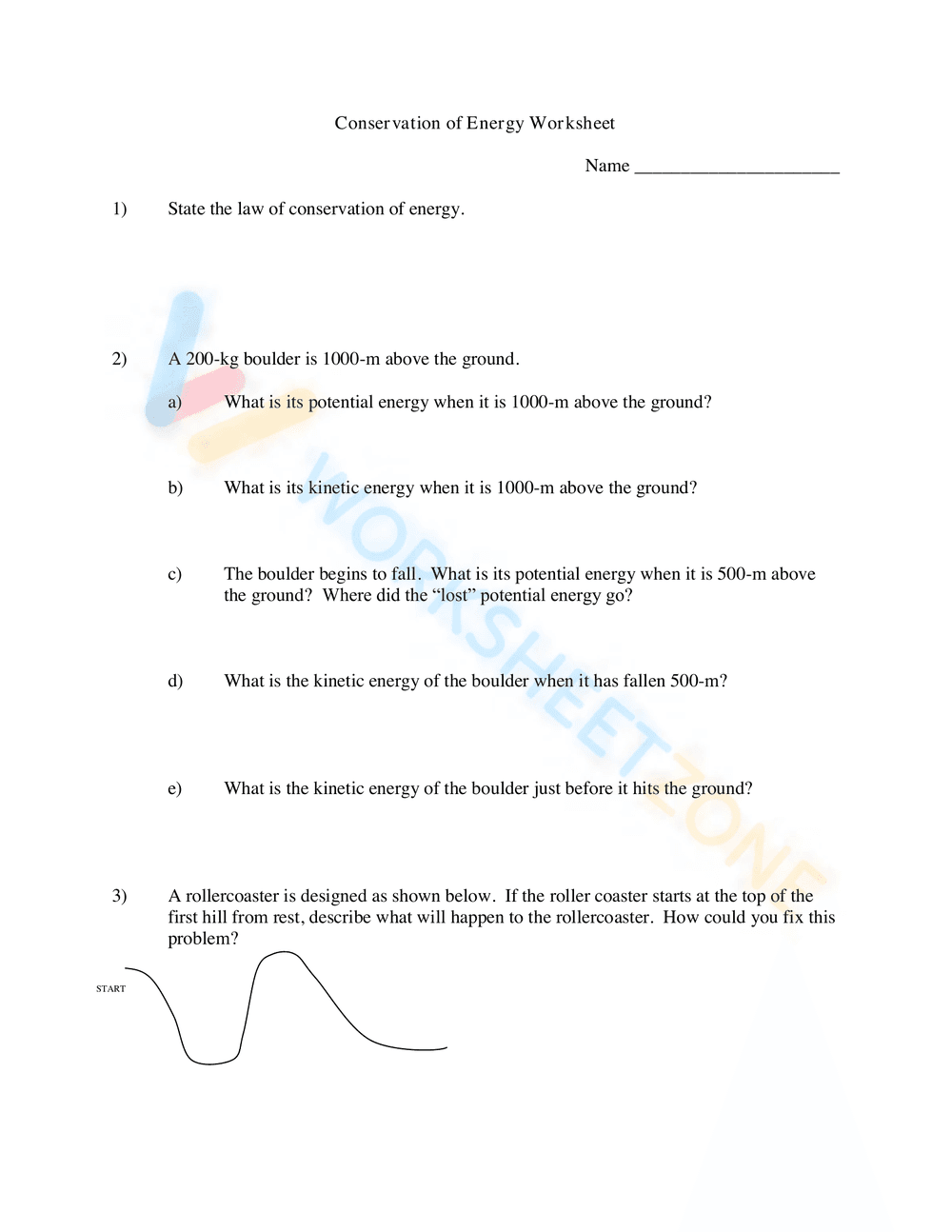
This comprehensive science resource helps students master the fundamental principles of physics by examining how energy transforms within closed systems. Students will apply the law of conservation of energy to real-world scenarios, calculating potential and kinetic energy shifts while identifying where energy is transferred as heat or sound. This practice ensures students move beyond rote memorization to true conceptual application.
At a Glance
- Grade: 6-7 · Subject: Science
- Standard:
MS-PS3-5— Explain how energy transfers between kinetic and potential states in systems- Skill Focus: Energy Transformation
- Format: 2 pages · 15 problems · Answer key included · PDF
- Best For: Independent practice or sub plans
- Time: 35–45 minutes
The worksheet contains 15 distinct tasks spread across two pages, featuring a mix of quantitative calculations and qualitative conceptual questions. Students interact with diverse models, including a falling boulder, a designed rollercoaster track, a stretching slingshot, and a swinging pendulum. The layout provides ample white space for calculations and includes a full answer key for rapid grading or student self-correction.
This resource follows a zero-prep workflow designed for busy educators. First, print the two-page PDF (30 seconds). Second, distribute the sheets to students for independent or partner work (1 minute). Third, review the results using the provided answer key to identify common misconceptions regarding energy "loss" versus energy transfer (5 minutes). This sequence requires less than two minutes of active teacher preparation time, making it an ideal choice for emergency sub plans or supplemental Friday practice.
The primary alignment for this activity is MS-PS3-5: "Construct, use, and present arguments to support the claim that when the kinetic energy of an object changes, energy is transferred to or from the object." The worksheet specifically addresses the transfer of energy to the environment through heat and sound during collisions and friction. This standard code can be copied directly into lesson plans, IEP goals, or district curriculum mapping tools.
To use this effectively, assign it after an introductory lesson on potential and kinetic energy formulas. It serves as an excellent formative assessment during the "You Do" phase of a gradual release model. While students work, circulate and observe if they correctly identify that the total energy remains constant even when the object's height or speed changes. Expect most middle school students to complete the full set within a single 45-minute class period.
This worksheet is designed for general education science students in grades 6 through 7, though it provides excellent review for 8th graders preparing for state assessments. It pairs naturally with a classroom pendulum demonstration or a digital simulation of a skate park. For students requiring extra support, consider providing the formulas for gravitational potential energy and kinetic energy on the whiteboard.
According to Fisher & Frey (2014), the use of scaffolded word problems in physics helps bridge the gap between abstract mathematical formulas and observable physical phenomena. This worksheet applies that research by requiring students to explain the "why" behind energy changes in 15 specific tasks. By focusing on MS-PS3-5, the resource targets the middle school requirement for students to track energy flow through a system. The inclusion of friction-based energy transfer (heat and sound) aligns with modern science standards that move away from idealized, frictionless environments. This approach ensures that students develop a sophisticated understanding of the law of conservation of energy that remains applicable in high school physics courses. The structured format allows for easy data collection for progress monitoring or standard-based grading systems.


