


























Views
Downloads

Essential Compound Words Worksheet | Grade 2 Printable
Paste this activity's link or code into your existing LMS (Google Classroom, Canvas, Teams, Schoology, Moodle, etc.).
Students can open and work on the activity right away, with no student login required.
You'll still be able to track student progress and results from your teacher account.
Mastering compound words is a fundamental step in building vocabulary and reading fluency for young learners. This printable worksheet provides a structured yet engaging way for students to practice deconstructing and reconstructing words. By focusing on identifying root words within compounds, students improve their ability to decode unfamiliar texts and expand their expressive language.
At a Glance
- Grade: 2 · Subject: Vocabulary
- Standard:
CCSS.ELA-LITERACY.L.2.4.D— Use individual word meanings to predict the meaning of a compound word- Skill Focus: Compound Word Construction
- Format: 1 page · 20 problems · Answer key included · PDF
- Best For: Independent practice or literacy centers
- Time: 15–20 minutes
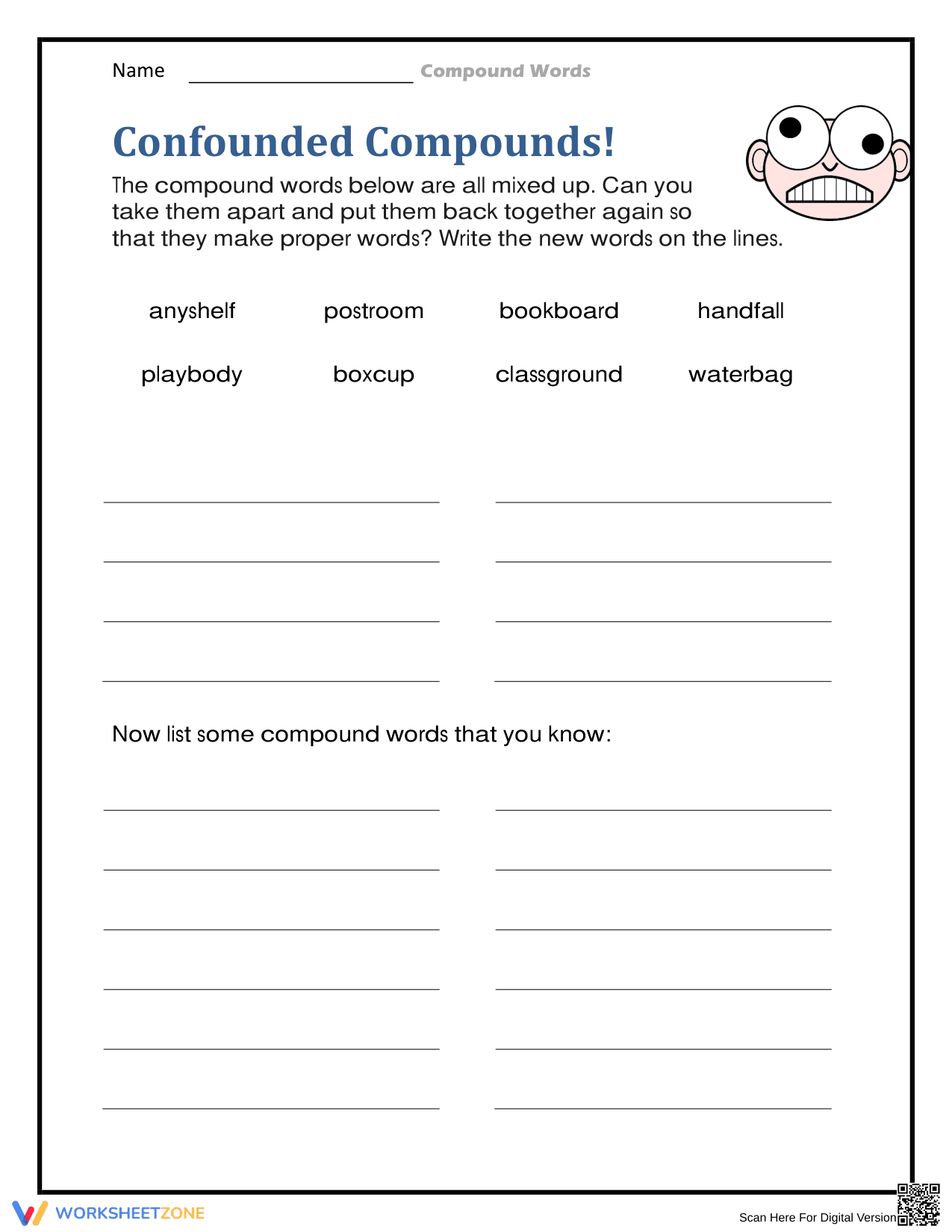
This resource features two sections to maximize student engagement. The first half has eight "confounded" compound words where the components have been swapped, challenging students to deconstruct and reconstruct them correctly. The second half provides twelve lines for students to brainstorm and list compound words from their own prior knowledge or classroom environment.
The zero-prep workflow for this resource is designed for maximum efficiency in a busy classroom. First, print the single-page PDF (30 seconds). Next, distribute the worksheets during your literacy block or as a transition activity (1 minute). Finally, review the answers as a whole group using the included answer key (2 minutes). This makes it an ideal choice for emergency sub plans or quick assessments.
Primary alignment is to CCSS.ELA-LITERACY.L.2.4.D, which requires students to use knowledge of the meaning of individual words to predict the meaning of a compound word. This worksheet directly supports this by forcing students to isolate individual lexemes before recombining them correctly. Both standard codes can be copied directly into lesson plans, IEP goals, or district curriculum mapping tools.
Use this worksheet during a morphology lesson for immediate application of the part-whole concept. For a formative assessment, observe students as they list words in the second section; those who struggle may need additional support with word walls. Completion typically takes between fifteen and twenty minutes depending on the student's level.
This resource is perfect for second graders, but works well for third-grade review or as a challenge for advanced first graders. It is particularly effective for English Language Learners who are studying how English combines words to create new meanings. Pair this with a compound word anchor chart for maximum instructional impact.
The Grade 2 Confounded Compounds worksheet is meticulously designed to support CCSS.ELA-LITERACY.L.2.4.D by engaging students in the morphological analysis of compound words. Research from Fisher & Frey (2014) emphasizes that structural analysis, such as deconstructing and reconstructing compound words, significantly enhances vocabulary acquisition and reading fluency in early elementary learners. By identifying individual word components (lexemes) and combining them to form new semantic units, students develop a deeper understanding of English language structure. This 20-task resource provides both structured scaffolding through word-fixing puzzles and open-ended cognitive challenge via a brainstorming section. Educational meta-analyses suggest that such dual-modality practice facilitates better retention of linguistic patterns than rote memorization. This worksheet serves as a high-utility tool for classroom teachers and literacy specialists aiming to meet rigorous standards while maintaining student engagement. It effectively bridges the gap between basic word recognition and complex morphological awareness, ensuring learners are prepared for higher-level reading comprehension tasks.


