


























Views
Downloads

Essential Composting Worksheet | Grade 1-3 Science
Paste this activity's link or code into your existing LMS (Google Classroom, Canvas, Teams, Schoology, Moodle, etc.).
Students can open and work on the activity right away, with no student login required.
You'll still be able to track student progress and results from your teacher account.
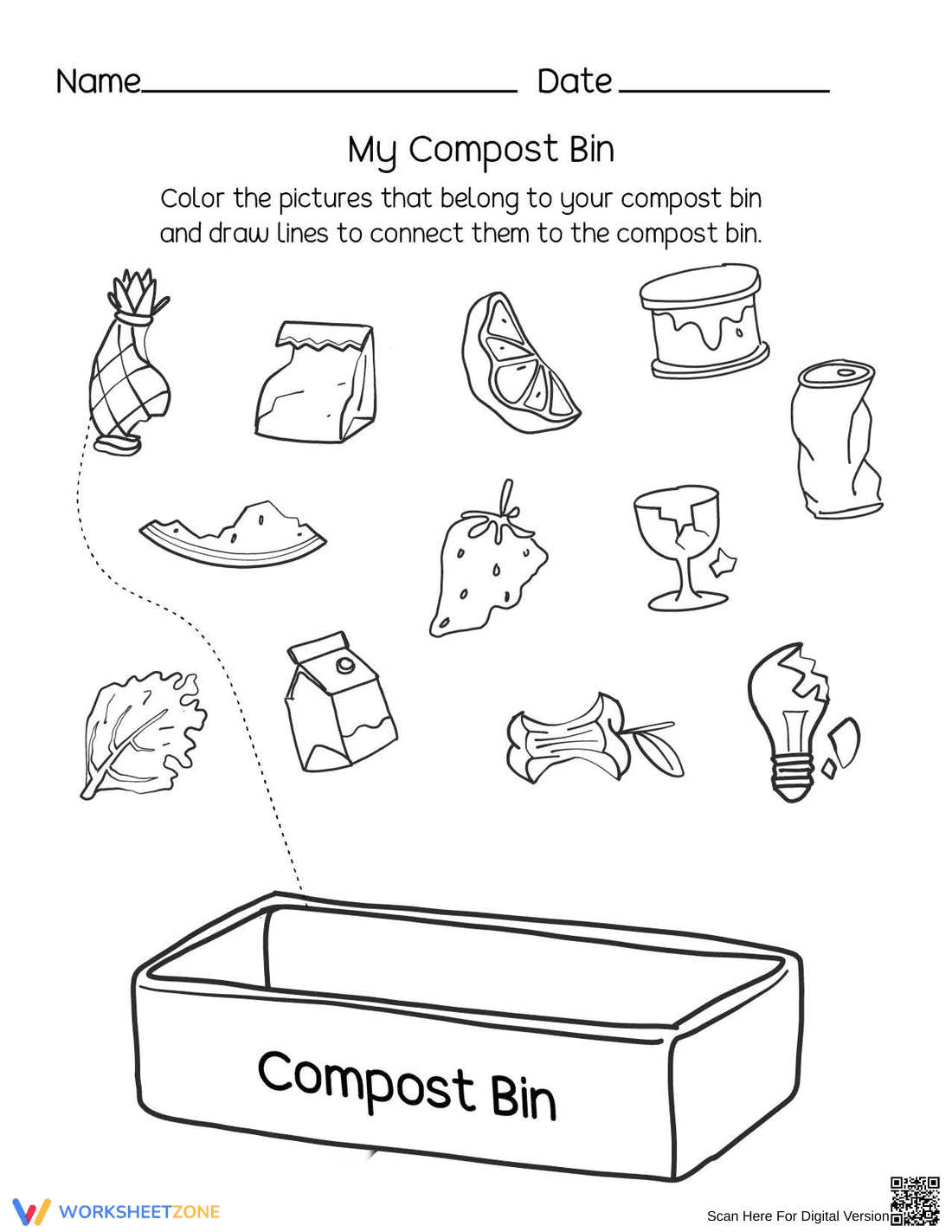
This essential science worksheet helps young learners master the fundamentals of composting through a hands-on sorting activity. Students identify which common household items belong in a compost bin, reinforcing their understanding of organic versus inorganic materials. By engaging with visual representations, students develop critical thinking skills for waste reduction.
At a Glance
- Grade: 1 · Subject: Science / Environment
- Standard:
K-ESS3-3— Communicate solutions that will reduce the impact of humans on the local environment- Skill Focus: Waste Sorting and Composting
- Format: 1 page · 12 problems · Answer key included · PDF
- Best For: Earth Day or Environmental Science units
- Time: 10–15 minutes
This single-page PDF features a clear, interactive layout titled "My Compost Bin." It contains 12 distinct illustrations of common waste products, including organic items like fruit rinds and leaves, and inorganic materials like soda cans. Students color the compostable items and draw lines to the central bin. A comprehensive answer key is provided to facilitate quick grading and student self-correction.
This classroom-ready resource ensures a teacher prep time of under 2 minutes. Print the copies (30 seconds), then distribute and briefly explain the difference between organic materials that break down and inorganic items (60 seconds). Allow students to work independently to complete the connections. This workflow is perfect for busy educators, substitute plans, or as a quick transition activity between science blocks.
The activity is directly aligned with `K-ESS3-3`, focusing on solutions for reducing human impact on the environment. Students explore sustainable waste management practices that protect local resources. This standard code can be copied directly into lesson plans, IEP goals, or district curriculum mapping tools.
Use this as an introductory hook before a lesson on decomposition. It also serves as a formative assessment tool; observe if students correctly exclude the tin cans and glass from the bin to gauge mastery. Expect a completion time of 12 minutes. The task combines fine motor practice with conceptual science, making it a versatile addition to any environmental unit.
This resource is optimized for Grade 1 through Grade 3 students, particularly visual learners. Simple instructions and clear icons make it accessible for English Language Learners. It pairs naturally with a classroom compost bin demonstration or a reading passage about recycling to provide a complete instructional loop, supporting diverse learner needs in a standard classroom setting.
Research from the RAND AIRS 2024 report highlights that early exposure to environmental stewardship activities significantly increases long-term ecological literacy. By engaging with concrete tasks like the `K-ESS3-3` aligned sorting exercise, children transition from abstract concepts to specific, actionable behaviors. Fisher & Frey (2014) emphasize that such scaffolds allow students to build the foundational knowledge necessary for complex ecological systems analysis. This worksheet provides the structured practice required to meet national standards while fostering a sense of agency in young learners regarding their environmental footprint. Including 12 distinct items ensures a sufficient breadth of examples to move beyond rote memorization toward conceptual understanding of organic breakdown. This approach aligns with best practices in science education, ensuring students can identify biodegradable materials in real-world contexts.


