


























Views
Downloads

Composing Rectangles Worksheet | Grade 2 Math Printable
Paste this activity's link or code into your existing LMS (Google Classroom, Canvas, Teams, Schoology, Moodle, etc.).
Students can open and work on the activity right away, with no student login required.
You'll still be able to track student progress and results from your teacher account.
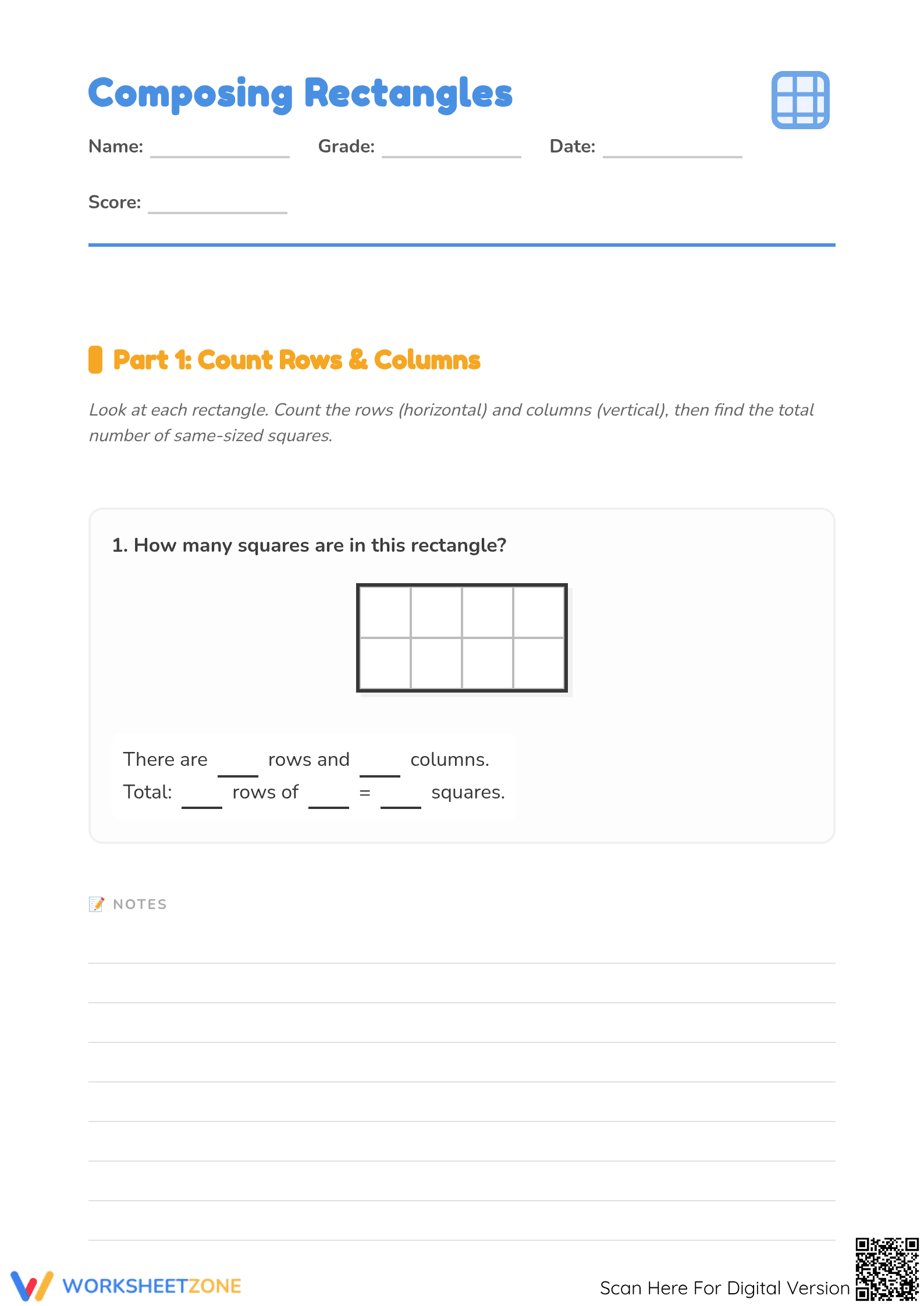
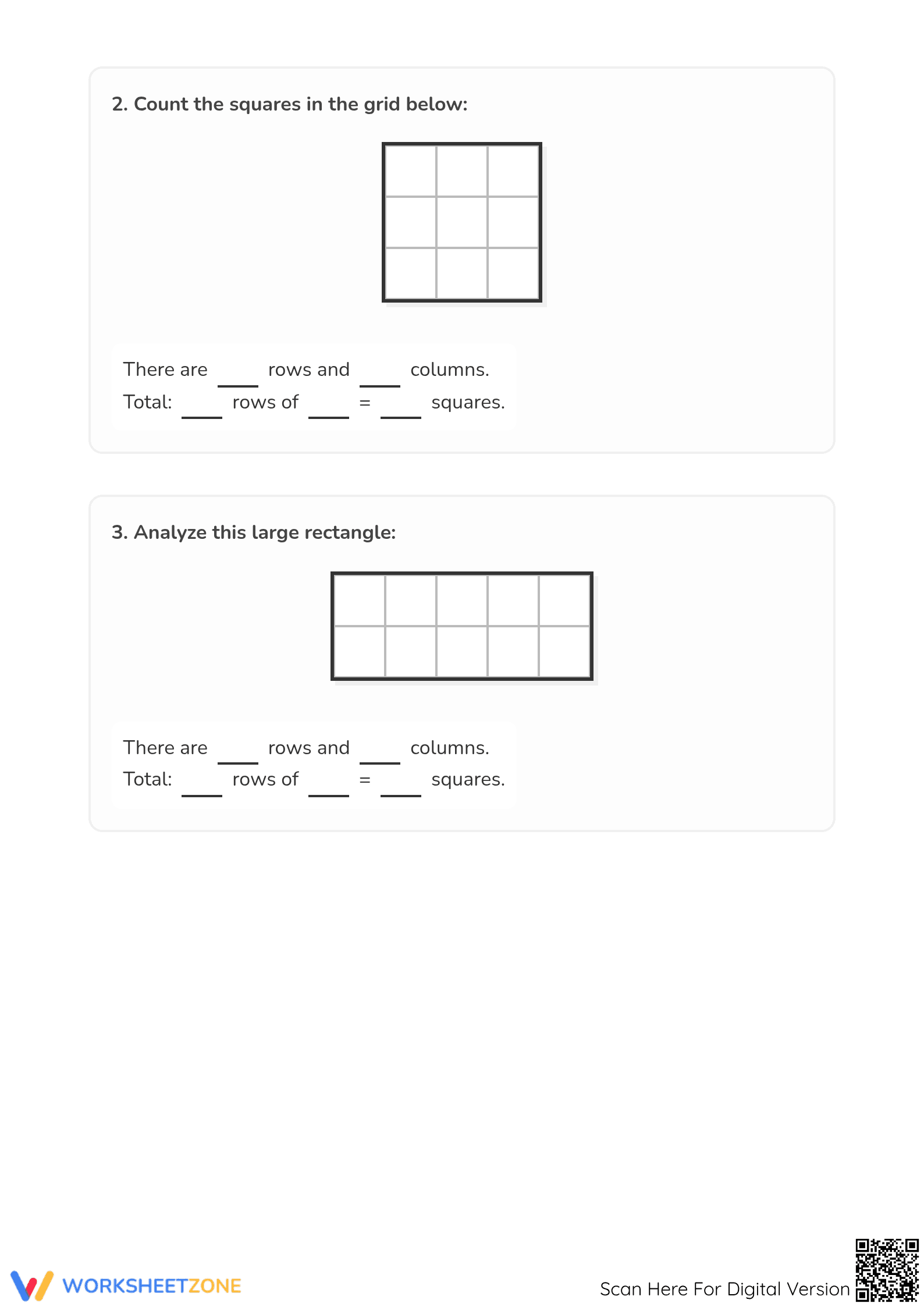
This Grade 2 math worksheet helps students master composing and decomposing rectangles. By partitioning shapes into rows and columns of same-size squares, learners build essential spatial reasoning and early multiplication concepts. The structured format ensures students confidently transition from counting visible squares to drawing their own grids.
At a Glance
- Grade: 2 · Subject: Math
- Standard:
CCSS.MATH.CONTENT.2.G.A.2— Partition rectangles into rows and columns and count squares- Skill Focus: Composing and partitioning rectangles
- Format: 5 pages · 10 problems · Answer key included · PDF
- Best For: Independent practice and skill building
- Time: 20–30 minutes
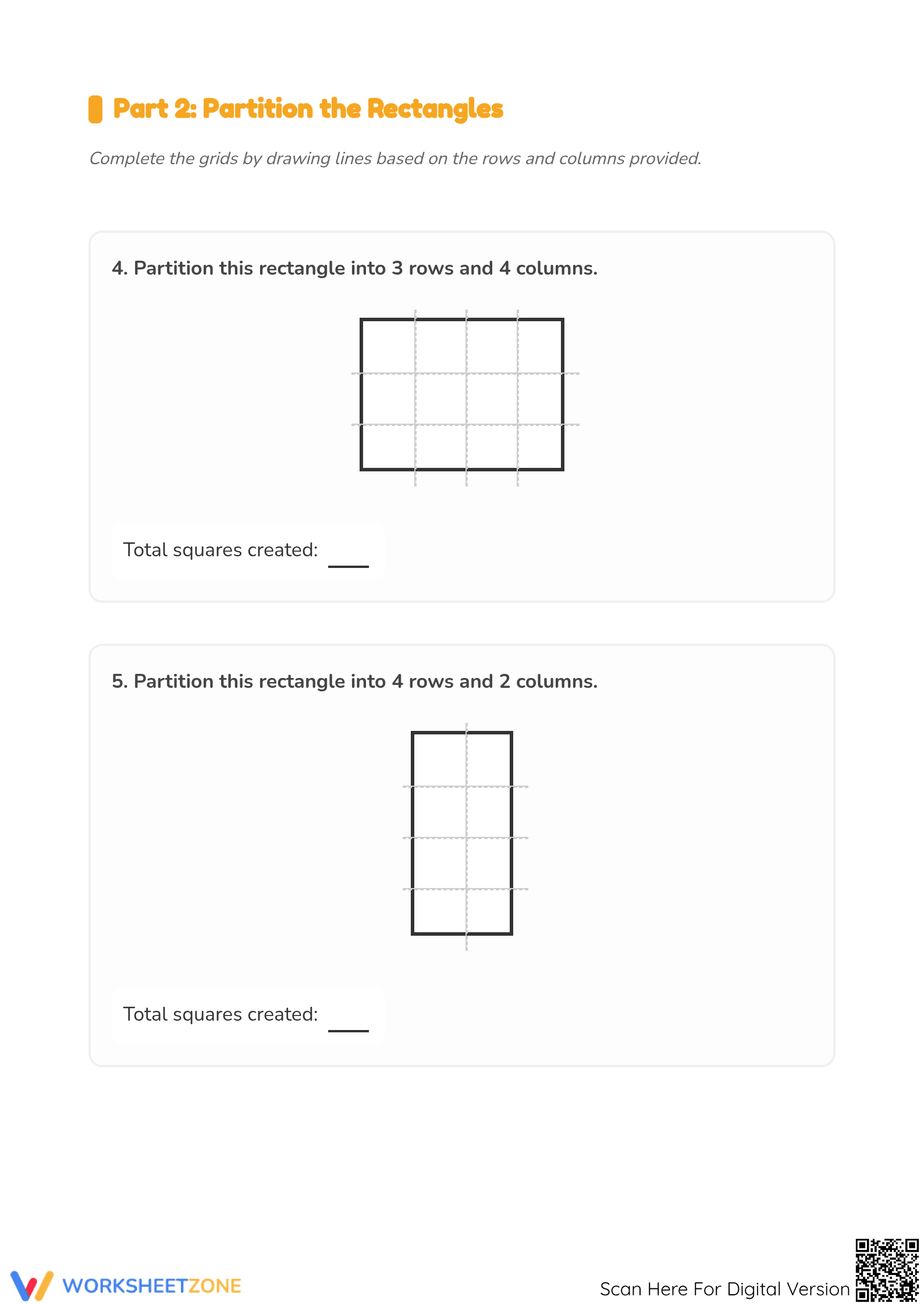
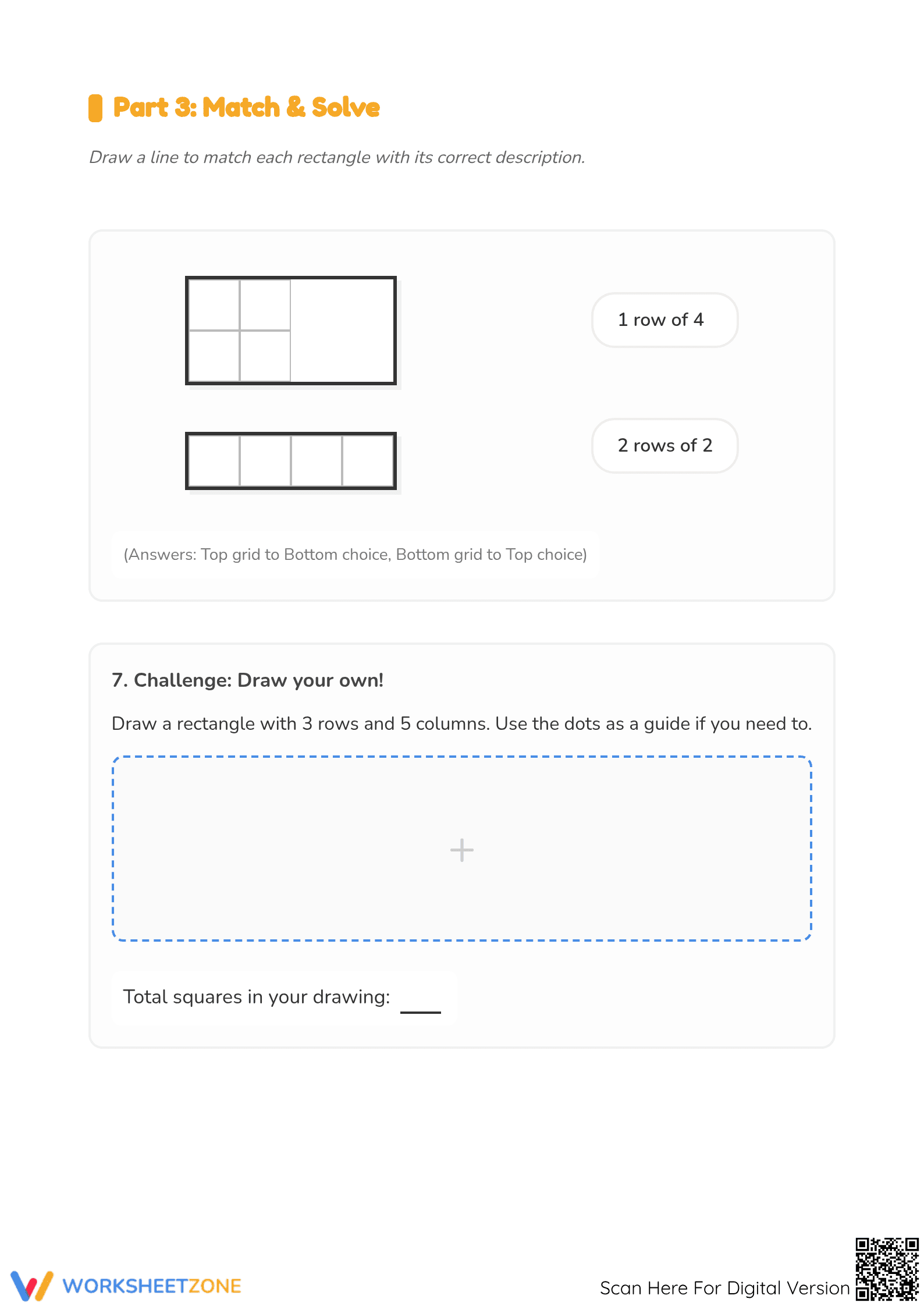
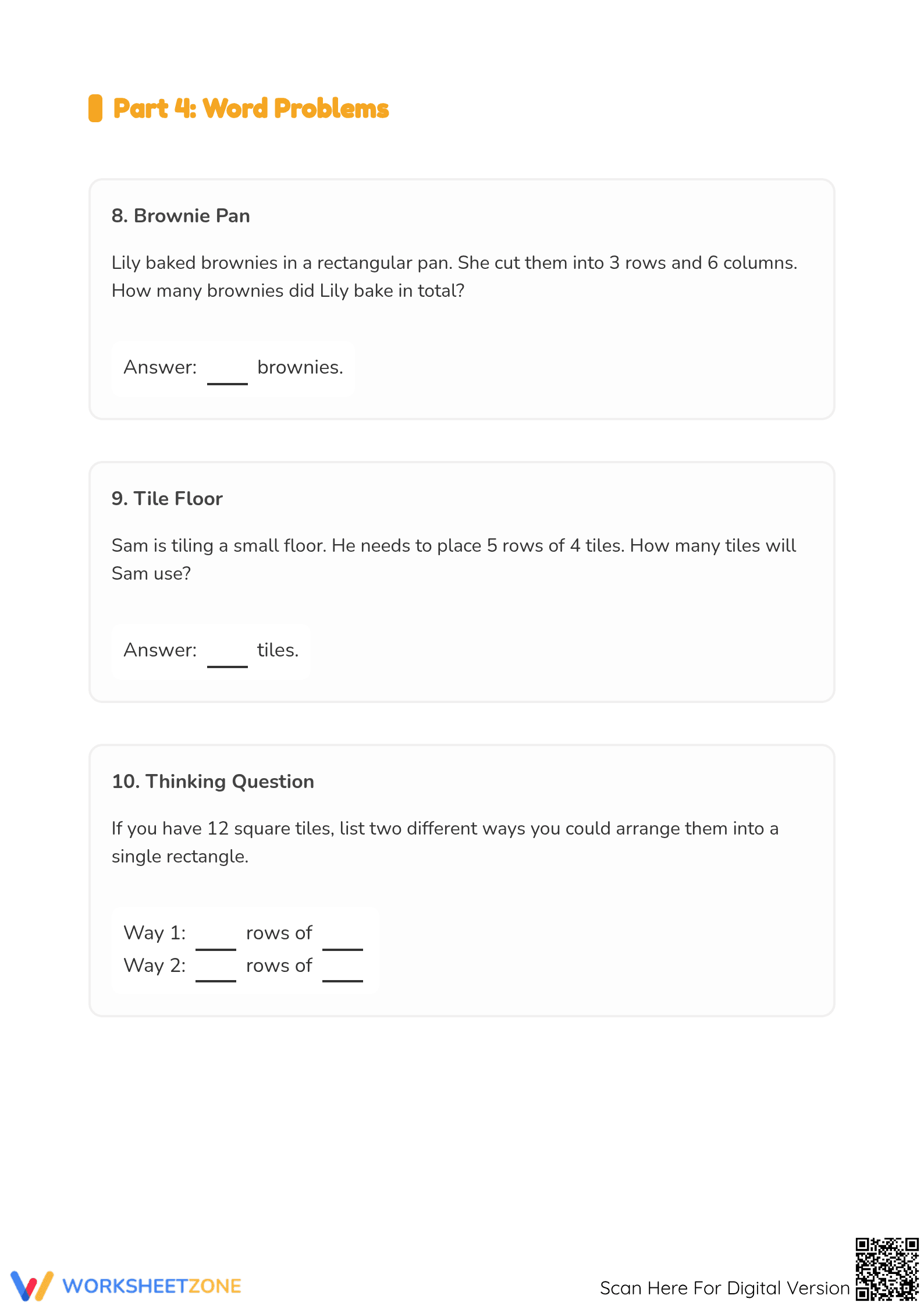
This five-page packet features 10 carefully sequenced problems divided into four distinct parts. Students begin by counting rows and columns in pre-drawn grids, move on to partitioning blank rectangles based on given dimensions, solve matching challenges, and finally apply their knowledge to real-world word problems. A complete answer key is provided for quick and accurate grading.
Skill Progression
- Guided practice: The first three problems provide fully drawn grids where students simply identify the number of rows, columns, and total squares, building initial confidence.
- Supported practice: The next set of tasks requires students to draw their own partition lines inside blank rectangles using provided row and column counts.
- Independent practice: The final sections challenge learners with word problems and open-ended drawing tasks, such as finding two different ways to arrange 12 square tiles.
This gradual-release approach perfectly models the "I Do, We Do, You Do" instructional framework.
Standards Alignment
This resource is directly aligned to CCSS.MATH.CONTENT.2.G.A.2, requiring students to partition a rectangle into rows and columns of same-size squares and count them. It also lays groundwork for third-grade area standards. Both standard codes can be copied directly into lesson plans or district curriculum mapping tools.
How to Use It
Deploy this worksheet during independent practice after a whole-group lesson on 2D shapes and arrays. It also works exceptionally well as a math center activity where students can use physical square tiles to build the rectangles before drawing them on the page. As a formative assessment tip, watch how students draw their partition lines in Part 2; uneven spacing often indicates a need for more hands-on practice with manipulatives. Expect students to complete the packet in 20 to 30 minutes.
Who It's For
This resource is designed for second-grade general education students, though it serves as excellent remediation for third graders struggling with the concept of area. The clear visual boundaries and step-by-step progression make it highly accessible for visual learners and students requiring structured scaffolding. Pair this worksheet with physical manipulatives like color tiles or a direct instruction lesson on early arrays.
Mastering the ability to partition rectangles into rows and columns and count squares is a critical stepping stone between early geometry and foundational multiplication. Aligned with CCSS.MATH.CONTENT.2.G.A.2, this specific skill helps young learners transition smoothly from additive counting to multiplicative reasoning. According to EdReports 2024, instructional materials that explicitly connect spatial structuring—such as drawing grids and counting identical squares—to numerical operations significantly improve students' conceptual understanding of area in later grades. When learners physically or visually divide a two-dimensional space into equal units, they develop the essential spatial structuring necessary for advanced mathematical modeling. This comprehensive worksheet provides the exact visual scaffolding required to build these vital cognitive connections, ensuring students do not just memorize formulas in the future, but truly understand the geometric basis of multiplication and area measurement.


