


























Views
Downloads

Printable Addition to 20 Worksheet | Grade 1 Math
Paste this activity's link or code into your existing LMS (Google Classroom, Canvas, Teams, Schoology, Moodle, etc.).
Students can open and work on the activity right away, with no student login required.
You'll still be able to track student progress and results from your teacher account.
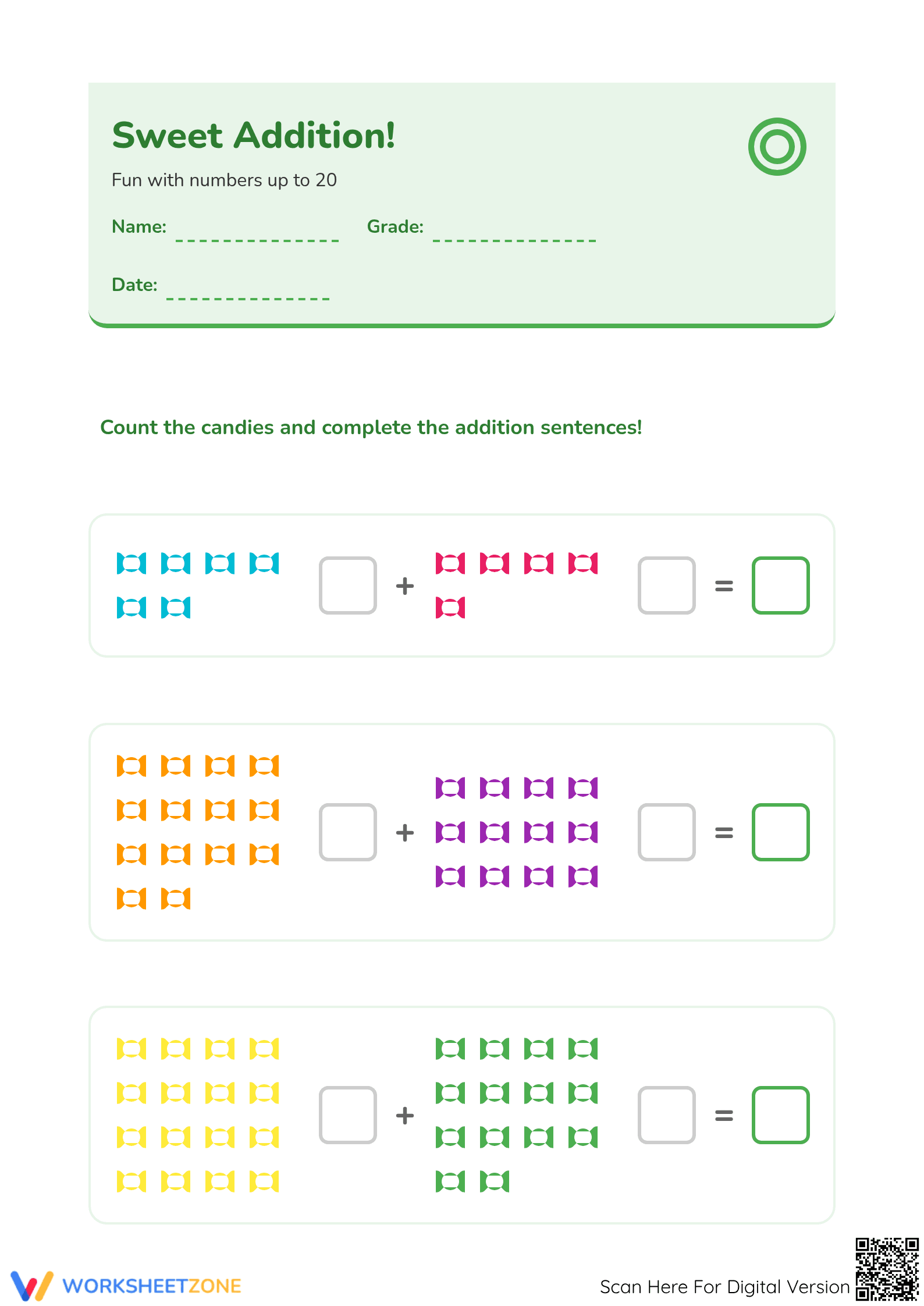
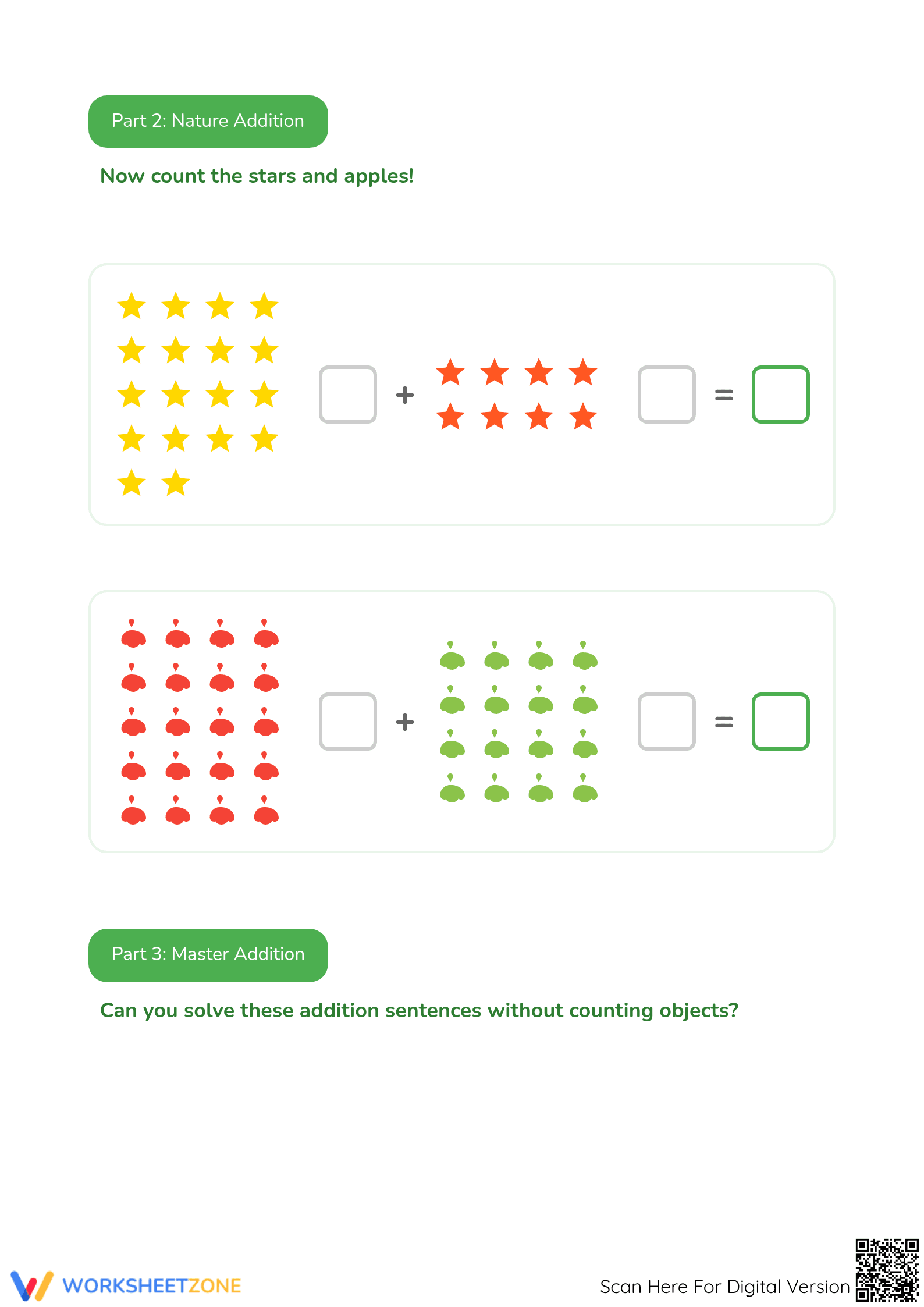
Mastering basic arithmetic requires a balance of visual support and abstract practice. This comprehensive three-page worksheet helps first-grade students build confidence in addition within 20 by transitioning from counting colorful candies and stars to solving standard equations. Students will demonstrate their understanding through guided counting, independent calculation, and a creative drawing challenge.
At a Glance
- Grade: 1 · Subject: Math
- Standard:
CCSS.MATH.CONTENT.1.OA.C.6— Add and subtract within 20, demonstrating fluency for addition and subtraction within 10- Skill Focus: Addition up to 20
- Format: 3 pages · 12 problems · Answer key included · PDF
- Best For: First-grade math centers and homework
- Time: 15–20 minutes
What's Inside
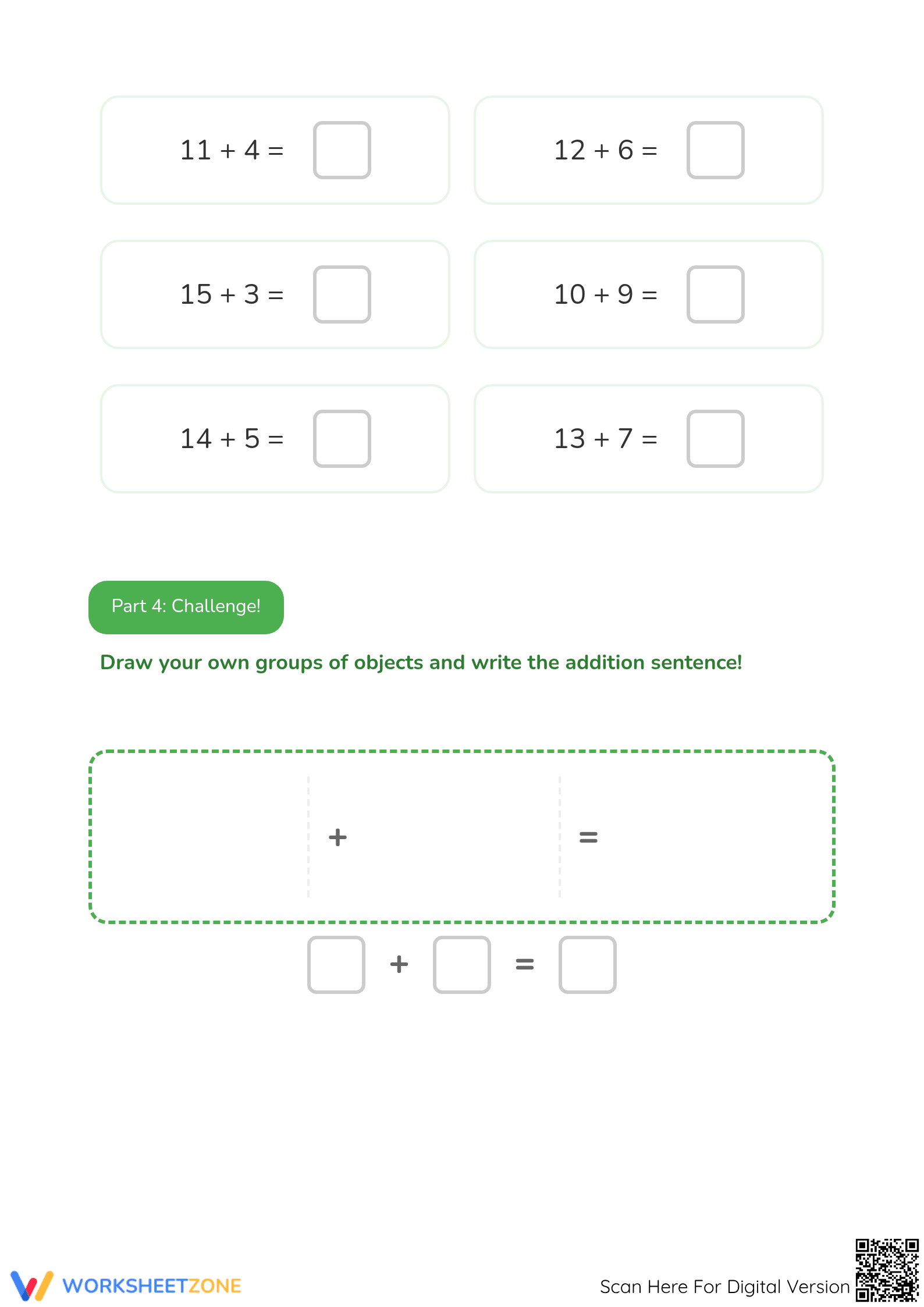
This resource contains three distinct pages designed to foster mathematical fluency. The first two pages feature five sets of visual models, including candies, stars, and apples, to support students. Page three moves toward mastery with six abstract equations followed by a creative challenge section where students must draw their own groups and write a corresponding math sentence.
Skill Progression
- Guided Practice: The first five tasks utilize high-interest visual manipulatives to anchor the concept of addition, helping students count total sets accurately.
- Supported Practice: Students transition to solving abstract addition sentences without visual aids, promoting mental math strategies like counting on.
- Independent Practice: The final challenge requires students to generate their own mathematical models, demonstrating a high level of conceptual mastery.
This structured "I Do, We Do, You Do" approach ensures that learners are never overwhelmed by the jump from pictures to numbers.
Standards Alignment
The primary focus of this worksheet is `CCSS.MATH.CONTENT.1.OA.C.6`: Add and subtract within 20, demonstrating fluency for addition and subtraction within 10. This resource also supports foundational algebraic thinking. Both standard codes can be copied directly into lesson plans, IEP goals, or district curriculum mapping tools.
How to Use It
Use this worksheet during your primary instruction block immediately after introducing addition within 20. Start with the visual counting pages to check for correspondence. For a formative assessment, watch how students approach the final page; look for those using mental strategies like counting on. Students typically complete all three pages in 15–20 minutes.
Who It's For
This worksheet is specifically designed for first-grade students but serves as an intervention for second-graders needing remedial support. It pairs naturally with a base-ten block lesson or a short reading passage about number relationships.
According to the NAEP framework, developing early numerical fluency requires a transition from concrete representation to abstract reasoning. This Grade 1 worksheet facilitates this cognitive shift by guiding students through three distinct phases: object counting, mental math application, and creative synthesis. By utilizing visual models like candies and stars, the resource reduces cognitive load during the initial acquisition phase, allowing learners to focus on the additive relationship. Aligned with CCSS.MATH.CONTENT.1.OA.C.6, the tasks encourage the use of strategies such as counting on or making ten. Research from Fisher & Frey (2014) emphasizes that scaffolded practice—moving from high-support visual cues to independent problem-solving—is essential for long-term retention of arithmetic facts. This 3-page set provides the structured repetition necessary to build the automaticity required for higher-level mathematics. The inclusion of a creative challenge further ensures that students can demonstrate conceptual understanding beyond rote calculation, making it a robust tool for first-grade numeracy development.


