


























Views
Downloads



Complete Wrong-Base Percents Worksheet | Grade 7 Math
Paste this activity's link or code into your existing LMS (Google Classroom, Canvas, Teams, Schoology, Moodle, etc.).
Students can open and work on the activity right away, with no student login required.
You'll still be able to track student progress and results from your teacher account.
Mastering percent relationships requires students to distinguish between the part and the reference whole. This targeted worksheet trains Grade 7 students to identify and correct wrong-base percent errors across authentic word problems. By analyzing common setup misconceptions, learners build conceptual precision and ensure accurate calculations when solving multi-step proportional relationships.
At a Glance
- Grade: 7 · Subject: Math
- Standard:
7.RP.A.3— Solve multistep ratio and percent problems using proportional relationships- Skill Focus: Correct Wrong-Base Percent Equations
- Format: 4 pages · 18 problems · Answer key included · PDF
- Best For: Error analysis and remediation practice
- Time: 40–50 minutes
This 4-page resource includes a review of the core percent equation, a worked error-analysis model, and 18 practice tasks arranged in three sections. Students examine flawed peer work, compute correct values, and write explanatory justifications. A 2-page answer key provides step-by-step solutions and error diagnoses for fast grading.
Skill Progression
- Guided Practice (Part A, 4 problems): Students examine structured scenarios to isolate the base quantity, identify parts and percents, and write baseline equations with visual scaffold support.
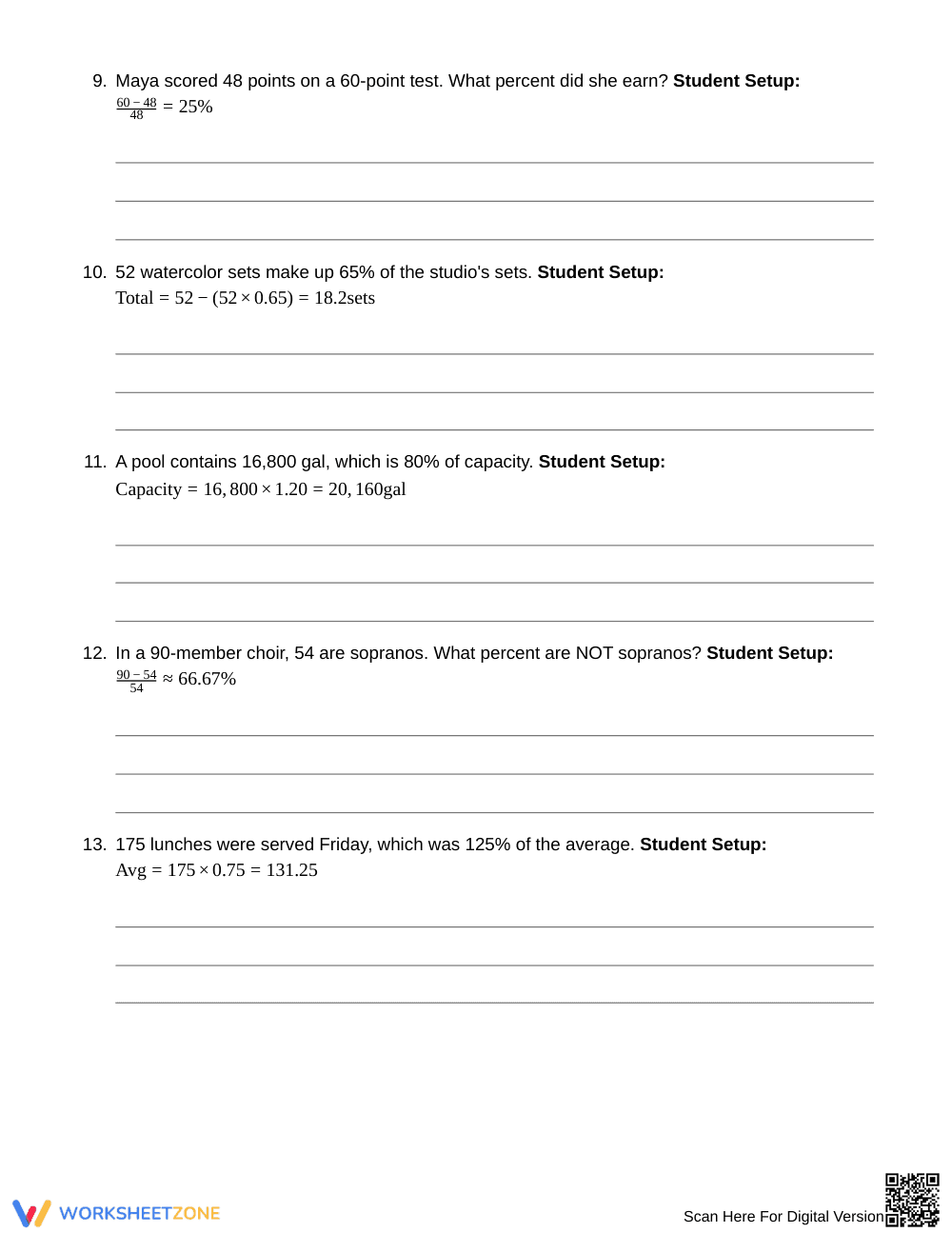
- Supported Practice (Part B, 10 problems): Learners evaluate common student errors, diagnose incorrect base assignments in context, and calculate correct percentage and whole-quantity solutions.
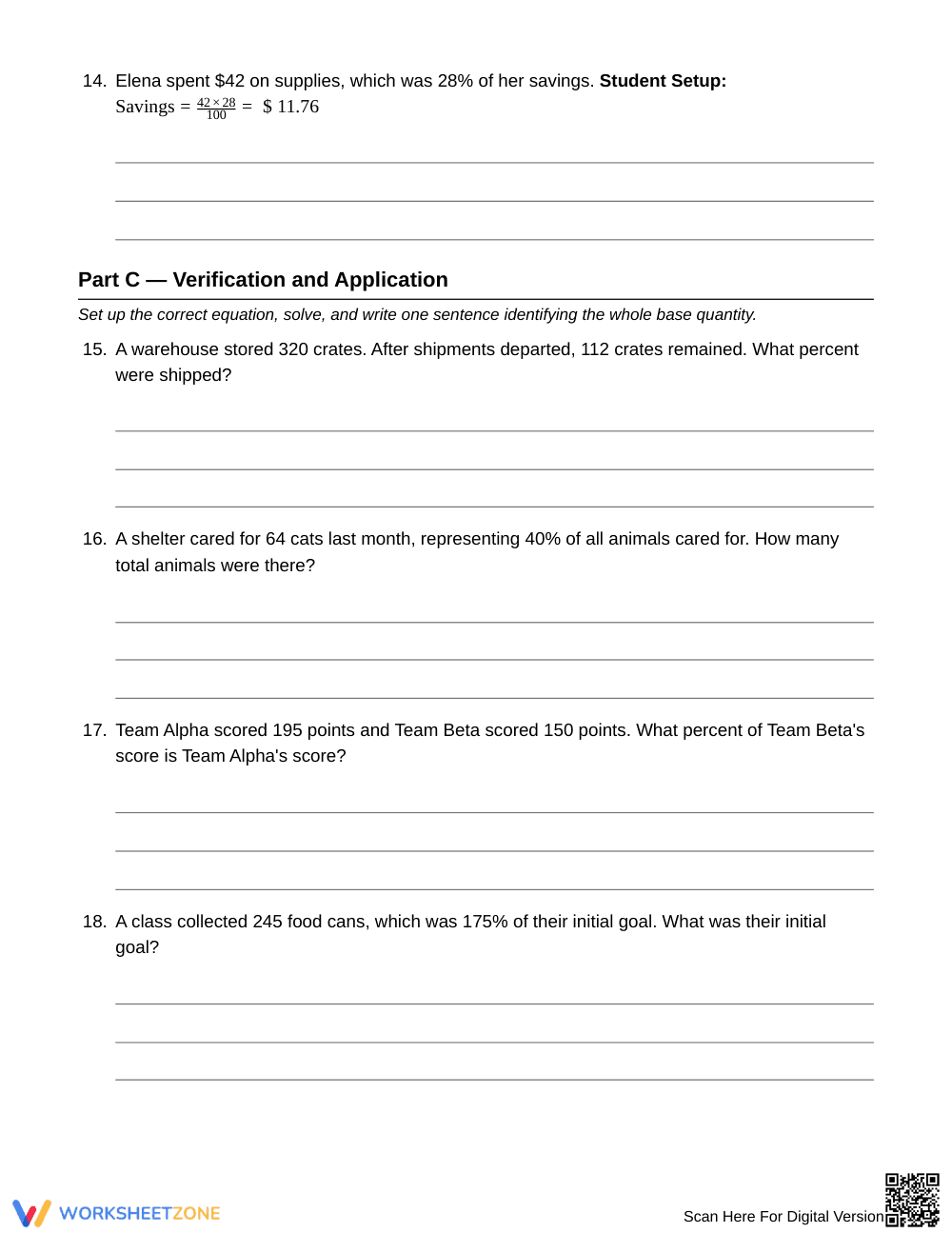
- Independent Practice (Part C, 4 problems): Students independently model multi-step word problems, solve for missing variables, and write complete explanatory sentences verifying the 100% reference whole.
This sequence mirrors the gradual release of responsibility model, transitioning students from foundational base identification to critical evaluation and unassisted problem solving.
Standards Alignment
This resource aligns to `7.RP.A.3`: Solve multistep ratio and percent problems using proportional relationships. It also reinforces supporting standard `7.RP.A.2` by requiring students to represent proportional relationships through formal equations. Both standard codes can be copied directly into lesson plans, IEP goals, or district curriculum mapping tools.
How to Use It
Deploy this worksheet after direct instruction on the percent equation to solidify base identification before multi-step consumer math. In small groups, use Part B as an error-analysis station where pairs debate why student setups failed. For formative assessment, check whether learners invert the part and base. Expect completion in 40 to 50 minutes.
Who It's For
This worksheet serves general education Grade 7 math classes, intervention groups addressing persistent rational number misconceptions, and accelerated Grade 6 students preparing for algebraic proportions. Struggling learners benefit from highlighting the base in word problems using colored pencils. Pair this activity with a visual ratio anchor chart displaying the relationship between parts, wholes, and benchmark percents.
Under standard 7.RP.A.3, middle school learners must apply proportional reasoning to solve complex ratio and percent problems. A persistent stumbling block in rational number fluency is identifying the reference base, where students invert ratios or treat the part as the whole. Research from Fisher & Frey (2014) emphasizes that deliberate error analysis fosters metacognitive awareness, enabling students to recognize structural flaws in mathematical setups rather than executing rote procedures blindly. By evaluating flawed student work across 18 targeted tasks, this worksheet guides Grade 7 learners to correct wrong-base percent equations systematically. Students contrast incorrect setups with accurate models, cementing the principle that the base represents the 100% whole quantity. As documented in instructional efficacy literature, systematic error diagnosis paired with corrective reasoning strengthens proportional schema, preparing students for multi-step consumer applications and linear algebra.


