




























Views
Downloads

Complete Two-Source Synthesis Worksheet | Grade 6 ELA

Paste this activity's link or code into your existing LMS (Google Classroom, Canvas, Teams, Schoology, Moodle, etc.).
Students can open and work on the activity right away, with no student login required.
You'll still be able to track student progress and results from your teacher account.
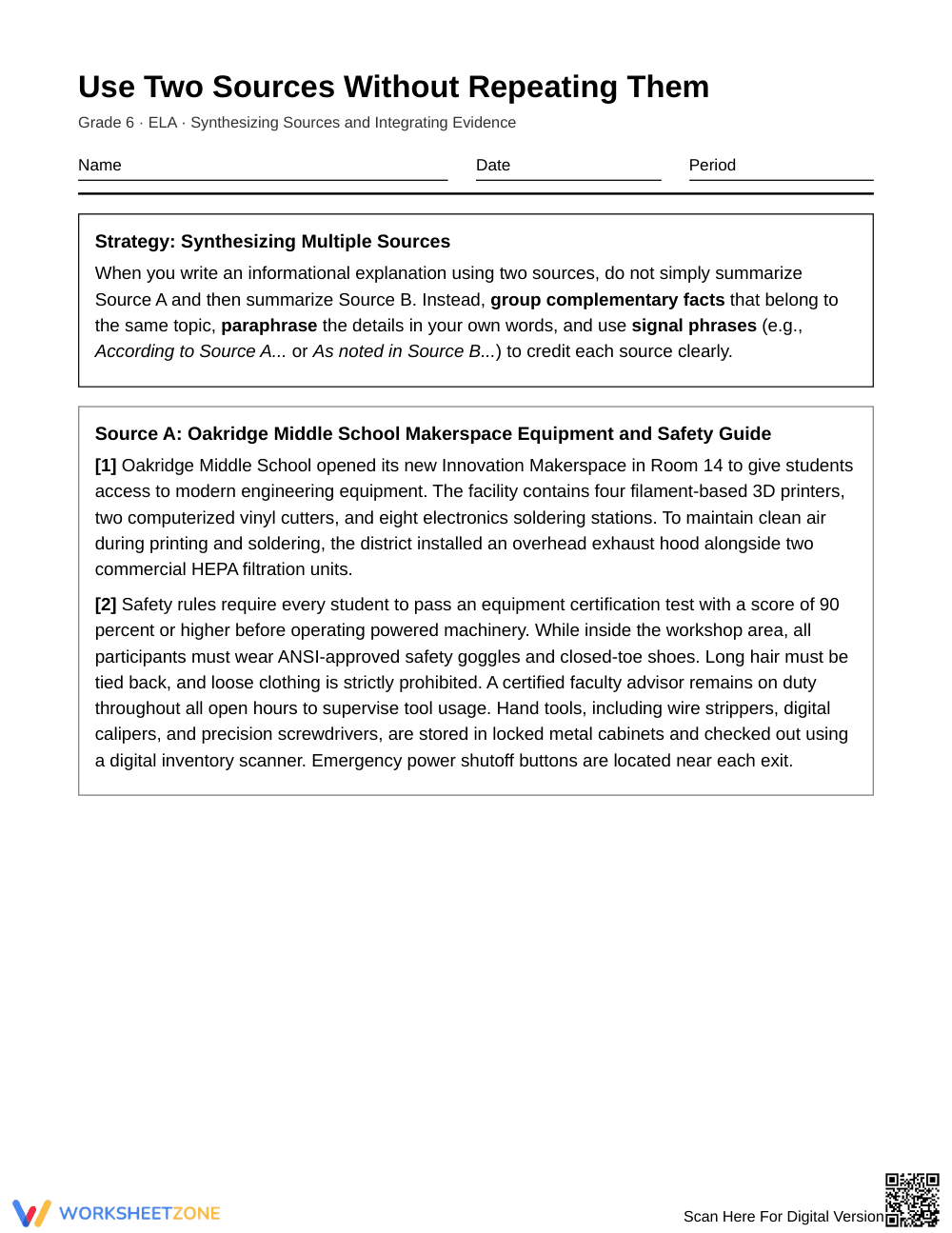
This Grade 6 ELA worksheet teaches middle school students how to synthesize evidence from two sources without duplicating facts. Working with paired texts on a school makerspace, students categorize complementary details, practice sentence-level attribution, and draft an objective multi-paragraph explanation.
At a Glance
- Grade: 6 · Subject: ELA
- Standard:
W.6.8— Gather information from multiple print sources and integrate evidence without plagiarizing- Skill Focus: Use Two Sources Without Repeating Them
- Format: 5 pages · 8 problems · Answer key included · PDF
- Best For: Informational synthesis and evidence integration practice
- Time: 35–45 minutes
What's Inside
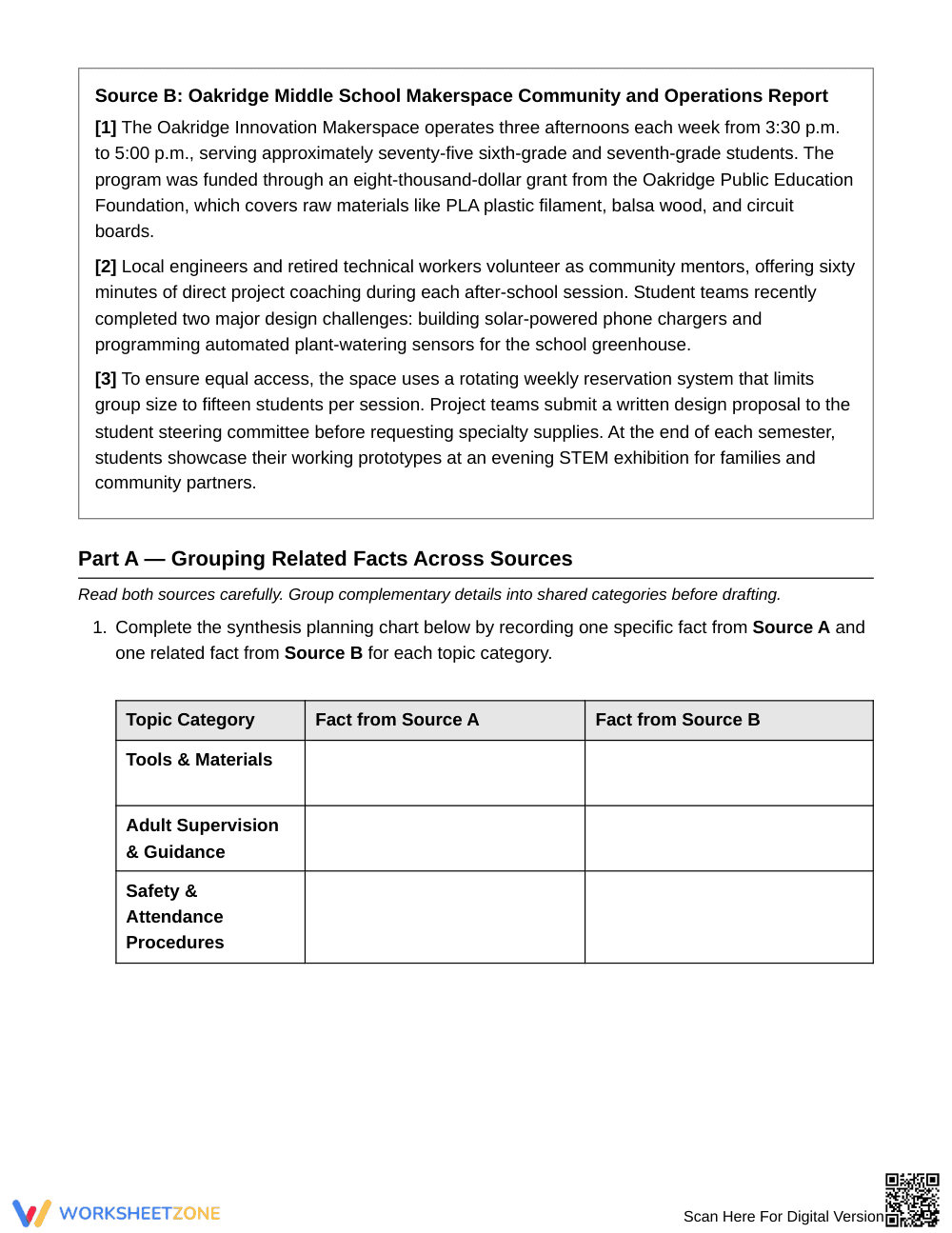
The 5-page worksheet features two paired informational texts, a strategy box, and 8 structured tasks. Students use a graphic organizer to sort cross-text facts, combine details using attribution phrases, write a 160-word synthesized response, and check their work with a self-assessment checklist and a 3-page answer key.
Skill Progression
- Guided Practice (Tasks 1–2): Students complete a 3-topic matrix grouping related facts across both sources and explain why topical grouping prevents repetitive summaries.
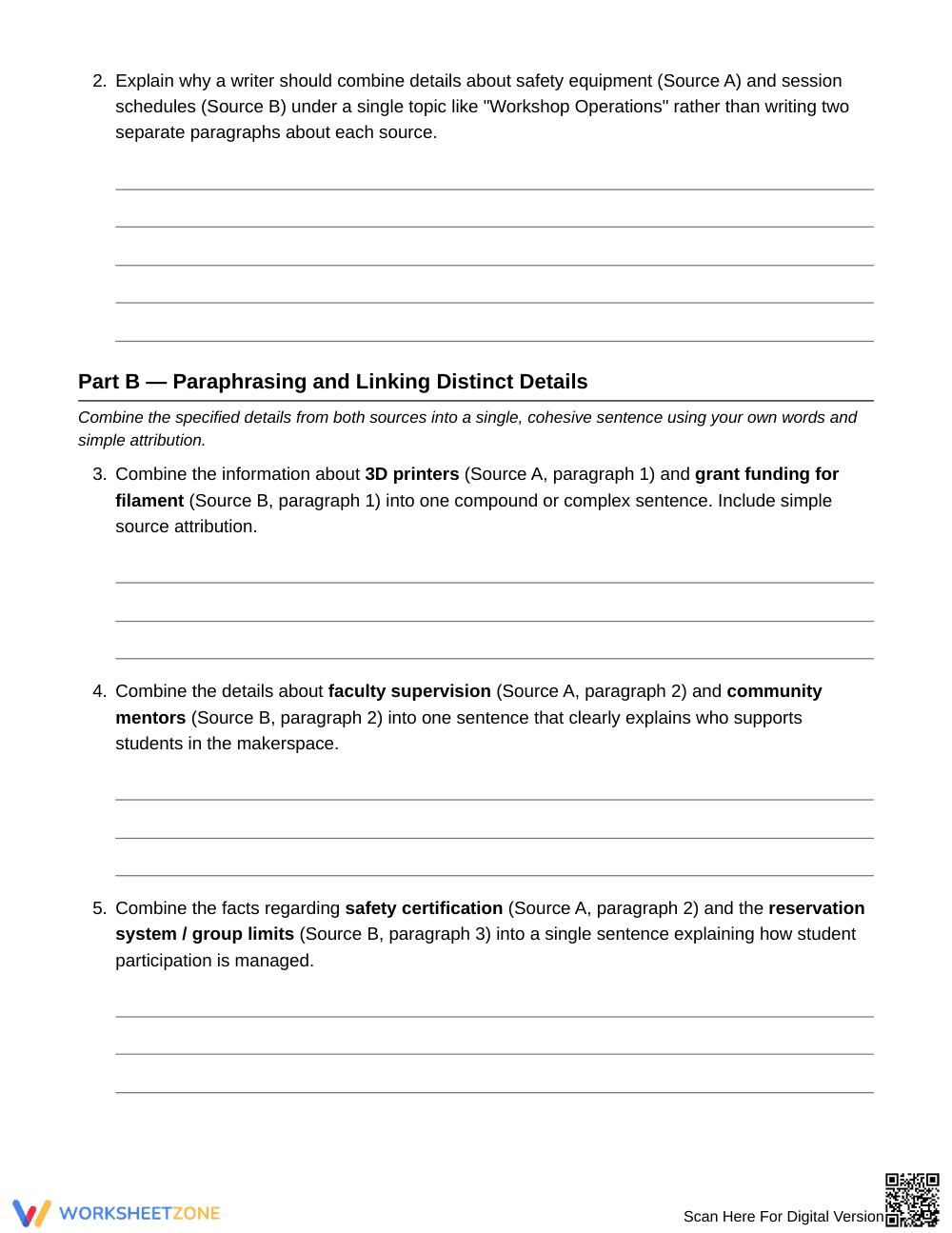
- Supported Practice (Tasks 3–6): Students combine specific details into cohesive sentences with signal phrases and revise a draft sentence to remove copied wording.
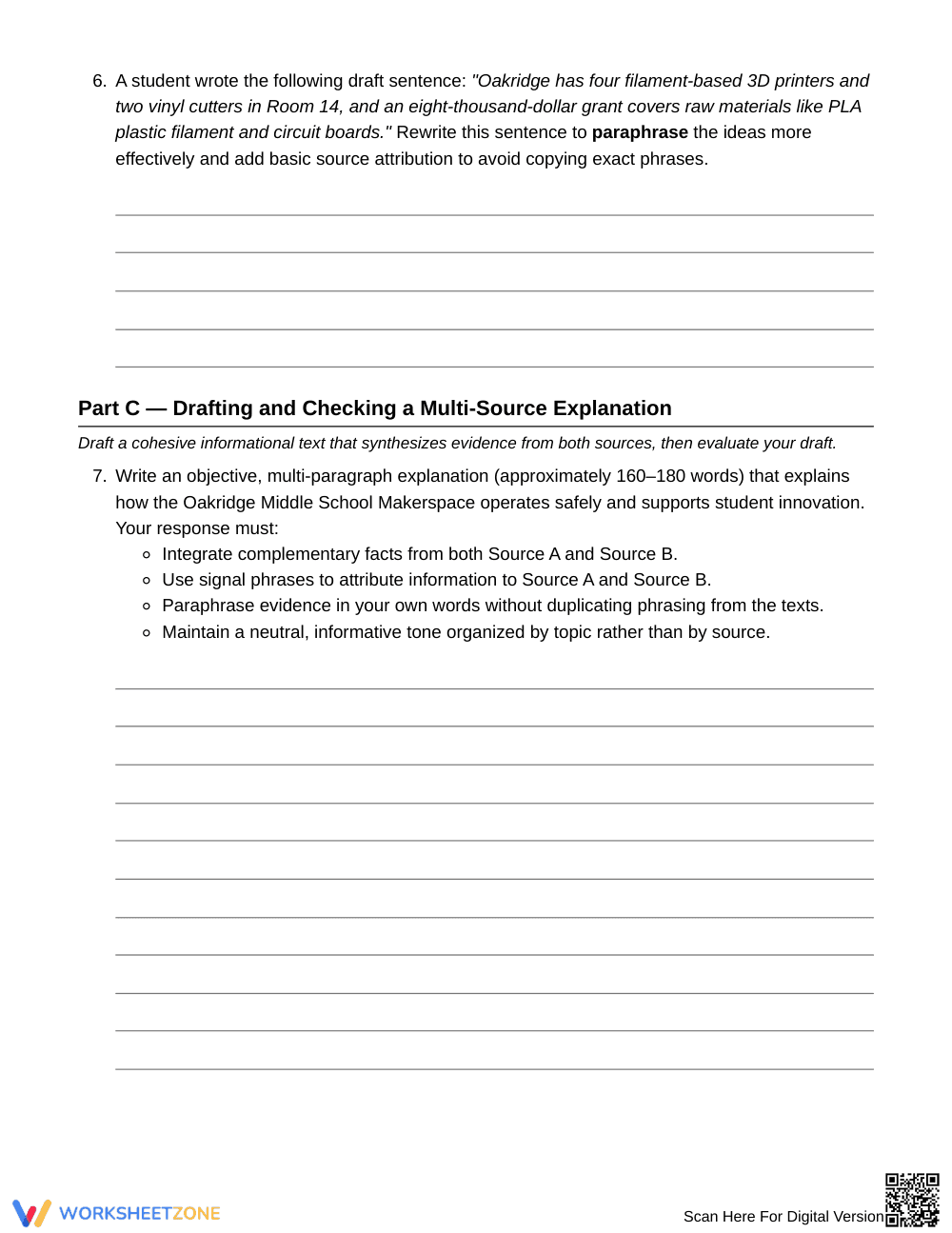
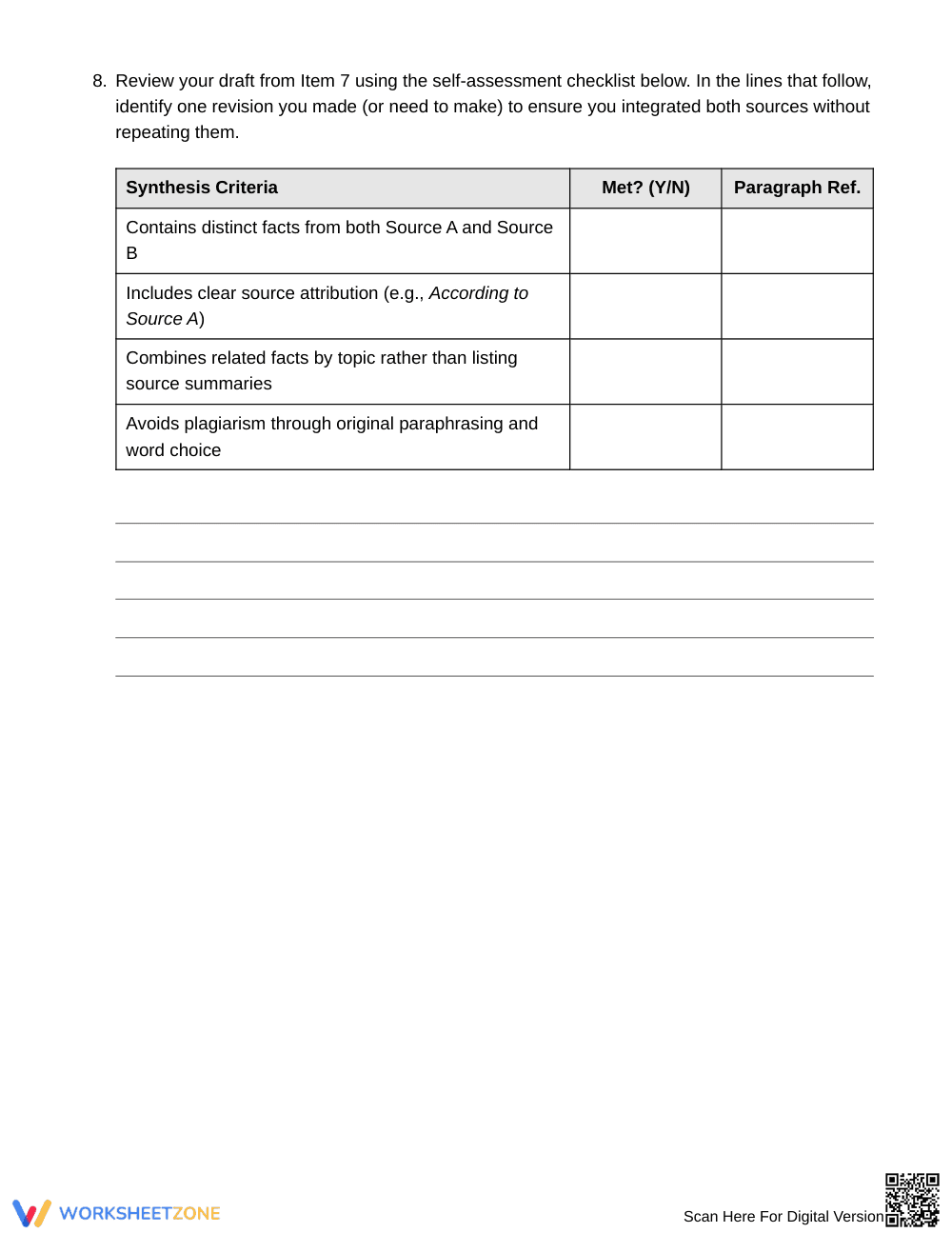
- Independent Practice (Tasks 7–8): Students draft a multi-paragraph synthesis explanation and evaluate their work using a 4-point self-assessment checklist.
This gradual release sequence guides students from structured fact grouping to independent informational synthesis.
Standards Alignment
This worksheet aligns directly to primary standard `W.6.8`: Gather relevant information from multiple print sources, paraphrase data without plagiarizing, and provide basic attribution. It also supports `W.6.2` by organizing informational topics with concrete facts and details. Both standard codes can be copied directly into lesson plans, IEP goals, or district curriculum mapping tools.
How to Use It
Use this resource after introducing synthesis and attribution in an informational writing unit, or as a mid-unit formative assessment. During class, check Part B to ensure students use attribution phrases rather than raw quotes. The 8 tasks take 35 to 45 minutes to complete.
Who It's For
This activity supports Grade 6 students learning to synthesize research, writers who struggle with repetitive summaries, and English learners needing sentence models. Pair it with an anchor chart on signal phrases.
According to Fisher & Frey (2014), structured instructional routines that combine categorical note-taking with scaffolded sentence combining significantly improve student proficiency in integrating evidence from multiple informational texts. This 5-page Grade 6 ELA worksheet operationalizes standard `W.6.8` by guiding middle school writers to systematically gather complementary facts from two informational sources, eliminate redundant paragraph-by-paragraph summaries, and compose original synthesized explanations. Across 8 progressive, standards-aligned tasks, students sort paired evidence into thematic categories, apply signal phrases such as "According to Source A" to credit authors properly, paraphrase technical vocabulary to prevent plagiarism, and evaluate their own drafts against an objective 4-item rubric checklist. By replacing repetitive source-by-source reporting with topical evidence integration, this comprehensive activity builds essential academic writing stamina and research readiness required for upper middle school state literacy benchmarks and beyond.


