


























Views
Downloads


Complete Picture Circle Drawing Worksheet | Ready to Print
Paste this activity's link or code into your existing LMS (Google Classroom, Canvas, Teams, Schoology, Moodle, etc.).
Students can open and work on the activity right away, with no student login required.
You'll still be able to track student progress and results from your teacher account.
Mastering basic geometric shapes is a foundational step in early mathematical development. This worksheet provides a structured yet creative way for Kindergarten and Grade 1 students to identify and draw circles. By completing familiar illustrations and creating their own, learners solidify their understanding of shape properties while refining the fine motor skills essential for handwriting and artistic expression.
At a Glance
- Grade: K–1 · Subject: Math (Geometry)
- Standard:
CCSS.MATH.CONTENT.K.G.B.5— Draw shapes in the world to model geometric concepts- Skill Focus: Circle identification and precision drawing
- Format: 4 pages · 9 problems · PDF · Instant access
- Best For: Early finishers and geometry center activities
- Time: 15–20 minutes
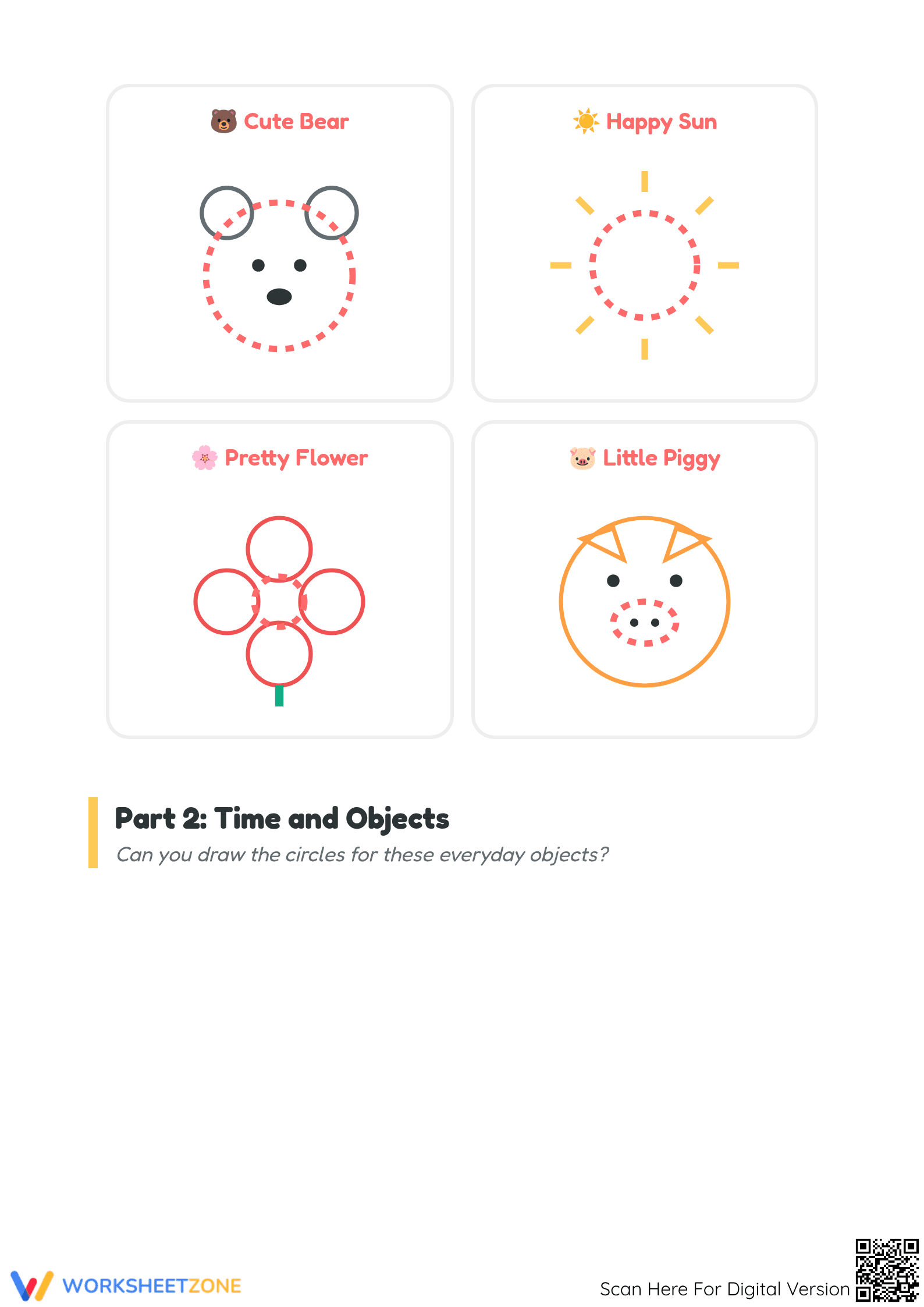
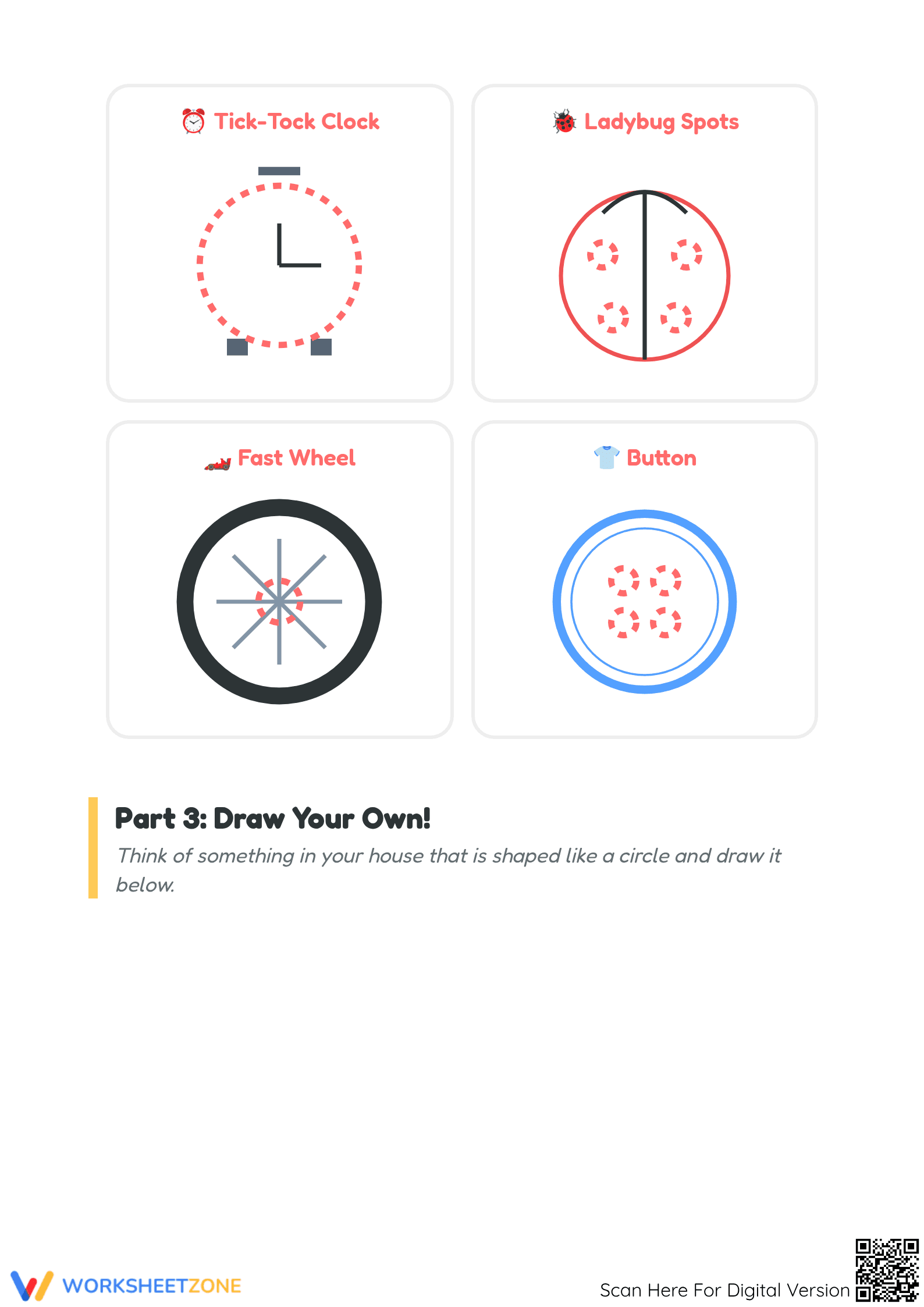
This comprehensive four-page PDF is designed for maximum student engagement. It features three distinct sections: "The Missing Circles," "Time and Objects," and "Draw Your Own." Students will find eight guided tracing tasks—including common icons like a sun, flower, and clock—alongside a dedicated full-page space for original creative expression. The layout uses clear, bold lines and friendly graphics to maintain focus without overwhelming young learners.
Implementing this resource takes less than two minutes. Simply print the four-page document and distribute it. Because instructions are visual and intuitive, children can begin immediately with minimal guidance. This makes it an ideal choice for emergency sub plans, morning work, or as a quiet transition activity between core lessons.
The primary alignment for this resource is `CCSS.MATH.CONTENT.K.G.B.5`, which requires students to model shapes in the world by drawing them. By tracing the missing components of a ladybug or a wheel, students move from passive recognition to active production. This standard code can be copied directly into lesson plans, IEP goals, or district curriculum mapping tools to demonstrate adherence to state and national frameworks.
Use this worksheet as a formative assessment after introducing circles. Observe students as they complete 'Time and Objects' to see if they maintain curves without flat edges. For an extension, have students share their original drawings with a partner, explaining why their object qualifies as a circle based on its geometric properties.
This resource is tailored for Kindergarten and Grade 1 students starting their journey with 2D shapes. It is effective for learners needing fine motor practice. Pair this with a physical scavenger hunt where students find circular items before drawing them in the 'Draw Your Own' section to reinforce real-world connections.
Research from the NAEP underscores that early proficiency in identifying and constructing geometric shapes is a strong predictor of later success in spatial reasoning and complex mathematical problem-solving. This worksheet directly addresses these requirements by focusing on `CCSS.MATH.CONTENT.K.G.B.5`, encouraging students to "Draw shapes in the world to model geometric concepts" through a sequence of guided and independent tasks. By moving from tracing dotted lines on familiar objects like suns and flowers to the freehand creation of circular items found in their own environment, students develop a robust mental model of 2D geometry. This approach aligns with best practices for gradual release of responsibility, ensuring that learners have the scaffolds necessary to achieve mastery. This self-contained module provides 9 specific tasks designed to bridge the gap between abstract shape recognition and practical application in real-world contexts, making it an essential tool for any early childhood mathematics curriculum.


