




























Views
Downloads

Complete Star Formation Word Search | Grades 6–7 Science

Paste this activity's link or code into your existing LMS (Google Classroom, Canvas, Teams, Schoology, Moodle, etc.).
Students can open and work on the activity right away, with no student login required.
You'll still be able to track student progress and results from your teacher account.
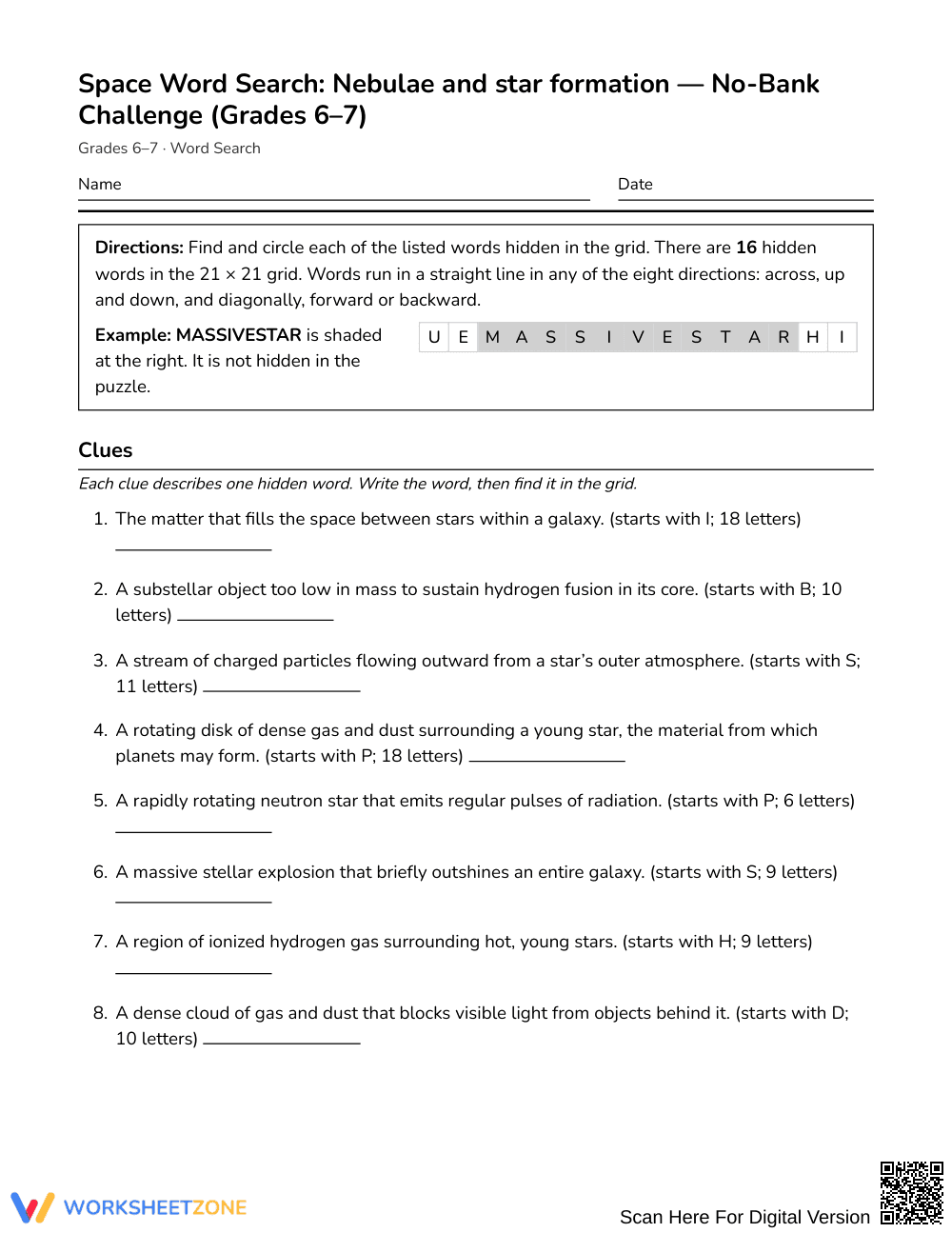
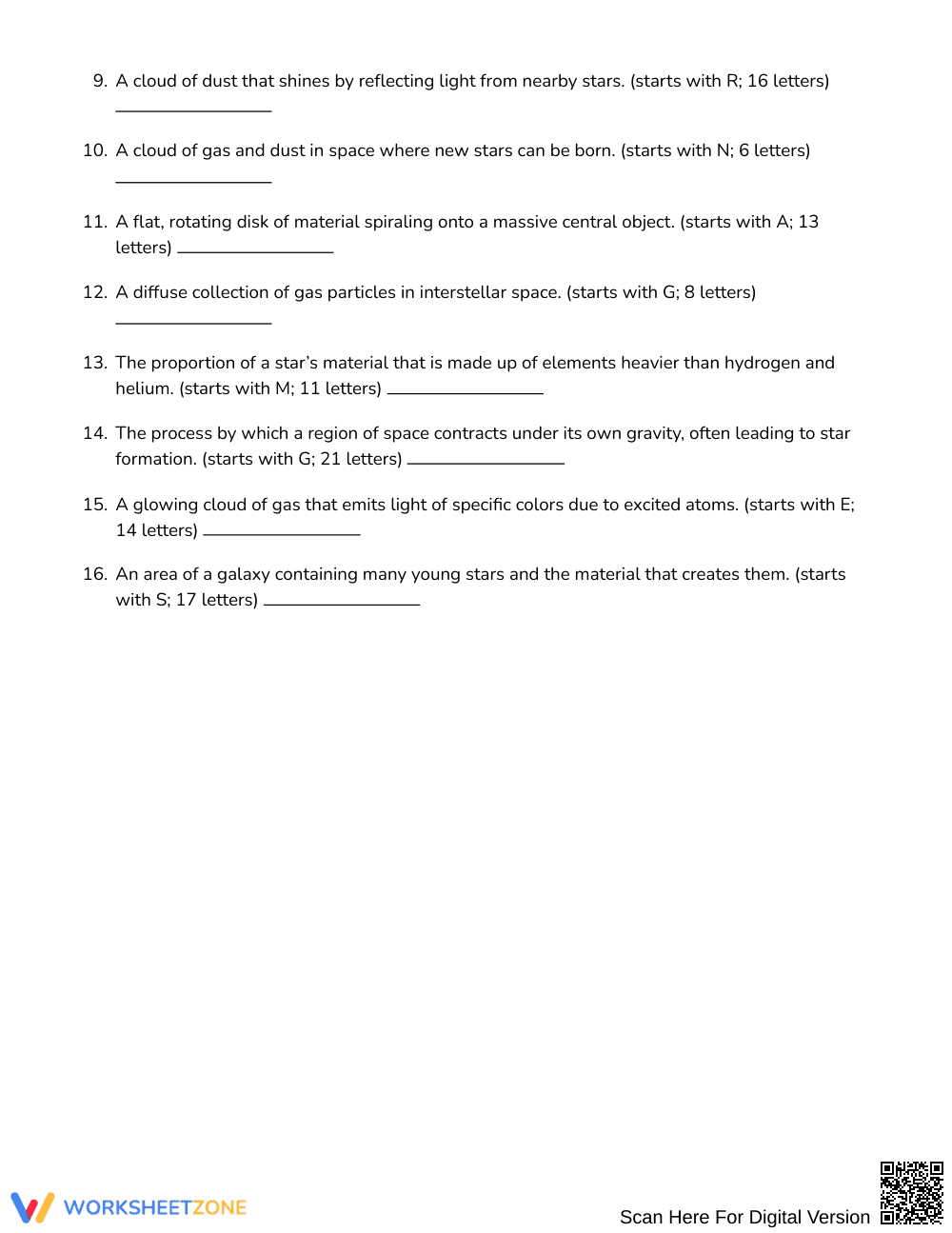
This astronomy word search reinforces essential vocabulary for nebulae and stellar evolution. Middle school science students locate 16 specialized terms using conceptual definitions rather than a standard word bank, connecting key terminology directly to planetary formation and lifecycle processes across interstellar space.
At a Glance
- Grade: Grades 6–7 · Subject: Science
- Standard: Not standards-assessed — vocabulary enrichment
- Skill Focus: Nebulae and star formation vocabulary
- Format: 3 pages · 16 words · Answer key included · PDF
- Best For: Vocabulary review and fast-finisher work
- Time: 20–35 minutes
What's Inside
This 3-page printable puzzle features a dense letter array paired with rigorous definitional clues for every target word. Rather than scanning for familiar spellings from a list, students read astronomy definitions covering core astrophysical structures—such as accretion disks, molecular clouds, and supernova remnants—and deduce the corresponding term before searching the puzzle grid. A comprehensive 3-page answer key clearly marks every word placement for straightforward verification.
Puzzle Architecture & Mechanics
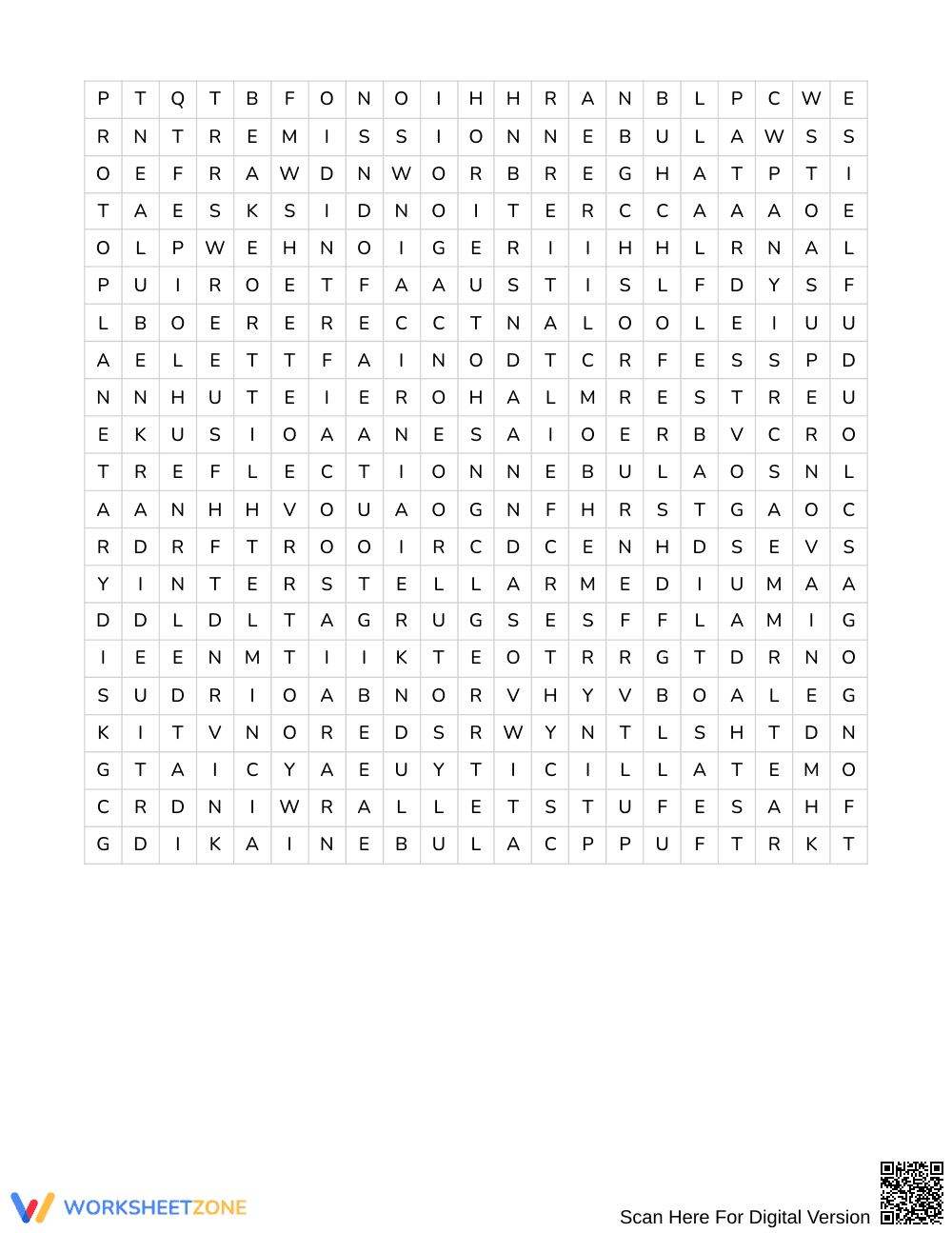
The activity is built on a 21 × 21 letter grid designed to provide an authentic cognitive challenge. All 16 vocabulary words are concealed in eight compass directions: north, northeast, east, southeast, south, southwest, west, and northwest. Because this is a no-bank challenge, learners must actively engage with the scientific clues to retrieve domain-specific vocabulary before scanning backwards, diagonally, and vertically across the grid.
Standards Alignment
This activity provides targeted vocabulary enrichment and is not aligned to a specific state or national standard. It supports foundational literacy within middle school astronomy units by exposing learners to advanced academic terms associated with stellar lifecycles and interstellar matter.
How to Use It
Deploy this puzzle as an independent review station during an astronomy unit or as a self-contained sub plan following initial instruction on the life cycles of stars. During seatwork, circulate to note which definitional clues prompt student questions; confusion regarding terms like emission versus reflection nebulae indicates a prime opportunity for a targeted mid-lesson clarification. Most students complete the activity within 20 to 35 minutes.
Who It's For
This resource is tailored for Grades 6–7 general science and physical science classrooms studying cosmic structures. It functions effectively as an extension task for advanced learners seeking challenge without a visible word list, and it pairs naturally with an anchor chart illustrating stellar nebulae, protostars, and planetary nebulae.
Domain-specific vocabulary acquisition serves as a critical bridge between introductory science concepts and advanced disciplinary literacy. Research documented by Fisher & Frey (2014) emphasizes that intentional, context-rich vocabulary practice enables adolescent learners to internalize complex academic language and construct coherent mental models of abstract physical systems. When students engage with domain-specific terms—such as interstellar medium, gravitational collapse, and protostellar accretion—through clue-driven retrieval rather than passive rote memorization, they develop durable conceptual schemas that support reading comprehension in secondary science coursework. By requiring middle school students to parse rigorous scientific definitions before identifying 16 key astronomy terms across multiple spatial orientations, this puzzle activity strengthens lexical fluency and scientific reasoning. Integrating meaningful vocabulary review into everyday astronomy instruction fosters greater student confidence during subsequent investigative inquiries, textbook readings, and formal classroom assessments.


