




























Views
Downloads


Complete Spanish Verbs Word Search | Grades 6–7 ELA

Paste this activity's link or code into your existing LMS (Google Classroom, Canvas, Teams, Schoology, Moodle, etc.).
Students can open and work on the activity right away, with no student login required.
You'll still be able to track student progress and results from your teacher account.
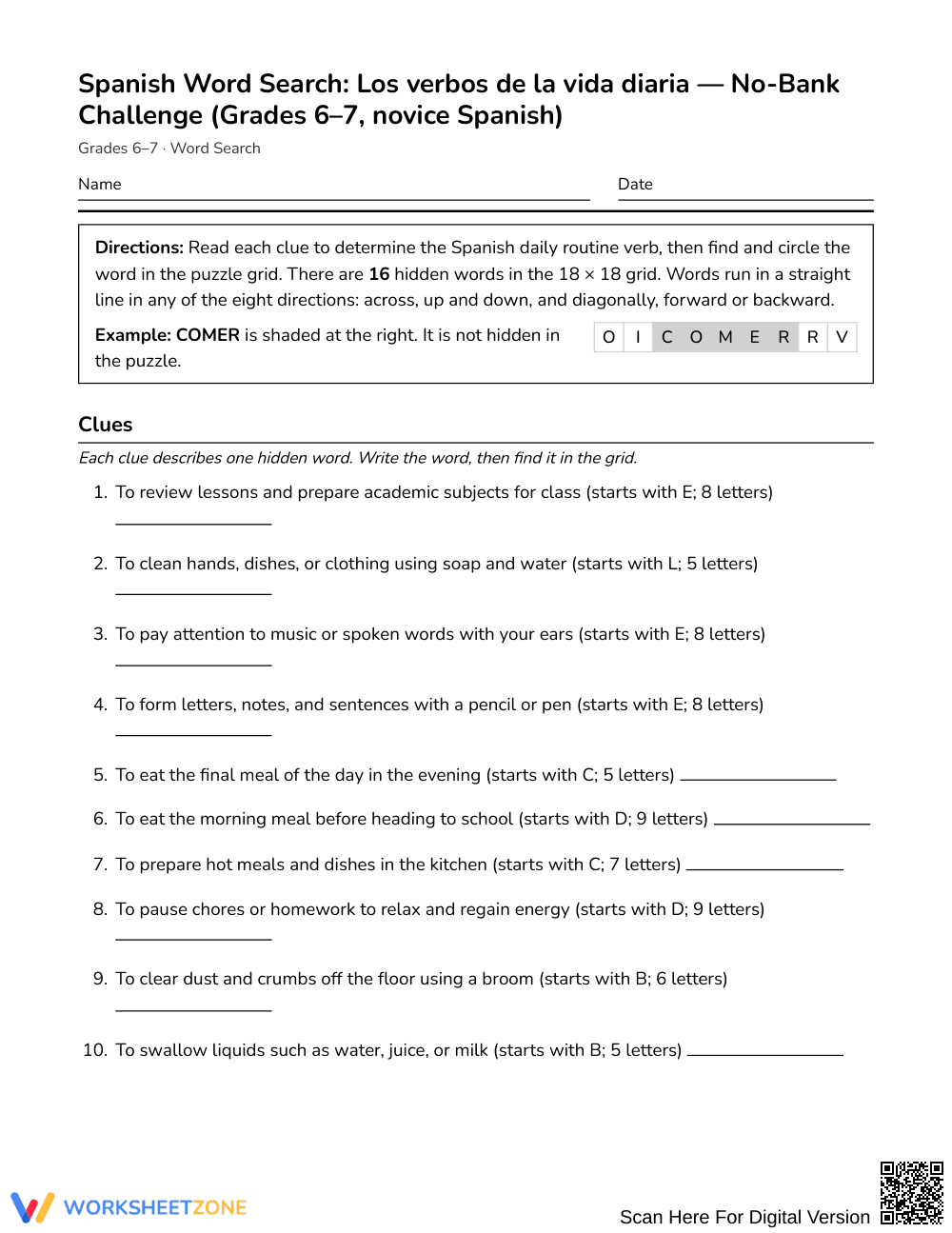
This Spanish word search strengthens vocabulary retention by challenging students to identify daily routine verbs from contextual English definitions. Students decode 16 target verbs—such as desayunar, estudiar, and limpiar—and locate them across a dense letter grid, reinforcing orthographic awareness and Spanish verb meaning without relying on a passive word bank.
At a Glance
- Grade: Grades 6–7 · Subject: ELA / Spanish
- Standard: Not standards-assessed — vocabulary enrichment
- Skill Focus: Los verbos de la vida diaria
- Format: 3 pages · 16 words · Answer key included · PDF
- Best For: Vocabulary review or fast-finisher enrichment
- Time: 20–30 minutes
What's Inside
This 3-page printable activity features a full-size puzzle challenge paired with a comprehensive 3-page solution key. Instead of a standard word bank, students receive 16 detailed English clues that describe familiar everyday actions. Students must recall or deduce the corresponding infinitive verb in Spanish before searching the letter matrix, ensuring active retrieval practice throughout the activity.
How the Puzzle Works
Students explore an 18 × 18 letter grid to locate all 16 target vocabulary words. Because this is a no-bank challenge, learners deduce each verb from functional clues before hunting. Words run in all 8 directions—north, northeast, east, southeast, south, southwest, west, and northwest—offering an engaging, rigorous cognitive search that deepens spelling recognition for novice Spanish learners.
Standards Alignment
This activity serves as supplemental vocabulary enrichment and is not aligned to a specific state or national standard. It is designed to bolster core language acquisition, lexical memory, and contextual verb recognition during introductory Spanish units within middle school English Language Arts or exploratory world language programs.
How to Use It
Deploy this word search during independent seatwork following direct instruction on daily routine verbs, or use it as a low-stress review session before a vocabulary assessment. While students search the grid, circulate to observe whether learners can independently translate the clue actions into Spanish infinitives or if they require reference notes. The activity typically takes 20 to 30 minutes to complete.
Who It's For
This activity is designed for Grades 6–7 students in novice Spanish or exploratory language classes. It offers natural self-pacing for fast finishers and pairs effectively with an anchor chart showing regular Spanish verb endings (-ar, -er, -ir) or a daily routine thematic reading passage.
Cognitive research underscores the instructional value of active retrieval and semantic clue decoding in introductory second-language acquisition. According to Fisher & Frey (2014), purposeful vocabulary tasks that require learners to generate target words from contextual definitions—rather than merely copying terms from an exposed bank—significantly improve long-term lexical retention and orthographic processing. By withholding a visible word list and requiring middle school learners to translate 16 English situational clues into Spanish infinitives, this resource transforms a recreational puzzle into a focused retrieval exercise. Locating terms across an 18 × 18 grid in eight possible orientations further forces students to attend closely to letter sequences and Spanish phoneme-grapheme correspondences. Educational research indicates that combining contextual inference with orthographic scanning supports dual-coding pathways, making vocabulary acquisition more durable during novice language study.


