


























Views
Downloads



Complete Signed Number Operations Worksheet | Grade 7 Math
Paste this activity's link or code into your existing LMS (Google Classroom, Canvas, Teams, Schoology, Moodle, etc.).
Students can open and work on the activity right away, with no student login required.
You'll still be able to track student progress and results from your teacher account.
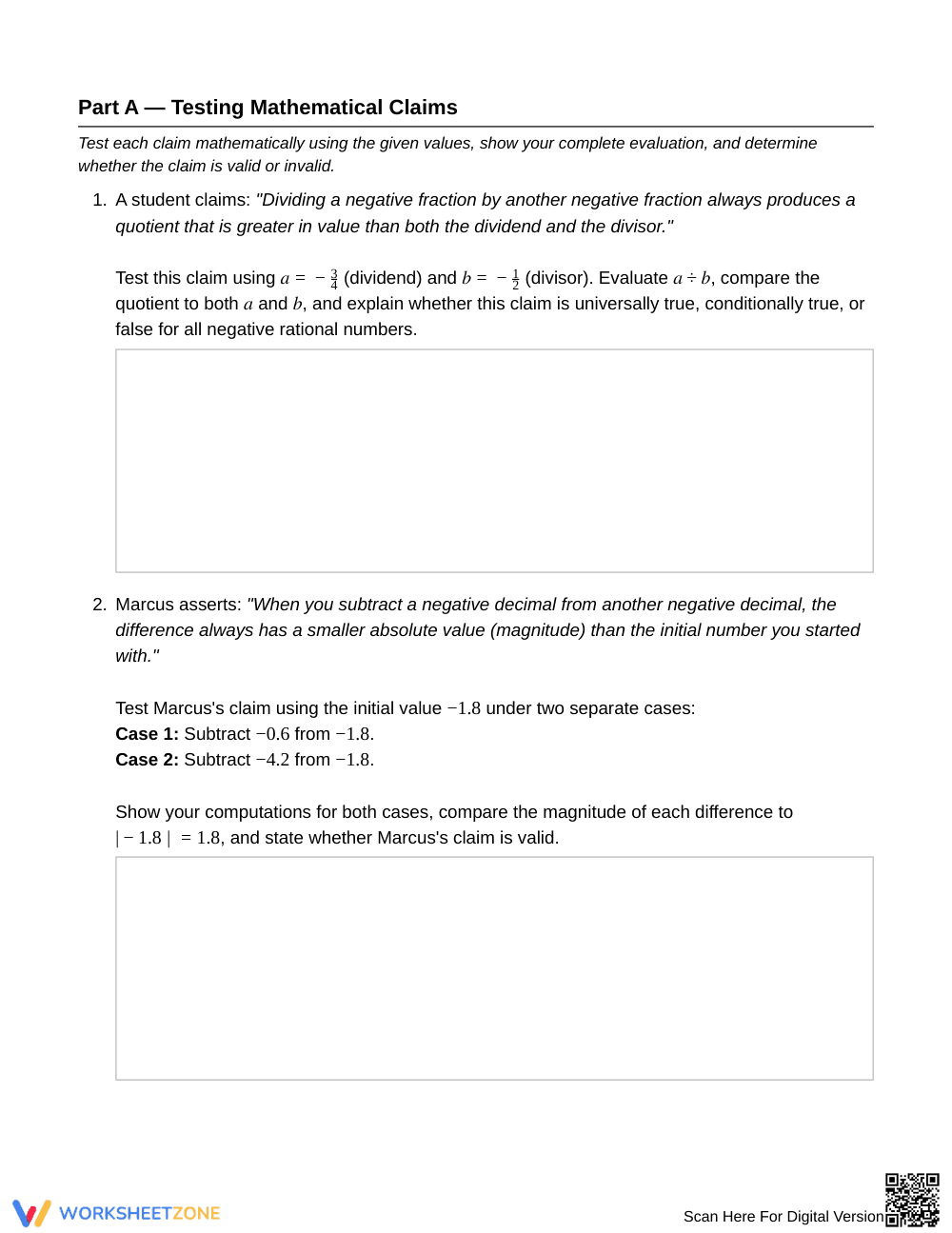
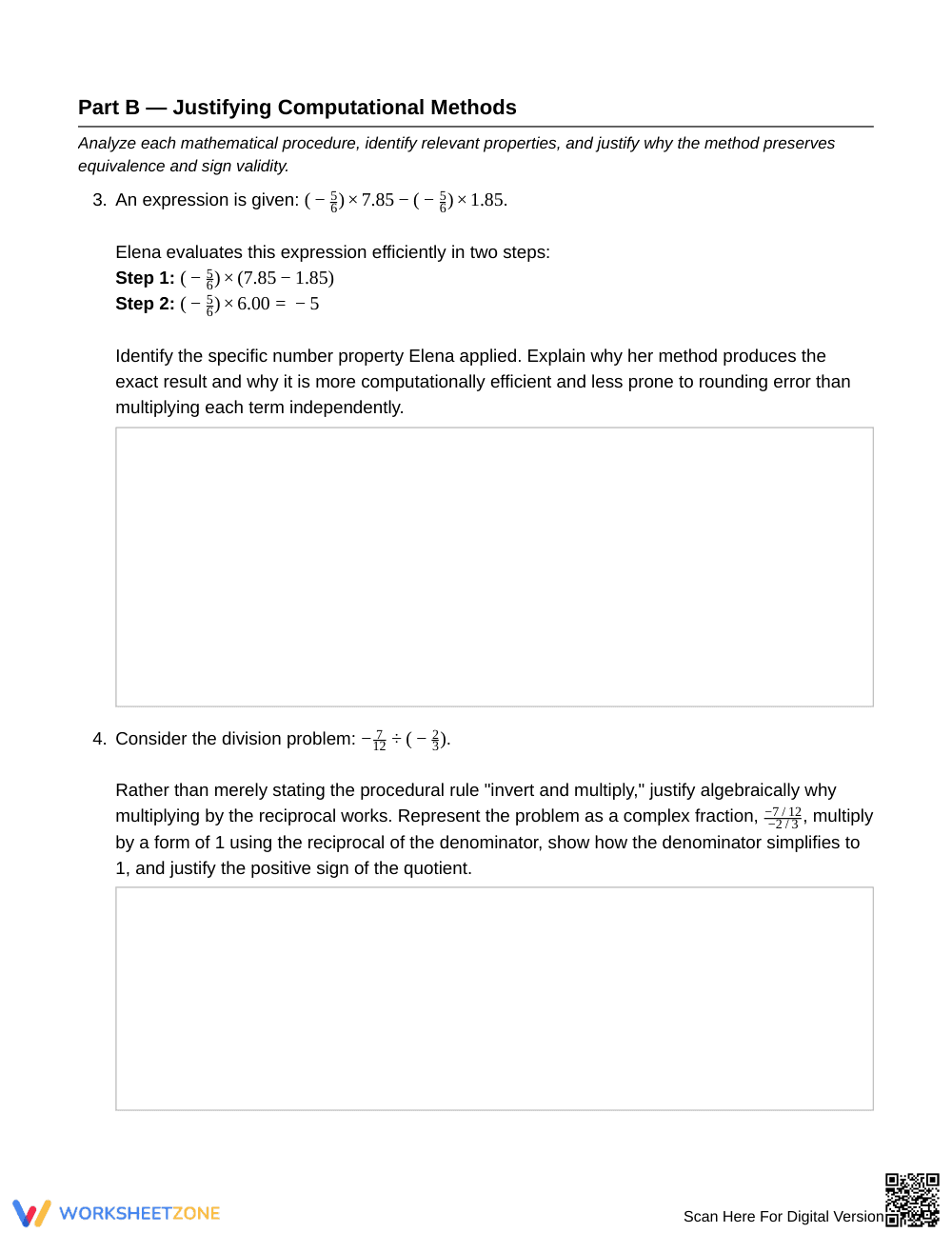
This Grade 7 worksheet asks students to justify why rational-number operations produce specific signs and magnitudes. Across 8 multi-step tasks, learners test mathematical claims, defend computational procedures with named properties, and construct counterexamples to build the rigorous reasoning skills required by standard 7.NS.A.3.
At a Glance
- Grade: 7 · Subject: Math
- Standard:
7.NS.A.3— Solve real-world problems using rational numbers- Skill Focus: Justify operation effects on signed values
- Format: 5 pages · 8 problems · Answer key included · PDF
- Best For: Post-instruction practice and formative review
- Time: 35–50 minutes
What's Inside
The worksheet begins with a Core Principles box defining signed values, absolute value, additive inverses, and multiplication and division sign rules. Students then complete three sections: Part A (Testing Mathematical Claims, 2 problems), Part B (Justifying Methods, 4 problems), and Part C (Counterexamples, 2 problems). A 4-page answer key provides fully worked algebraic justifications.
Skill Progression
- Guided Practice (Part A): Students test claims with given values and classify each as true, conditionally true, or false.
- Supported Practice (Part B): Students justify the multiply-by-reciprocal algorithm, apply the distributive property with negative terms, and evaluate multi-step rate-of-change expressions.
- Independent Practice (Part C): Students construct original counterexamples using signed rational numbers and analyze inequality conditions.
Standards Alignment
Every problem directly targets 7.NS.A.3, requiring learners to solve mathematical problems involving operations on rational numbers. The tasks also reinforce 7.NS.A.1 through sign analysis and 7.NS.A.2 through reciprocal multiplication rules.
How to Use It
Assign Parts A and B after initial instruction on rational operations to assess whether students understand procedural justifications. Assign Part C as an exit ticket or warm-up. Total completion time is approximately 35 to 50 minutes.
Who It's For
This resource serves Grade 7 math classes seeking to strengthen mathematical reasoning and conceptual clarity. It works well for small-group intervention, independent practice, or peer-led partner work.
The 7.NS.A.3 standard requires students to apply all four operations to rational numbers in both mathematical and real-world contexts. This worksheet targets the justification layer of that standard: students must explain sign outcomes, cite named properties such as the distributive property and the multiplicative inverse, and construct counterexamples that disprove universal claims about signed-number operations. According to NAEP data, only 44 percent of eighth-graders demonstrate proficiency with rational-number reasoning, suggesting that explicit justification practice in Grade 7 is critical for long-term mastery. The 8-problem set spans claim testing, procedural defense, and condition analysis across fractions and decimals, giving teachers a single printable resource that checks conceptual understanding alongside computational accuracy. The included 4-page answer key supports both structured self-assessment and efficient grading for middle school educators during daily classroom math instruction and targeted intervention blocks.


