


























Views
Downloads



Complete Signed Expressions Worksheet | Grade 7 Math
Paste this activity's link or code into your existing LMS (Google Classroom, Canvas, Teams, Schoology, Moodle, etc.).
Students can open and work on the activity right away, with no student login required.
You'll still be able to track student progress and results from your teacher account.
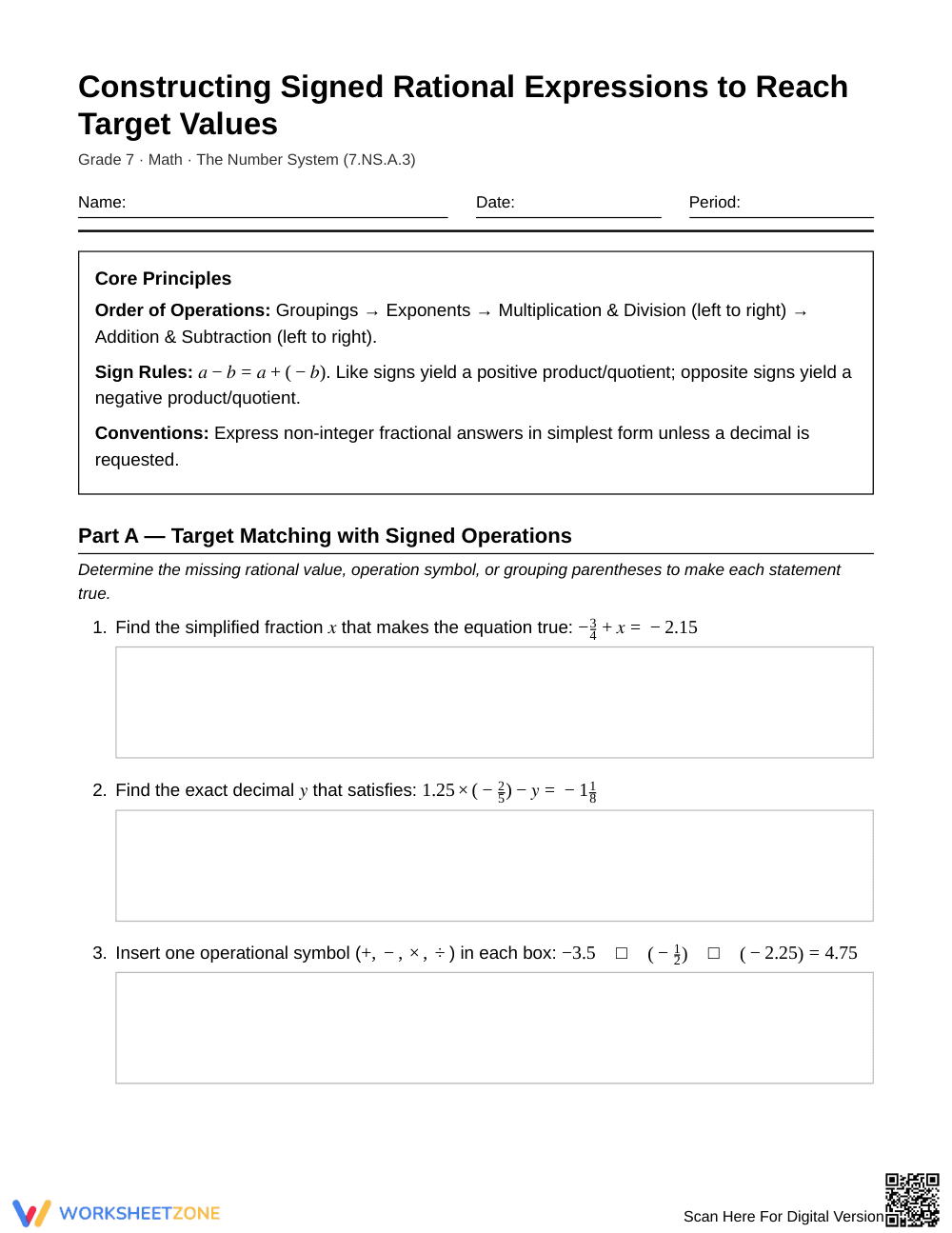
This Grade 7 math worksheet equips students to construct, balance, and evaluate complex signed rational number expressions to achieve specific target values. Learners synthesize positive and negative fractions, decimals, and integers under proper order of operations, deepening their conceptual understanding of rational number arithmetic and operational flexibility.
At a Glance
- Grade: 7 · Subject: Math
- Standard:
7.NS.A.3— Solve multi-step arithmetic problems using operations with positive and negative rational numbers- Skill Focus: Construct a Signed Expression with a Target Value
- Format: 5 pages · 14 problems · Answer key included · PDF
- Best For: Rational number operations mastery practice
- Time: 45–60 minutes
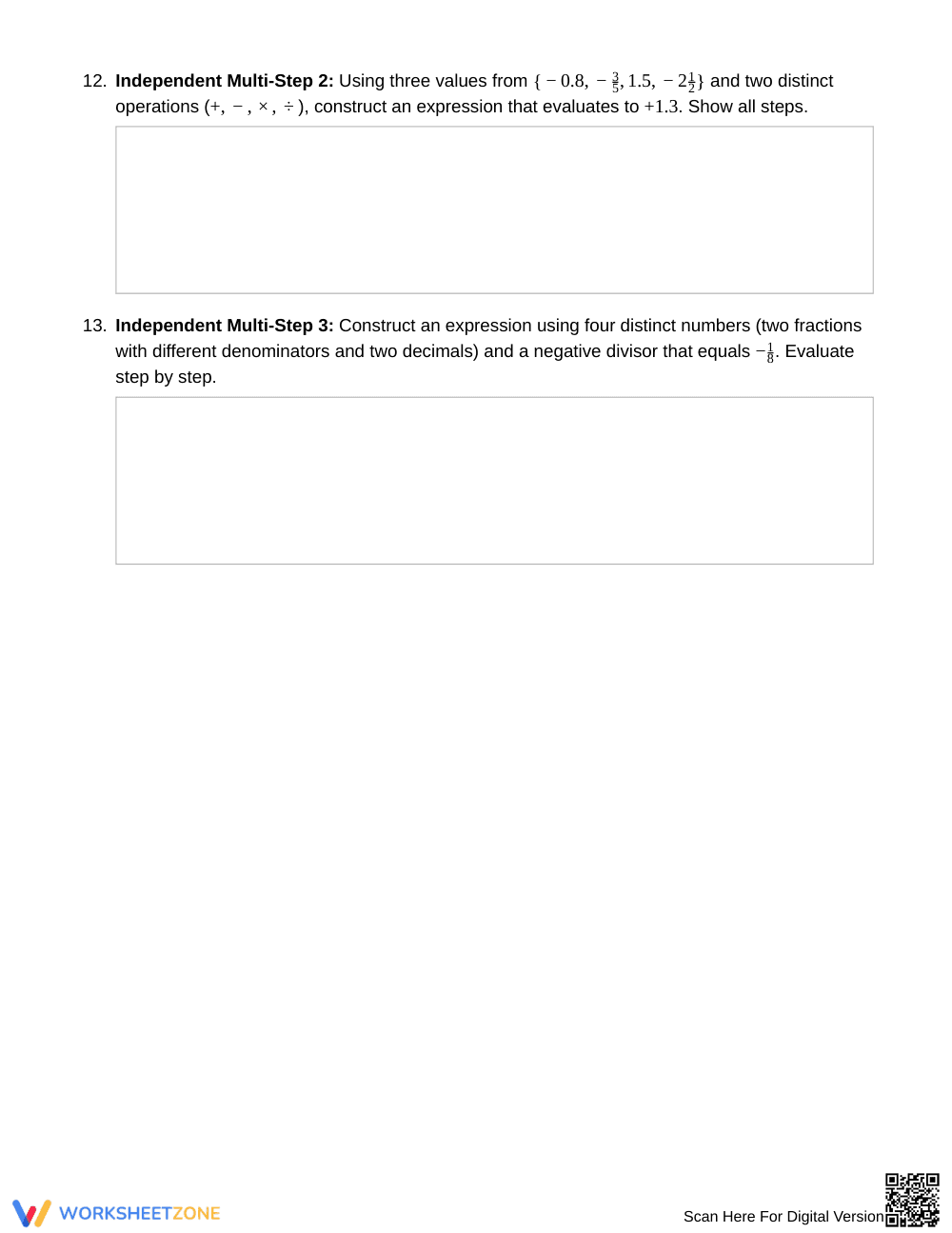
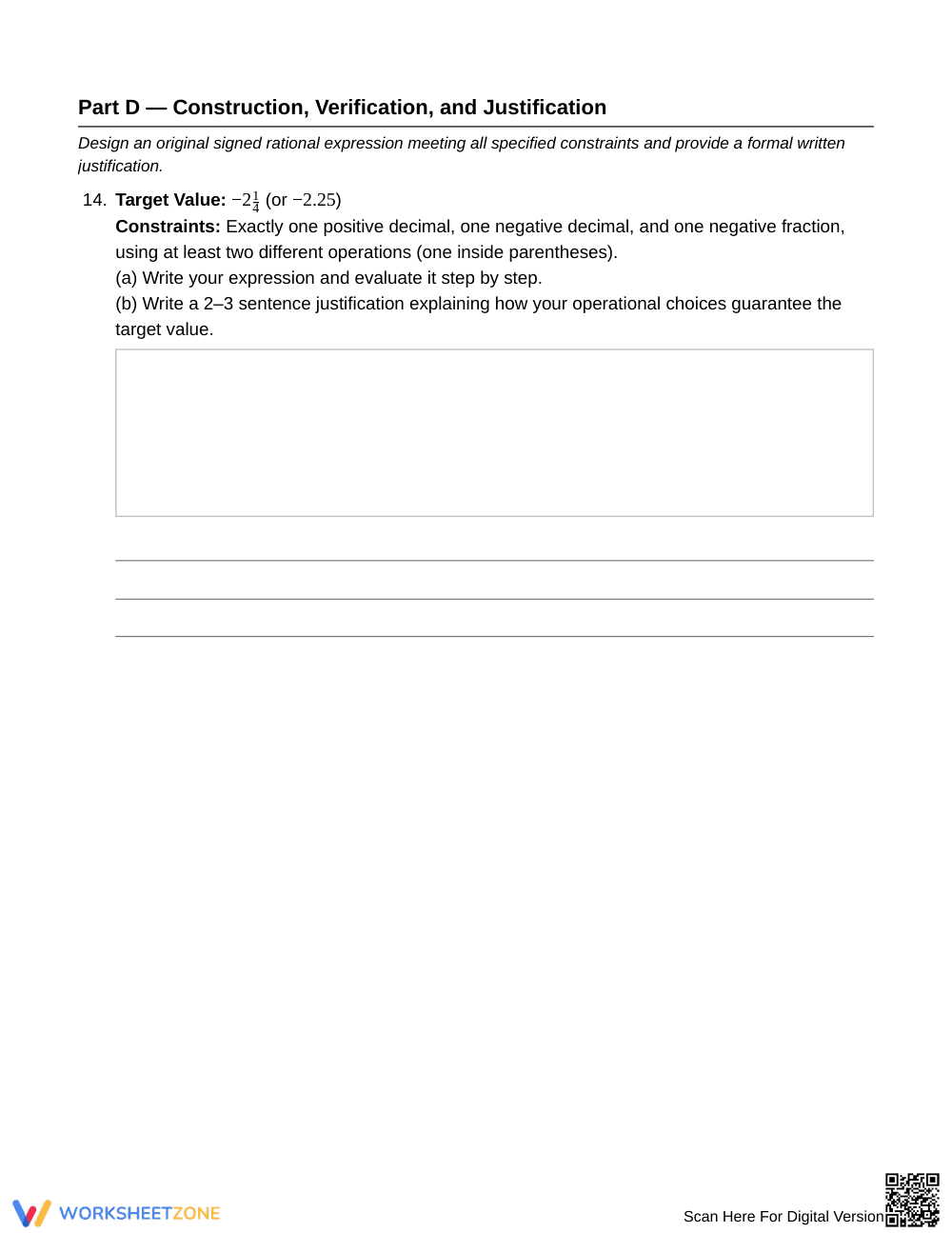
Spanning 5 pages, this resource contains 14 rigorous tasks organized across four structured parts. It opens with an essential reference box covering order of operations, sign rules, and fractional conventions. Students encounter missing-value equations, four-card rational number banks, multi-step contextual modeling problems, and an open-ended justification challenge. A comprehensive 3-page answer key provides complete step-by-step evaluations for immediate feedback.
Skill Progression
- Guided Practice (Part A, 4 problems): High scaffolding with target-matching exercises where learners determine missing values, insert operation symbols, or place parentheses to satisfy target equations.
- Supported Practice (Part B, 4 problems): Intermediate scaffolding using discrete number banks, prompting students to optimize sums, products, and quotients under structured constraints.
- Independent Practice (Parts C & D, 6 problems): Minimal scaffolding featuring multi-step temperature modeling, open-ended rational constraints, and complete written justification of operational choices.
This sequence follows a gradual-release instructional model, transitioning students from structured equation completion to autonomous algebraic synthesis.
Standards Alignment
This worksheet directly aligns with 7.NS.A.3: Solve real-world and mathematical problems involving the four operations with rational numbers. It also reinforces foundational standard 7.NS.A.1 through strategic addition and subtraction of signed fractions and decimals. Both standard codes can be copied directly into lesson plans, IEP goals, or district curriculum mapping tools.
How to Use It
Deploy this worksheet after direct instruction on signed rational operations to solidify algebraic reasoning. During independent or partner work, observe how students handle negative divisors and grouping symbols in Part B; students frequently confuse sign inversion rules during multi-step division. The complete 14-problem set requires approximately 45 to 60 minutes of focused instructional time.
Who It's For
This activity is designed for Grade 7 general mathematics students, accelerated Grade 6 learners, or Grade 8 students needing targeted algebraic remediation. Provide number lines or integer chips for struggling learners navigating sign combinations. Pair this practice with a rational operations anchor chart or a worked-example modeling mini-lesson.
Targeting standard 7.NS.A.3, this Grade 7 mathematics resource develops student competency in constructing signed rational expressions to match designated target values. Students manipulate positive and negative fractions, decimals, and parentheses, requiring both procedural fluency and structural reasoning across rational number systems. According to Fisher & Frey (2014), purposeful instructional design that couples deliberate problem constraints with explicit written justification accelerates the transition from mechanical calculation to deep conceptual mastery. By evaluating expressions under strict multi-step parameters, learners build algebraic flexibility, reconcile competing operational rules, and verify numerical equivalence with precision. The accompanying three-page answer key details intermediate computational steps, supporting diagnostic error analysis and systematic feedback. Consequently, this worksheet serves as an effective instrument for standard-aligned practice, targeted small-group intervention, and formative evaluation of multi-step rational number fluency across middle school mathematics curricula.


