


























Views
Downloads



Complete Rhetorical Appeals Worksheet | Grade 10 English II
Paste this activity's link or code into your existing LMS (Google Classroom, Canvas, Teams, Schoology, Moodle, etc.).
Students can open and work on the activity right away, with no student login required.
You'll still be able to track student progress and results from your teacher account.
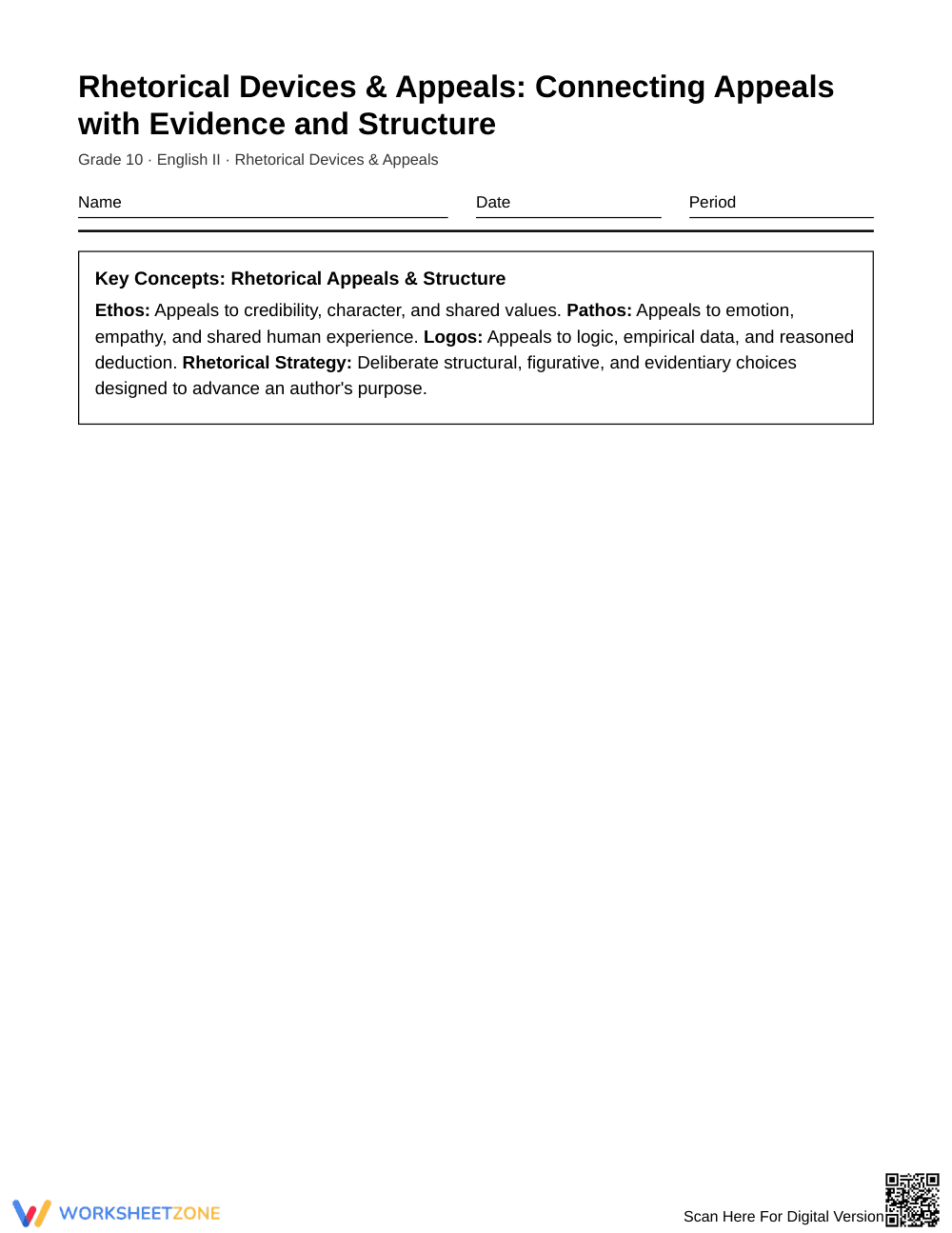
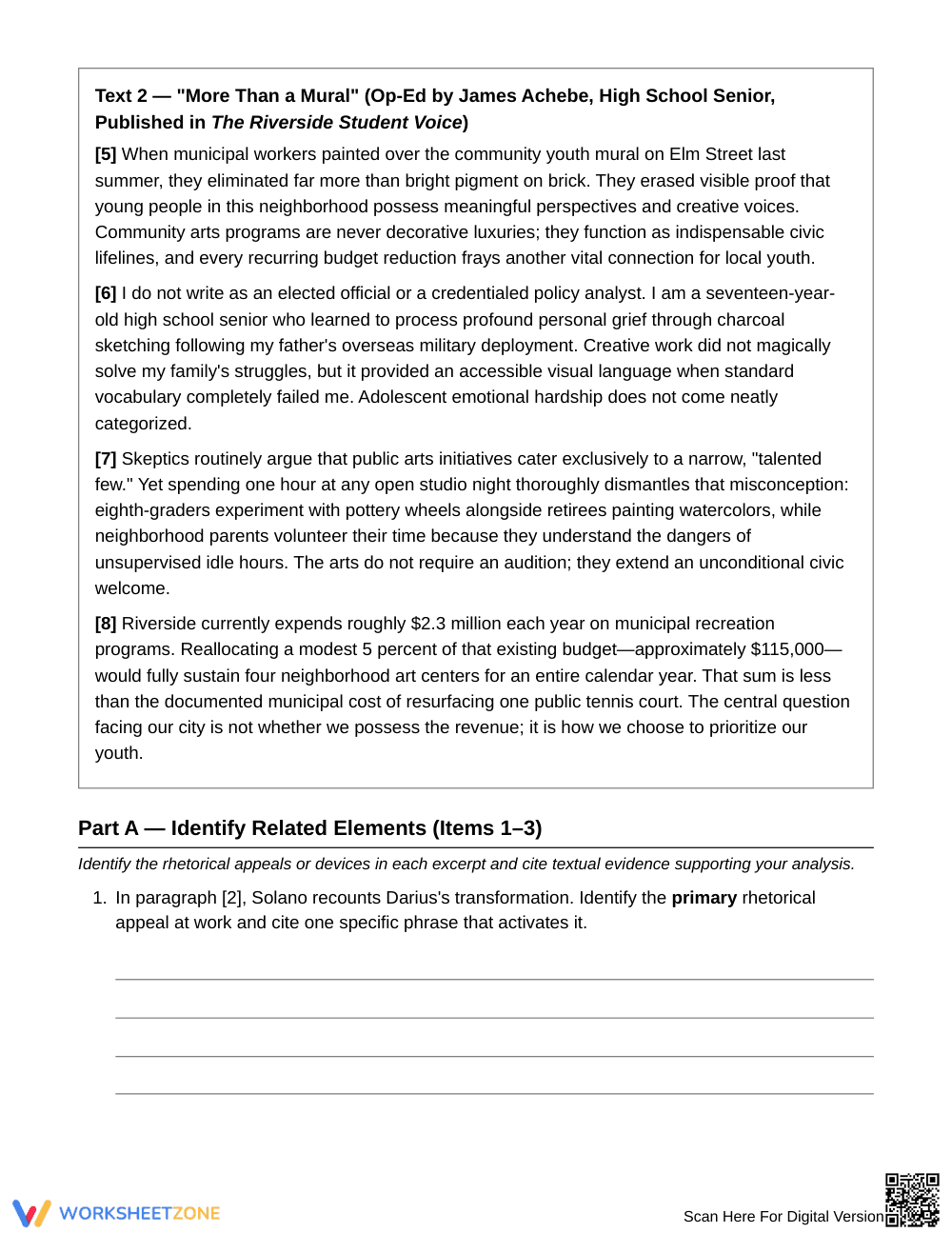
This Grade 10 English II worksheet helps students analyze how authors connect rhetorical appeals to evidence and structure. Analyzing two paired persuasive texts on municipal arts funding, high schoolers evaluate ethos, pathos, and logos, examine structural choices, and justify how rhetorical organization advances an author's core purpose.
At a Glance
- Grade: 10 · Subject: English II
- Standard:
RI.9-10.6— Determine author's purpose and analyze how rhetoric advances that purpose- Skill Focus: Connect Appeals with Evidence and Structure
- Format: 6 pages · 12 problems · Answer key included · PDF
- Best For: Rhetorical analysis and paired-text close reading
- Time: 45–60 minutes
What's Inside
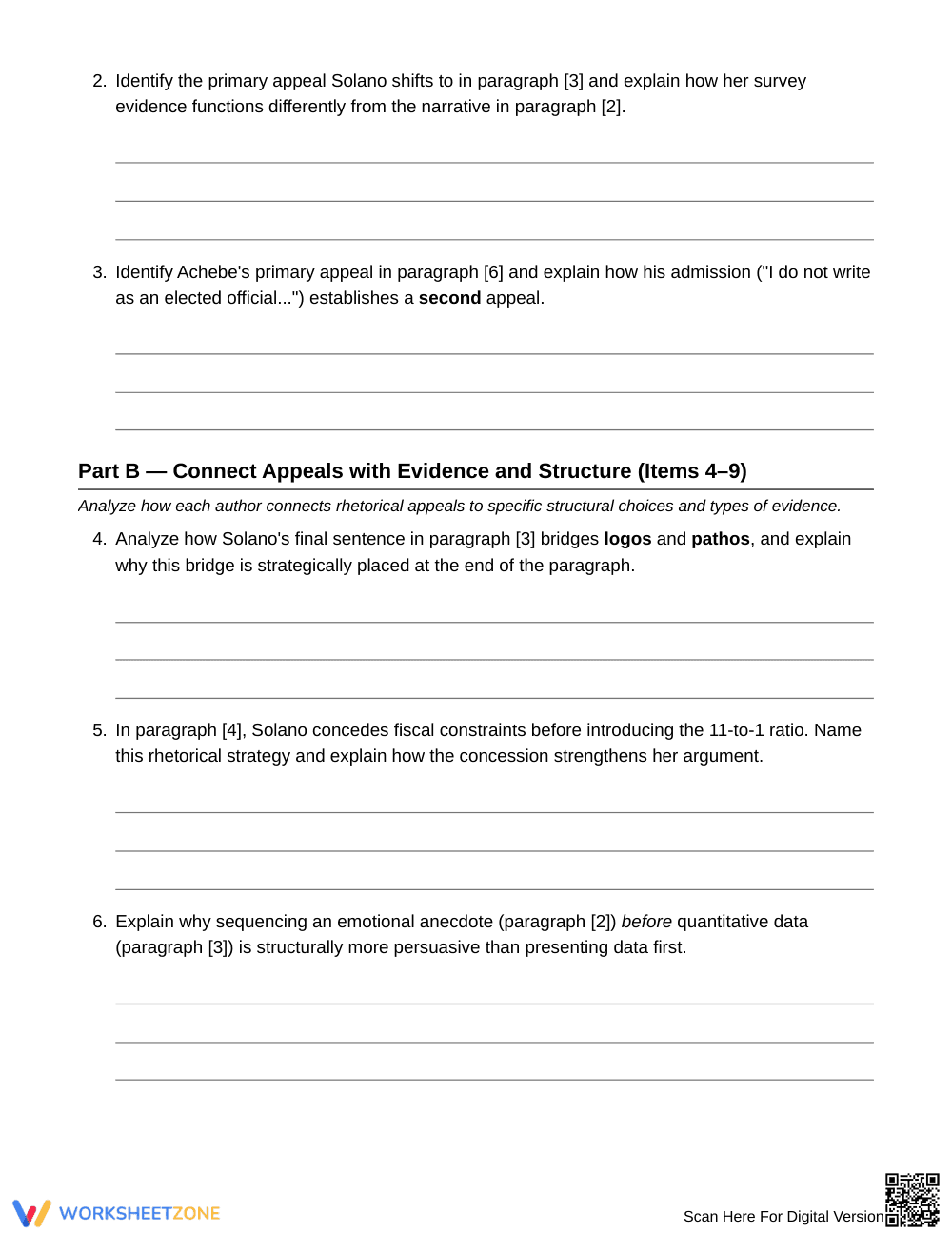
This 6-page printable resource includes two contrasting opinion texts: a formal city council keynote address and a student newspaper op-ed. Students utilize a foundational concept reference box before completing 12 analytical problems across three parts. The document also includes an analytical self-monitoring checklist and a complete 3-page answer key with exemplar responses.
Skill Progression
The 12 items follow a gradual-release instructional model:
- Guided Practice (Items 1–3): Students identify discrete rhetorical appeals in short excerpts and cite textual evidence with high initial support.
- Supported Practice (Items 4–9): Learners analyze how appeals interact with structural sequencing, concessions, and comparative data with moderate scaffolding.
- Independent Practice (Items 10–12): Students independently evaluate audience awareness, compare rhetorical positions, and critique evidentiary limitations.
This progression moves learners methodically from foundational recognition to independent rhetorical synthesis.
Standards Alignment
This worksheet aligns directly with `RI.9-10.6`: "Determine an author's point of view or purpose in a text and analyze how an author uses rhetoric to advance that point of view or purpose." It also supports `RI.9-10.5` by evaluating structural sentence relationships. Both standard codes can be copied directly into lesson plans, IEP goals, or district curriculum mapping tools.
How to Use It
Assign this worksheet following direct instruction on the rhetorical triangle. In a close reading lesson, have students read both speeches and complete Part A in pairs before tackling Parts B and C independently. For formative assessment, observe whether students distinguish between emotional narrative and empirical data when justifying structural placement. Expected completion time is 45 to 60 minutes.
Who It's For
This resource serves Grade 10 English II students and pre-AP cohorts mastering rhetorical analysis. The concept box provides accessible entry points for striving readers, while Part C challenges advanced analytical thinkers. Pair this worksheet with direct instruction on classical argumentative structures or persuasive speech writing.
Aligned to standard RI.9-10.6, this Grade 10 English II resource targets connecting rhetorical appeals with evidence and structure using paired civic texts. High school students systematically deconstruct how persuasive authors employ ethos, pathos, and logos alongside tactical devices such as concessions, counterargument refutations, and comparative statistics. Grounded in the gradual-release framework established by Fisher & Frey (2014), the worksheet guides learners across twelve scaffolded items from initial appeal identification to sophisticated whole-text evaluation. Educational research indicates that comparing paired arguments enhances critical reading comprehension and sharpens analytical writing. By combining rigorous textual citation with an integrated self-assessment checklist, this activity ensures students understand how structural choices reinforce persuasive claims. The comprehensive six-page layout provides secondary educators with an evidence-based tool that measurably improves rhetorical analysis performance, critical thinking stamina, and standards mastery across diverse classroom settings.


