




























Views
Downloads


Complete Repair Gaps & Digressions Worksheet | Grade 7 ELA

Paste this activity's link or code into your existing LMS (Google Classroom, Canvas, Teams, Schoology, Moodle, etc.).
Students can open and work on the activity right away, with no student login required.
You'll still be able to track student progress and results from your teacher account.
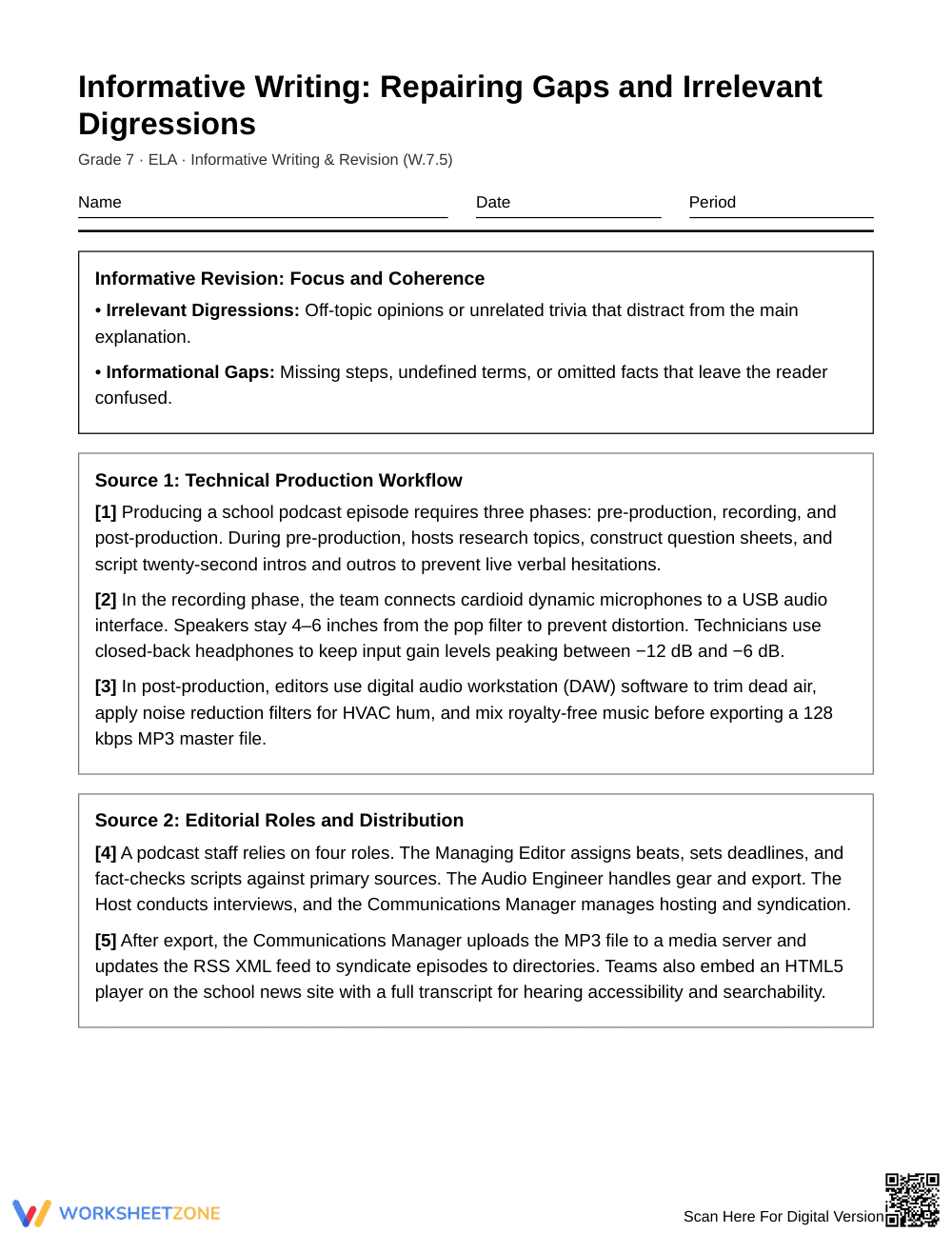
This Grade 7 informative writing worksheet equips students to strengthen texts by eliminating irrelevant digressions and repairing technical gaps. Learners evaluate a flawed student draft against technical sources, practice targeted sentence revisions, and compose a cohesive informational briefing backed by textual evidence.
At a Glance
- Grade: 7 · Subject: ELA
- Standard:
W.7.5— Strengthen writing by planning, revising, editing, and rewriting focused texts- Skill Focus: Repairing Gaps and Irrelevant Digressions
- Format: 4 pages · 10 problems · Answer key included · PDF
- Best For: Informative revision and targeted writing practice
- Time: 45–60 minutes
Inside this 4-page resource, educators will find two technical source passages, a flawed student draft, and 10 structured tasks. Exercises span diagnostic multiple-choice and short-answer prompts, sentence rewrites, and an extended briefing draft with a revision audit checklist. A 3-page answer key provides complete model responses and diagnostic notes.
Skill Progression
- Guided Practice (Items 1–3): Students analyze the flawed draft alongside sources, diagnosing off-topic personal anecdotes and omitted technical steps.
- Supported Practice (Items 4–8): Learners execute sentence-level repairs, replacing vague phrasing with domain terms and integrating workflow details.
- Independent Practice (Items 9–10): Students synthesize source facts into a 200–280 word briefing, verifying focus and precision with an audit table.
This gradual-release model guides writers from analytical evaluation to independent compositional mastery.
Standards Alignment
This resource aligns to W.7.5: "With some guidance and support from peers and adults, develop and strengthen writing as needed by planning, revising, editing, rewriting, or trying a new approach." It also reinforces W.7.2 through domain-specific vocabulary and informative organization. Both standard codes can be copied directly into lesson plans, IEP goals, or district curriculum mapping tools.
How to Use It
Deploy this worksheet after direct instruction on informative text organization and revision strategies. In a guided workshop, have students complete Part A in pairs before tackling Part B independently. For formative assessment, examine Items 4 and 8 to evaluate how students replace vague statements with precise terminology. Expect completion to take 45 to 60 minutes.
Who It's For
This resource serves Grade 7 English Language Arts students mastering informational revision, including general education classrooms and intervention groups. Differentiate by using source definitions as a vocabulary reference for striving writers. Pair this printable with a direct instruction lesson on technical vocabulary or an anchor chart on cohesive transitions.
Developing revision competence is essential for middle school literacy outcomes. According to Fisher & Frey (2014), explicit instruction in evaluating and repairing informational texts helps students internalize the cognitive habits of expert writers. Under Common Core standard W.7.5, Grade 7 students must learn to strengthen draft clarity by identifying informational gaps, eliminating irrelevant digressions, and inserting precise domain-specific facts. Research demonstrates that scaffolded writing tasks—progressing from error diagnosis to targeted sentence rewrites and culminating in independent synthesis—yield substantial gains in writing quality. When students actively cross-reference technical source material to repair flawed prose, they build lasting informational coherence and audience awareness. By pairing analytical evaluation with structured composition and evidence-based self-audits, this instructional resource bridges foundational reading comprehension and high-utility informative writing skills across secondary curricula.


