




























Views
Downloads



Complete Renewal Word Search | Grades 6–7 Social Studies

Paste this activity's link or code into your existing LMS (Google Classroom, Canvas, Teams, Schoology, Moodle, etc.).
Students can open and work on the activity right away, with no student login required.
You'll still be able to track student progress and results from your teacher account.
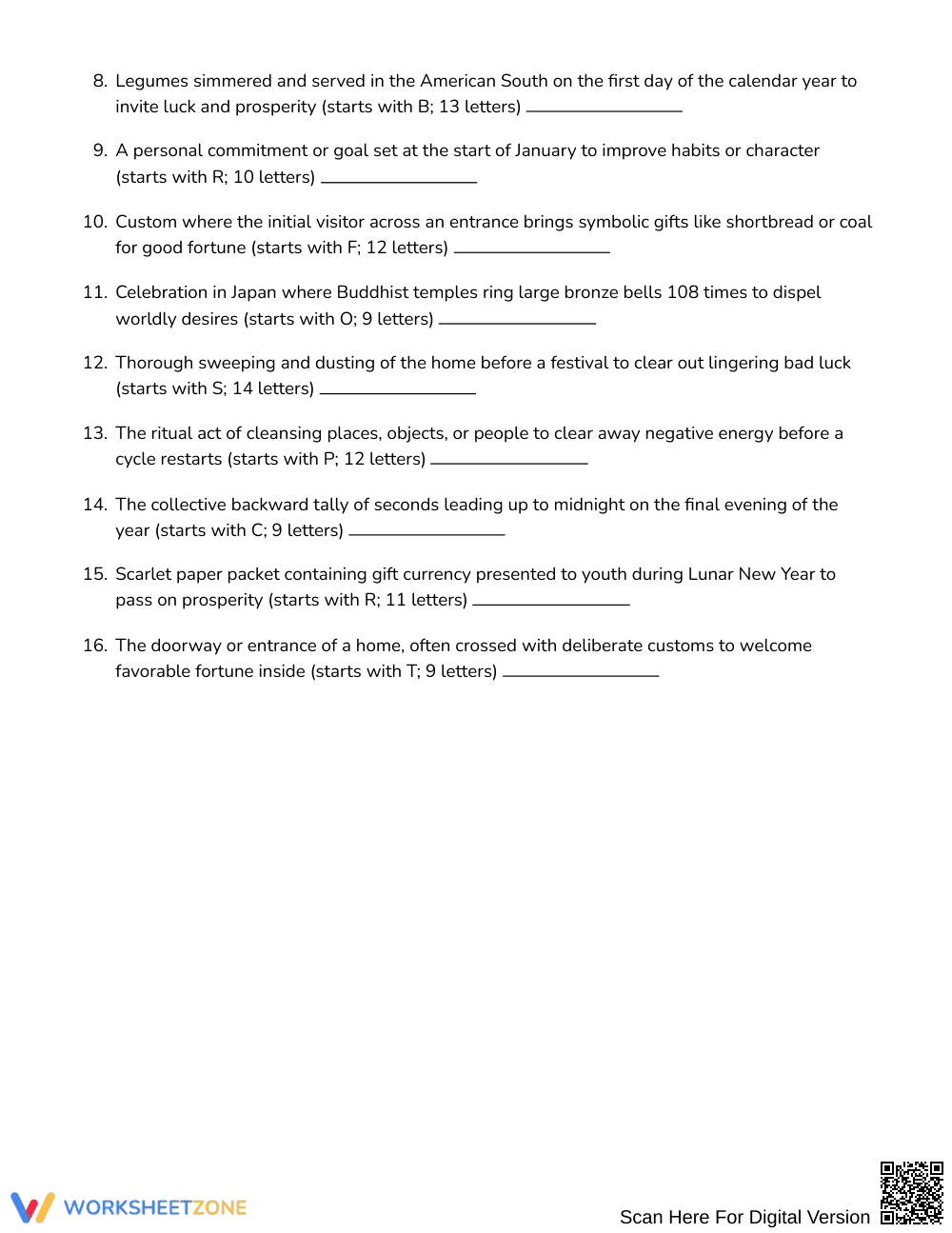
This Grades 6–7 social studies word search builds cultural awareness by engaging learners with traditions of renewal from global civilizations. Students read historical and cultural clues to deduce sixteen key terms before finding them in an unassisted grid, deepening their conceptual understanding of how societies mark new beginnings.
At a Glance
- Grade: Grades 6–7 · Subject: Social Studies · Unit: Community & Culture
- Standard: Not standards-assessed — vocabulary enrichment
- Skill Focus: Traditions of renewal across global cultures
- Format: 3 pages · 16 words · 4-page answer key included · PDF
- Best For: Cultural vocabulary enrichment, holiday exploration, and bell-ringer work
- Time: 25–35 minutes of focused learning
What's Inside
This 3-page printable activity delivers a rigorous no-bank challenge centered on world renewal customs. Rather than relying on a simple word bank, the resource provides sixteen contextual clues spanning diverse rituals such as Nowruz, Songkran, Tashlich, and Oshogatsu. Students analyze each definition to identify the hidden term, then locate it in the puzzle. A comprehensive 4-page answer key provides clear solution paths for efficient teacher review or student self-checking.
How the Puzzle Works
The puzzle features an 18 x 18 letter grid engineered for rigorous visual scanning. Words run in all 8 compass directions: north, northeast, east, southeast, south, southwest, west, and northwest, including forward and backward orientations. Because there is no word bank, students must rely on clue-based retrieval, using semantic clues to identify all 16 target words before locating them within the matrix.
Standards Alignment
This learning resource serves as focused vocabulary enrichment within middle school social studies and is not aligned to a specific state or national standard. It supports cultural literacy by familiarizing students with historical customs, seasonal celebrations, and shared human motifs of rebirth across global societies.
How to Use It
Deploy this word search during direct instruction on world cultures as an interactive mid-lesson check, or assign it afterward as an engaging culminating activity. During classwork, circulate to observe whether students recognize ritual names from clues alone or require context prompts. Expect completion within 25 to 35 minutes depending on partner collaboration.
Who It's For
This puzzle is designed for Grades 6–7 social studies classrooms exploring world geography, comparative culture, or seasonal customs. For differentiation, permit emerging readers to partner with a peer or highlight clue keywords, while advanced learners complete the search independently. Pair this activity directly with a cultural reading passage or world calendar anchor chart.
Vocabulary acquisition research by Fisher & Frey (2014) demonstrates that intentional word exposure paired with semantic retrieval prompts significantly accelerates domain-specific language retention in middle grades social studies. This word search targets traditions of renewal across diverse world cultures, requiring students to interpret 16 analytical clues rather than passively copying terms from a predetermined list. By eliminating the word bank, the activity demands active cognitive processing, prompting learners to connect cultural definitions—such as purification ceremonies, seasonal thresholds, and New Year customs—directly to specific cultural terminology before conducting visual pattern searches across the 18 x 18 grid. Although designed as non-assessed cultural vocabulary enrichment rather than a standards-aligned assessment, the structure reinforces cross-cultural schema building and contextual reasoning. Teachers can utilize this clue-driven exercise to solidify foundational background knowledge, enhance historical vocabulary fluency, and stimulate comparative discussions regarding global celebrations of renewal.


