


























Views
Downloads



Complete Quantities from Percents Worksheet | Grade 7 Math
Paste this activity's link or code into your existing LMS (Google Classroom, Canvas, Teams, Schoology, Moodle, etc.).
Students can open and work on the activity right away, with no student login required.
You'll still be able to track student progress and results from your teacher account.
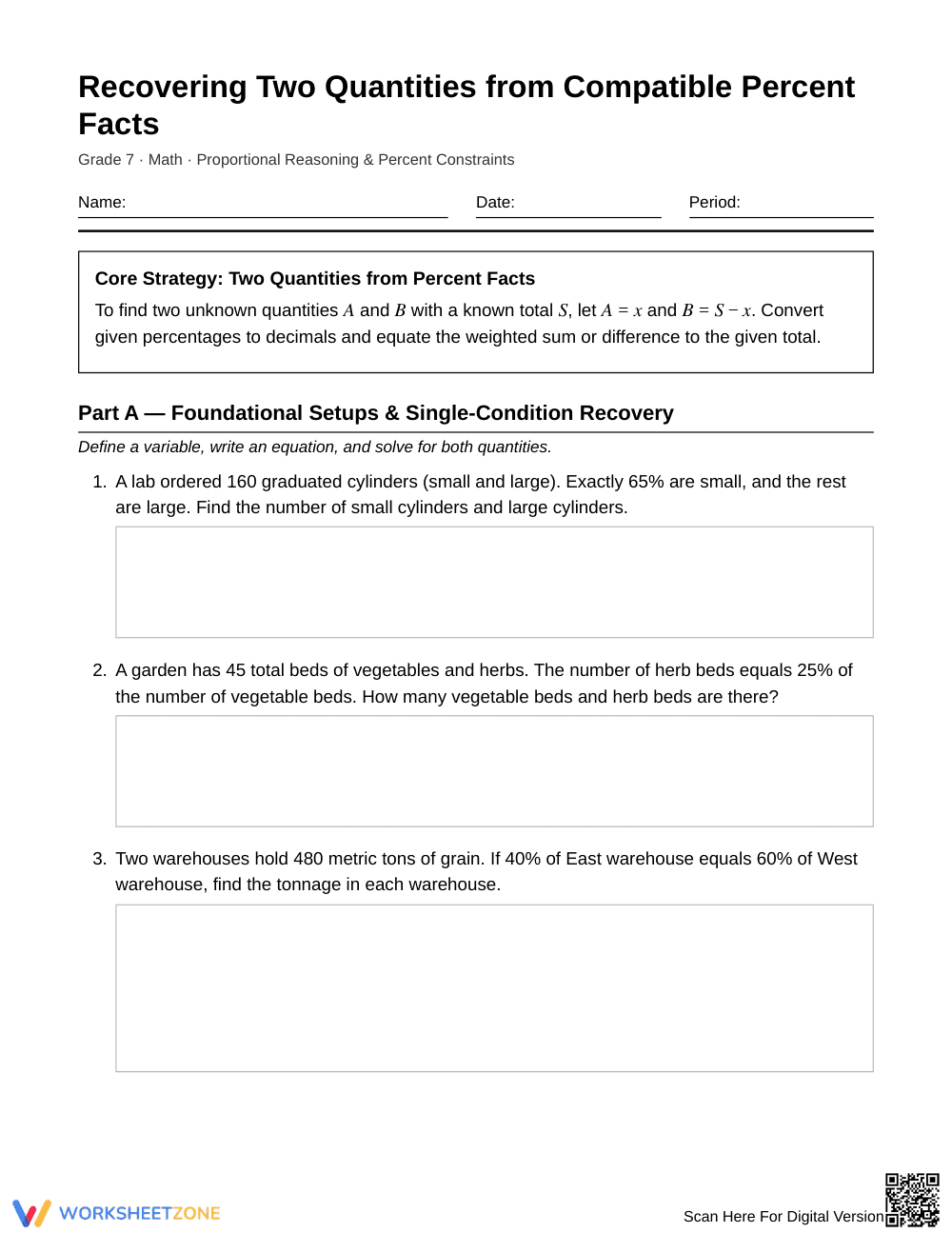
This Grade 7 math worksheet teaches students to recover two unknown quantities from proportional percent constraints. Students translate realistic scenarios into single-variable linear equations using algebraic substitution. By mastering compatible percent relationships, learners develop fluency in multi-step problem solving, transitioning smoothly from concrete quantities to abstract mathematical modeling.
At a Glance
- Grade: 7 · Subject: Math
- Standard:
7.RP.A.3— Solve multi-step percent problems involving proportional relationships and unknown quantities- Skill Focus: Recover Two Quantities from Percent Facts
- Format: 4 pages · 10 problems · Answer key included · PDF
- Best For: Guided practice and independent problem solving
- Time: 45–60 minutes
What's Inside
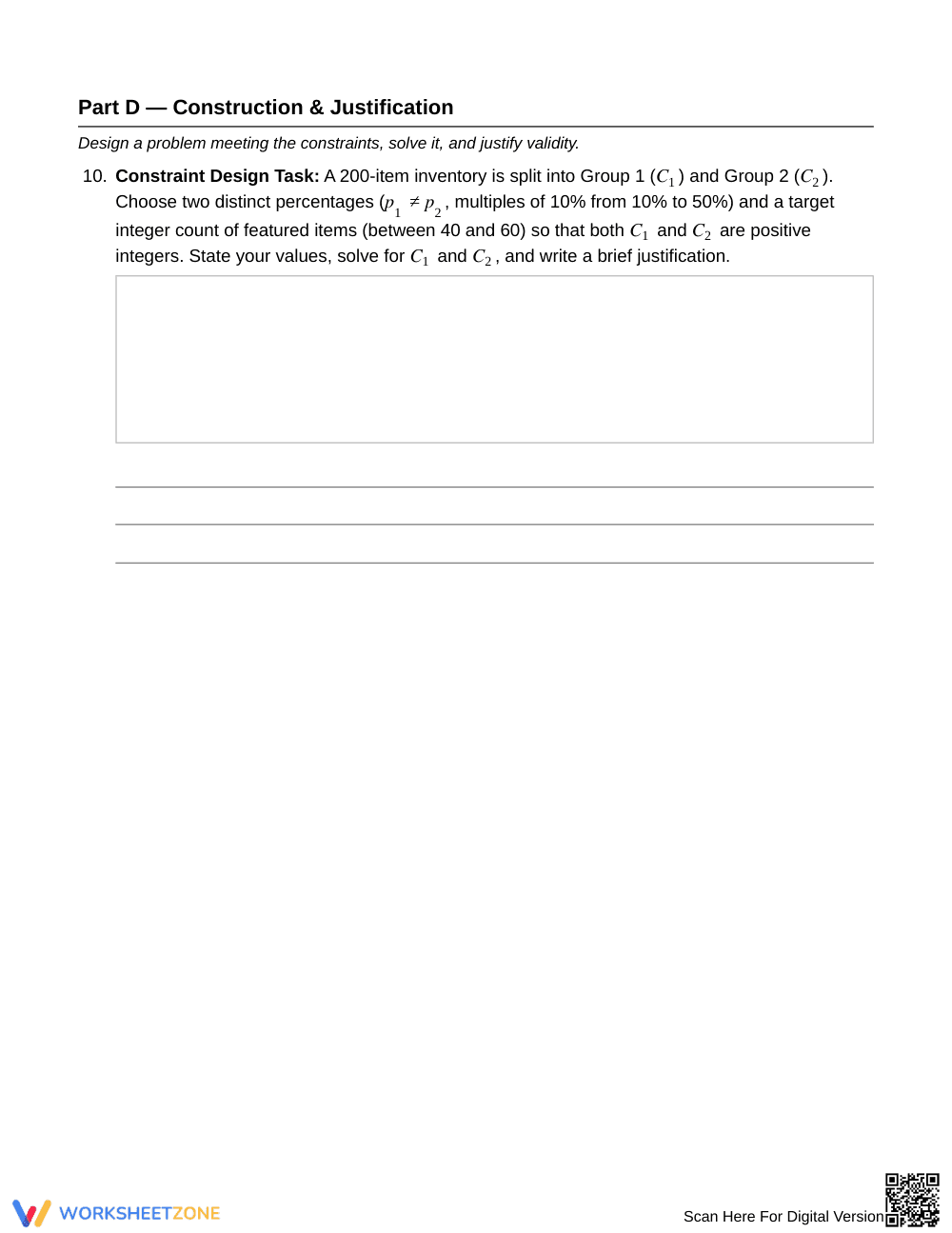
This 4-page printable document provides 10 structured tasks targeting percent constraints. A reference strategy box opens the assignment by establishing algebraic modeling rules. The worksheet includes variable definition scaffolds, multi-step real-world application items, an open-ended constraint design challenge, and a comprehensive 2-page answer key detailing complete equation setups and final solutions.
Skill Progression
- Guided practice (Part A, 4 tasks): Foundational single-condition problems where students practice variable definitions and basic equation setups with clear numerical totals.
- Supported practice (Part B, 2 tasks): Explicitly scaffolded multi-step problems providing prompt frames such as defining one quantity as x and the second as the total minus x.
- Independent practice (Parts C & D, 4 tasks): Unscaffolded multi-step word problems, tool inventory extensions, and an original constraint design task requiring mathematical justification.
This structure follows an intentional gradual-release model, shifting cognitive ownership from guided variable definition to autonomous equation formulation.
Standards Alignment
This activity aligns with primary standard `7.RP.A.3`, which requires students to use proportional relationships to solve multi-step ratio and percent problems. It also supports `7.EE.B.4` by prompting learners to construct and solve linear equations representing real-world quantities. Both standard codes can be copied directly into lesson plans, IEP goals, or district curriculum mapping tools.
How to Use It
Deploy this worksheet after direct instruction on setting up percent equations. During class, use Parts A and B for paired collaboration while circulating to check whether students correctly express the second quantity as the total minus x. Then, assign Part C for independent assessment within a 45- to 60-minute instructional block.
Who It's For
This resource serves Grade 7 math classrooms, accelerated Grade 6 math cohorts, and Grade 8 algebra readiness interventions. Teachers can pair this practice set directly with visual bar models or tape diagram anchor charts to reinforce part-whole relationships before setting up equations.
Mastering multi-step percent equations under standard 7.RP.A.3 requires students to coordinate proportional reasoning with algebraic modeling. Rather than relying on rote algorithmic tricks, recovering two unknown quantities from compatible percent facts trains learners to represent complementary quantities using single-variable expressions. According to Fisher & Frey (2014), structured gradual-release frameworks significantly enhance problem-solving retention by bridging teacher modeling, collaborative practice, and independent application. This worksheet embeds that pedagogical sequence across 10 targeted tasks, starting with scaffolded variable identification before progressing to complex constraint justification. Middle school mathematics students who systematically practice decomposing combined totals into algebraic components develop greater conceptual flexibility in linear algebra and systems of equations. Educational practitioners can leverage this rigorous four-page resource to diagnose student misconceptions around percent operations, monitor variable definition accuracy, and ensure measurable mastery across standards-based proportional reasoning objectives.


