




























Views
Downloads




Complete Protein Synthesis Worksheet | Grade 10 Biology

Paste this activity's link or code into your existing LMS (Google Classroom, Canvas, Teams, Schoology, Moodle, etc.).
Students can open and work on the activity right away, with no student login required.
You'll still be able to track student progress and results from your teacher account.
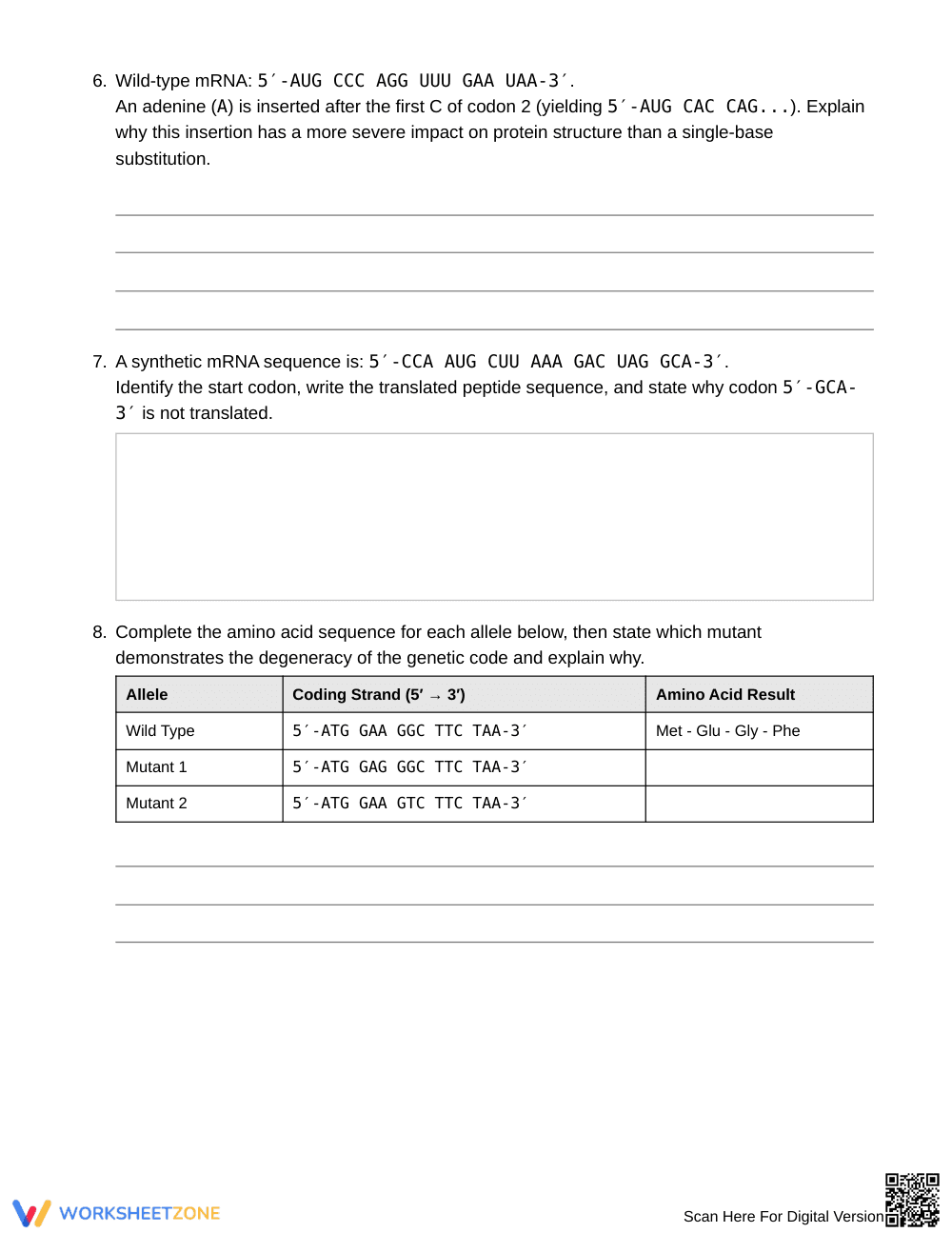
This Grade 10 protein synthesis worksheet delivers rigorous practice in decoding genetic information from DNA to functional polypeptides. Students analyze strand polarities, translate codons using a standard genetic code chart, evaluate silent, missense, nonsense, and frameshift mutations, and interpret biochemical data from translation inhibitor experiments.
At a Glance
- Grade: 10 · Subject: Biology
- Standard: Model how DNA sequences determine amino acid sequences in proteins
- Skill Focus: Transcription, translation, codon reading, and mutation analysis
- Format: 5 pages · 12 problems · Answer key included · PDF
- Best For: Mid-unit checks, review, and lab prep
- Time: 40–55 minutes
What's Inside
This 5-page printable resource includes 12 multi-tiered tasks divided into three distinct parts, supported by an embedded mRNA codon reference table. It features structural comparison tables, sequence decoding items with explicit 5′ and 3′ polarities, mutation classification prompts, degeneracy calculation items, and experimental translation assay data. A complete 2-page answer key provides step-by-step explanations and full sequence keys.
Skill Progression
- Guided Practice (Part A, Items 1–3): Students solidify foundational mechanics by identifying eukaryotic transcription properties, mapping tRNA anticodons to mRNA codons, and completing a structured comparative table of RNA polymerase versus the ribosome.
- Supported Practice (Part B, Items 4–9): Learners apply the genetic code to transcribe template DNA, decode reading frames, calculate coding degeneracy, and contrast the structural severity of single-base substitutions against frameshift insertion mutations.
- Independent Practice (Part C, Items 10–12): Students analyze a synthetic experiment involving three antibacterial compounds to deduce specific ribosomal inhibition stages and predict truncated peptide outcomes from induced nonsense mutations.
This gradual-release structure moves students systematically from basic molecular recall to high-level experimental evaluation.
Standards Alignment
This resource aligns directly with high school life science standards requiring students to construct explanations based on evidence for how the structure of DNA determines the structure of proteins, which carry out the essential functions of life through systems of specialized cells. Students trace information flow through transcription and translation and evaluate how changes in nucleotide sequences affect protein structure and function. Standard details can be copied directly into lesson plans, IEP goals, or district curriculum mapping tools.
How to Use It
Administer this worksheet during the synthesis phase of your molecular genetics unit, immediately after direct instruction on the Central Dogma. During independent seatwork, circulate and observe how students handle sequence polarity; ensure they transcribe 3′ → 5′ DNA templates into antiparallel 5′ → 3′ mRNA before referencing the codon chart. Expect completion in 40 to 55 minutes.
Who It's For
Designed for Grade 10 general and honors biology students, this worksheet offers embedded reference tables to support emerging bioscientists while delivering data-interpretation tasks that challenge advanced learners. Pair this activity with an interactive ribosome model or a transcription paper-manipulative lab for a complete hands-on learning cycle.
According to Fisher & Frey (2014), structured practice tasks that progressively shift cognitive load from guided molecular recall to independent experimental data analysis produce deeper retention of complex cellular mechanisms. This 12-task biology assignment targets high school molecular genetics by systematically walking learners through transcription base-pairing rules, translational reading frames, genetic code degeneracy calculations, and mutation classifications. By embedding authentic experimental data on translational inhibitors alongside a reference codon chart, the worksheet reinforces critical thinking, sequence polarity awareness, and causal reasoning regarding how nucleotide alterations disrupt final protein structure. It serves as an instructional asset for formative assessment and standardized test readiness.


