


























Views
Downloads

Complete Percents Above 100% Worksheet | Grade 7 Math
Paste this activity's link or code into your existing LMS (Google Classroom, Canvas, Teams, Schoology, Moodle, etc.).
Students can open and work on the activity right away, with no student login required.
You'll still be able to track student progress and results from your teacher account.
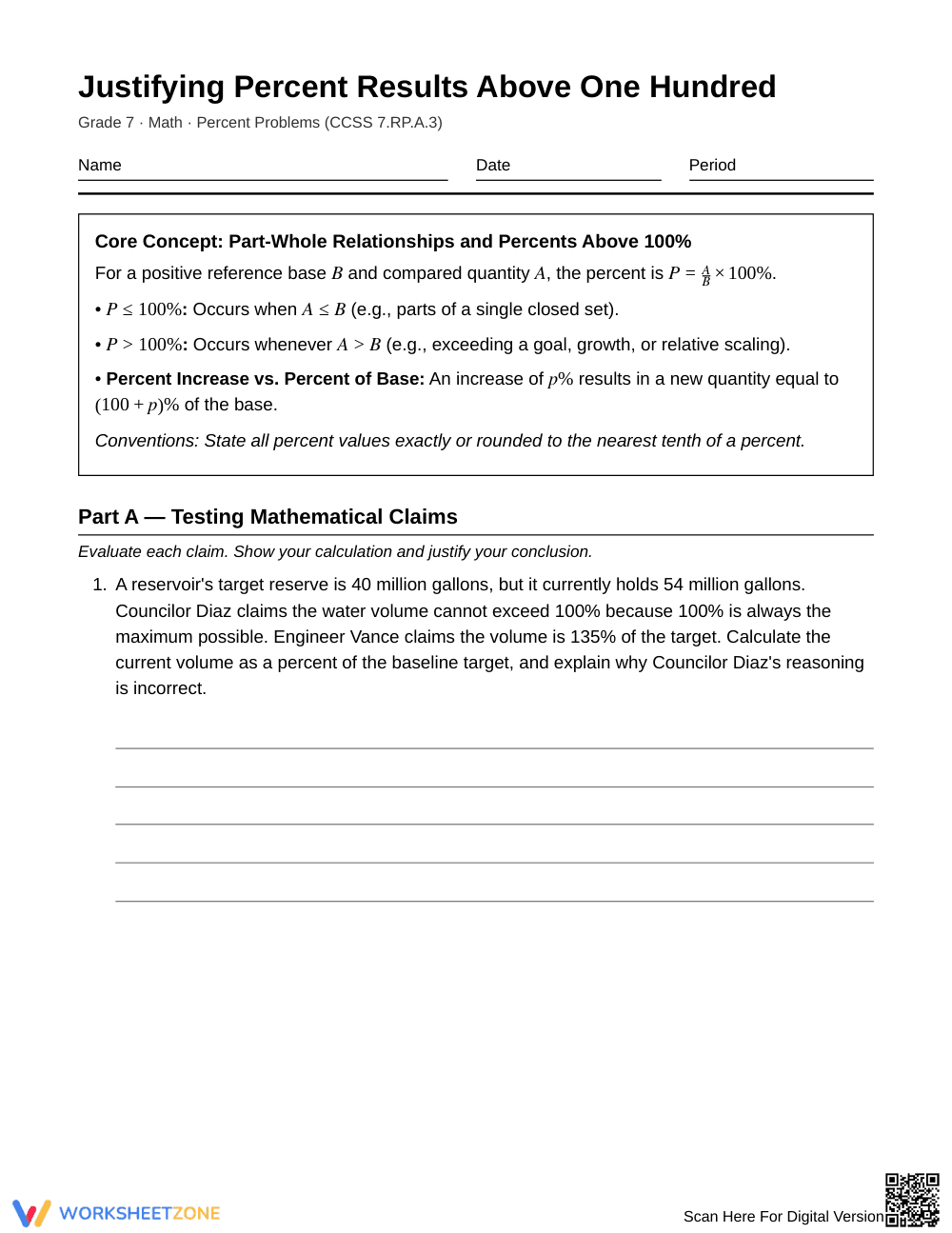
This Grade 7 math worksheet helps students master and justify percent results greater than 100% through conceptual reasoning. Students analyze mathematical claims, validate algebraic methods, and construct counterexamples to understand why quantities can exceed a baseline value, building essential reasoning skills for multistep proportional relationships.
At a Glance
- Grade: 7 · Subject: Math
- Standard:
7.RP.A.3— Solve multistep ratio and percent problems involving quantities exceeding baseline totals- Skill Focus: Justify a Percent Result Above One Hundred
- Format: 4 pages · 8 problems · Answer key included · PDF
- Best For: Conceptual percent problem practice
- Time: 40–50 minutes
What's Inside
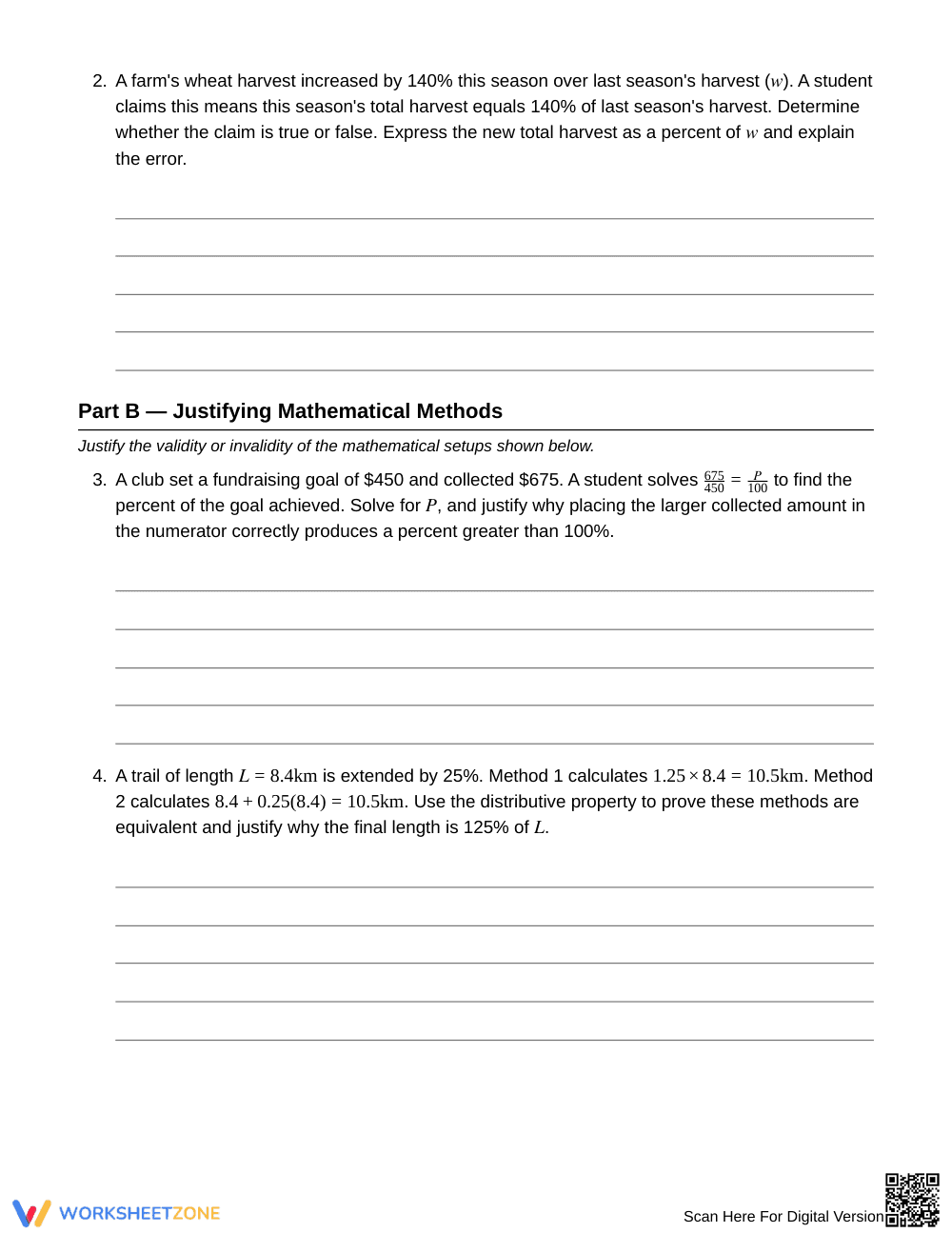
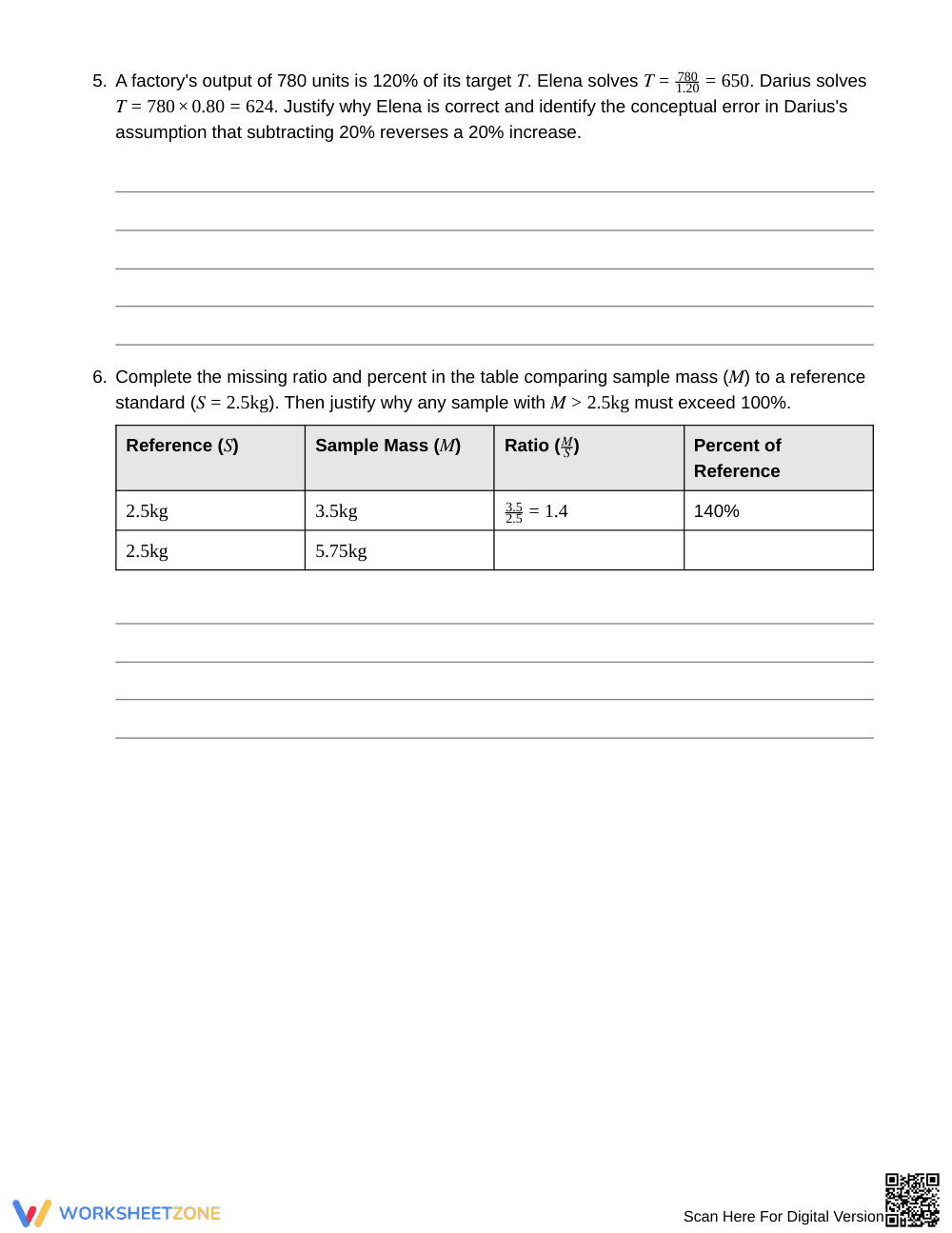
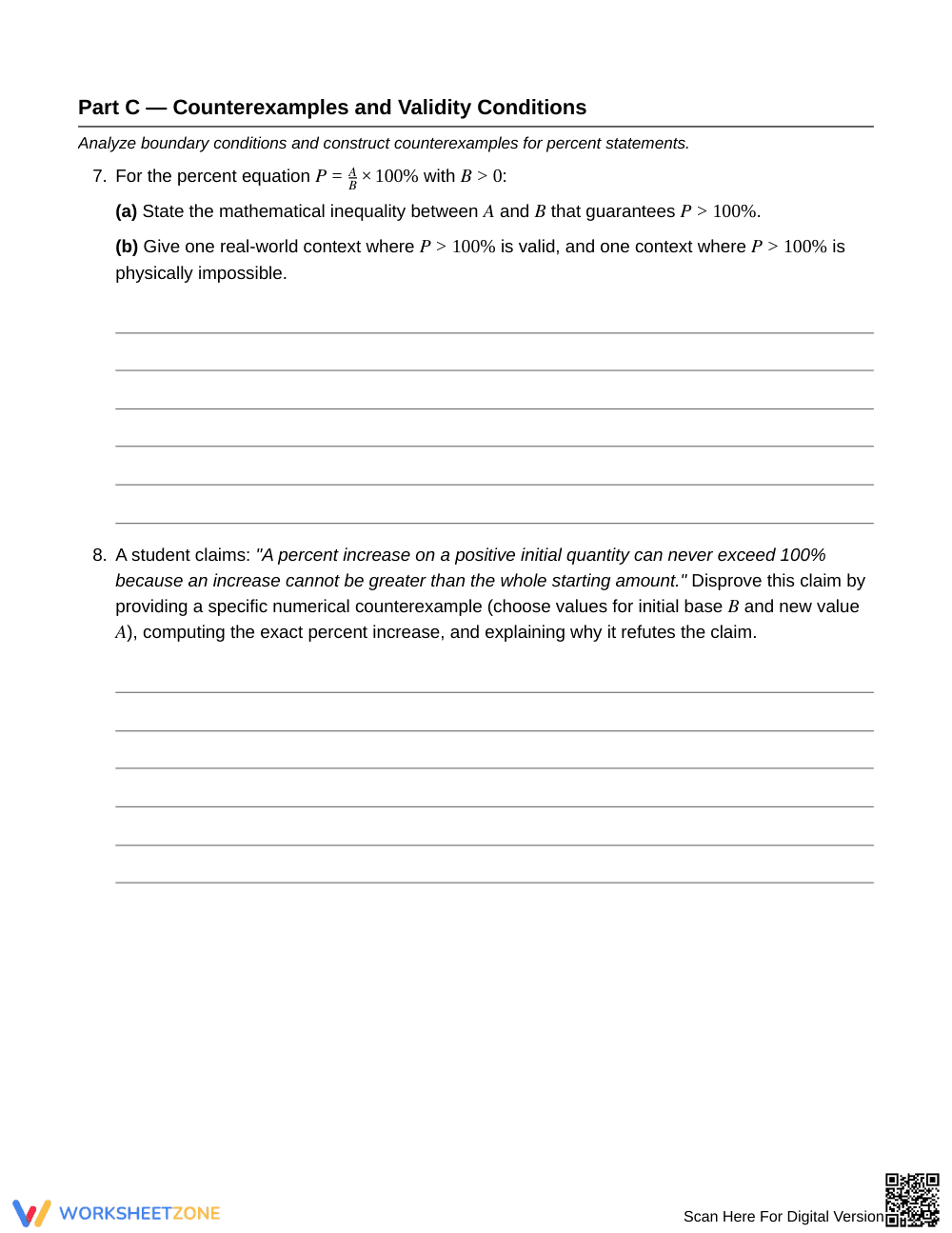
This 4-page worksheet contains 8 structured analytical problems across three parts. It includes claim evaluations, algebraic proof verifications with the distributive property, ratio tables, and boundary analyses. A 3-page answer key provides step-by-step calculations and conceptual notes.
Skill Progression
- Guided practice (Problems 1–2): Students evaluate claims about reservoir volume and crop yield to distinguish percent increase from total percent of a base.
- Supported practice (Problems 3–6): Students justify proportional setups, apply the distributive property, refute percentage reversal errors, and complete ratio tables.
- Independent practice (Problems 7–8): Students determine boundary conditions and construct original counterexamples to disprove common percent misconceptions.
This gradual-release structure guides students from initial claim evaluation to independent mathematical justification.
Standards Alignment
This resource aligns with 7.RP.A.3: Use proportional relationships to solve multistep ratio and percent problems. Supporting standard 7.EE.A.2 reinforces rewriting expressions to show quantity relationships. Both standard codes can be copied directly into lesson plans, IEP goals, or district curriculum mapping tools.
How to Use It
Use this worksheet during guided practice or after direct instruction on multistep ratios. During work time, observe if students confuse an increase of p% with (100 + p)% of the base. Completion takes 40 to 50 minutes.
Who It's For
Designed for Grade 7 math classes, intervention groups, and accelerated middle school learners. Pair this resource with double number line anchor charts for visual scaffolding.
According to Fisher & Frey (2014), structured instructional progression through guided argumentation, collaborative justification, and independent problem-solving significantly strengthens middle school mathematical reasoning and conceptual retention. When addressing CCSS standard 7.RP.A.3, learners frequently stumble on proportional part-whole relationships where values exceed one hundred percent, mistakenly assuming one hundred percent represents an absolute physical limit in all contexts. By requiring students to justify why compared quantities produce percents greater than one hundred, evaluate flawed mathematical setups, and formulate explicit numerical counterexamples, this 4-page worksheet directly targets deep conceptual understanding over rote algorithmic execution. The systematic sequence of 8 analytical tasks moves students from evaluating realistic scenarios to formalizing algebraic validity conditions. This evidence-based design ensures students develop enduring proportional reasoning skills, thoroughly preparing them for advanced algebraic equations and real-world quantitative analysis across future STEM coursework.


