




























Views
Downloads


Complete Organizational Choices Worksheet | Grade 8 ELA

Paste this activity's link or code into your existing LMS (Google Classroom, Canvas, Teams, Schoology, Moodle, etc.).
Students can open and work on the activity right away, with no student login required.
You'll still be able to track student progress and results from your teacher account.
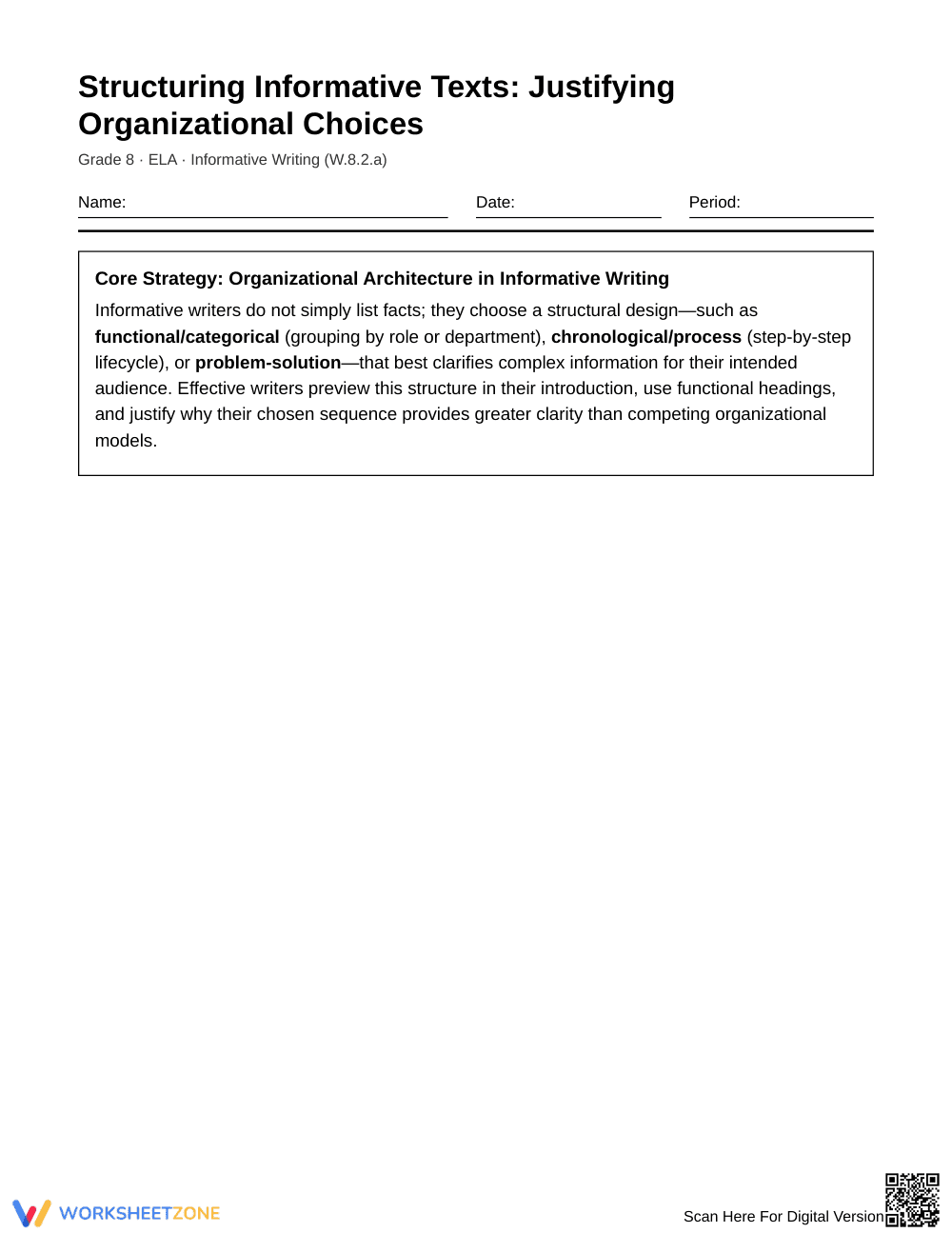
This Grade 8 informative writing worksheet trains students to analyze, select, and justify structural frameworks for informational texts. Working with real-world seed library sources, middle school writers evaluate competing architectures, draft scaffolded text sections with clear headings, and defend their revision choices to build deep organizational mastery.
At a Glance
- Grade: 8 · Subject: ELA
- Standard:
W.8.2.a— Introduce a topic and organize complex ideas using purposeful formatting structures- Skill Focus: Justify an Organizational Choice
- Format: 5 pages · 8 problems · Answer key included · PDF
- Best For: Informative writing analysis and drafting practice
- Time: 45–60 minutes
What's Inside
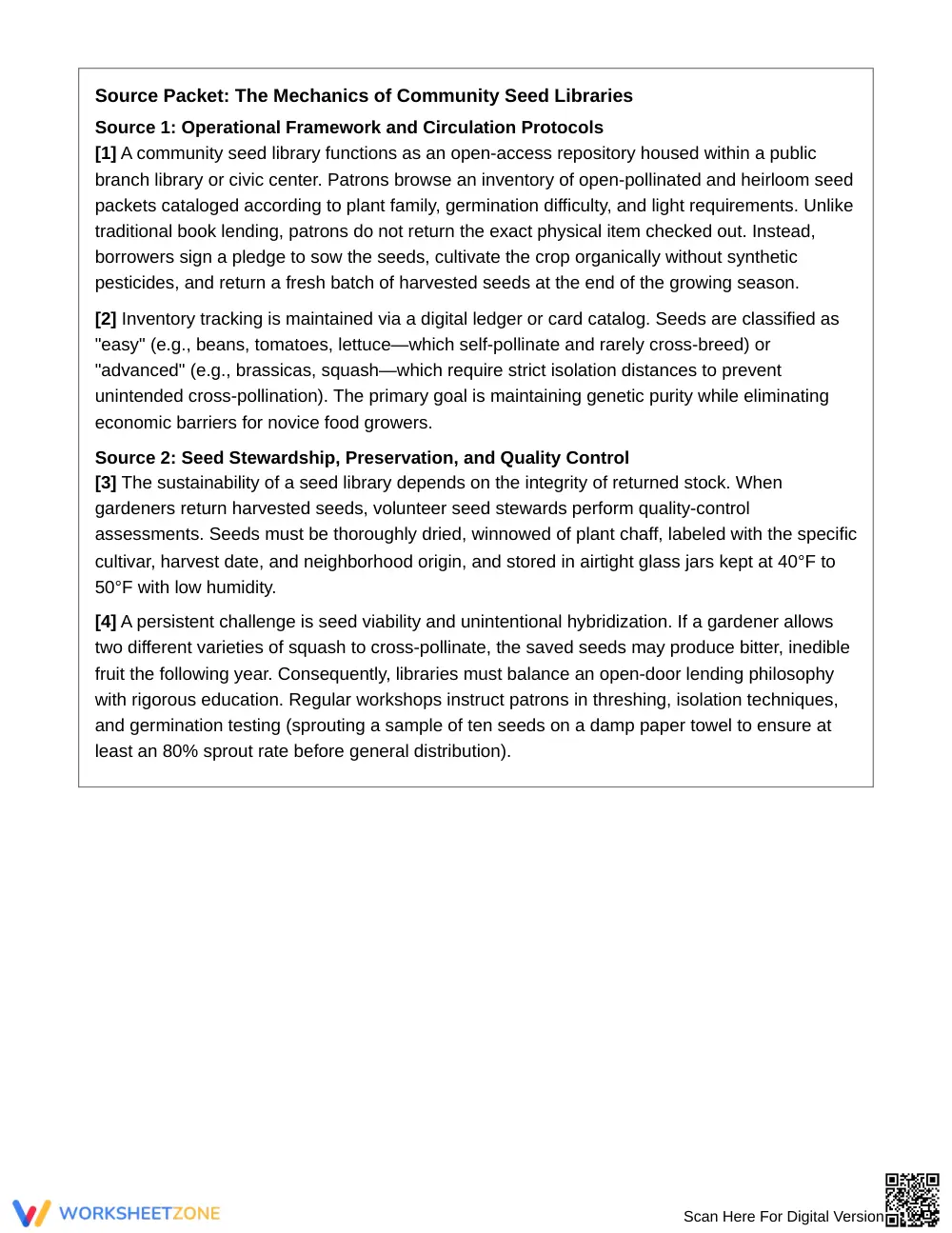
This 5-page student packet includes two informational source texts detailing community seed library operations, protocols, and quality control. Students complete 8 rigorous analytical and drafting tasks supported by structural strategy boxes, formatting prompts, and a multi-paragraph synthesis assignment, followed by a comprehensive 4-page answer key with model written justifications.
Skill Progression
- Guided Practice (Part A, Items 1–2): Students evaluate competing structural designs (chronological process vs. categorical institutional) and propose formatting solutions to overcome organizational weaknesses.
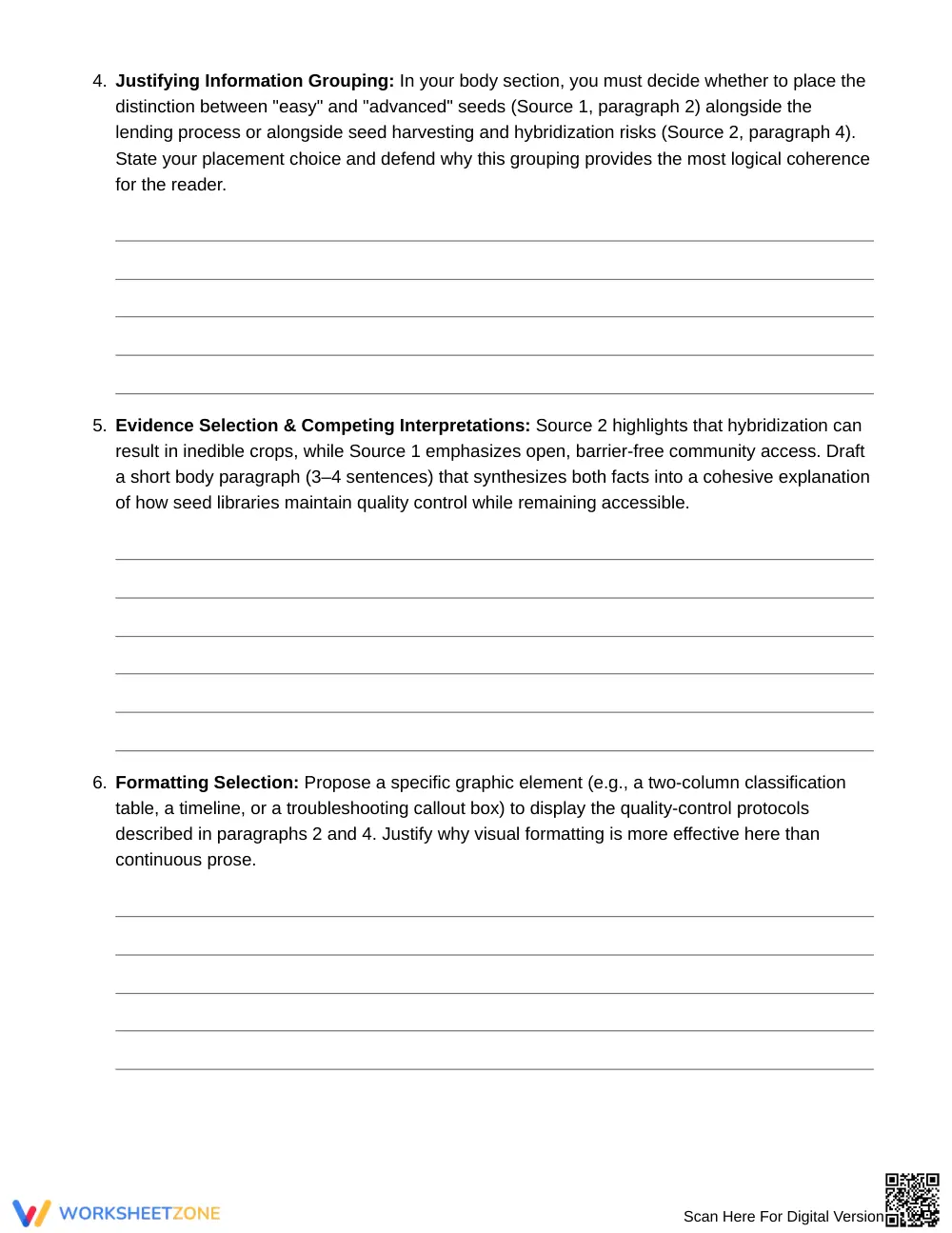
- Supported Practice (Part B, Items 3–6): Students draft text introductions, justify tactical evidence placement, synthesize contrasting source facts, and select visual graphic elements.
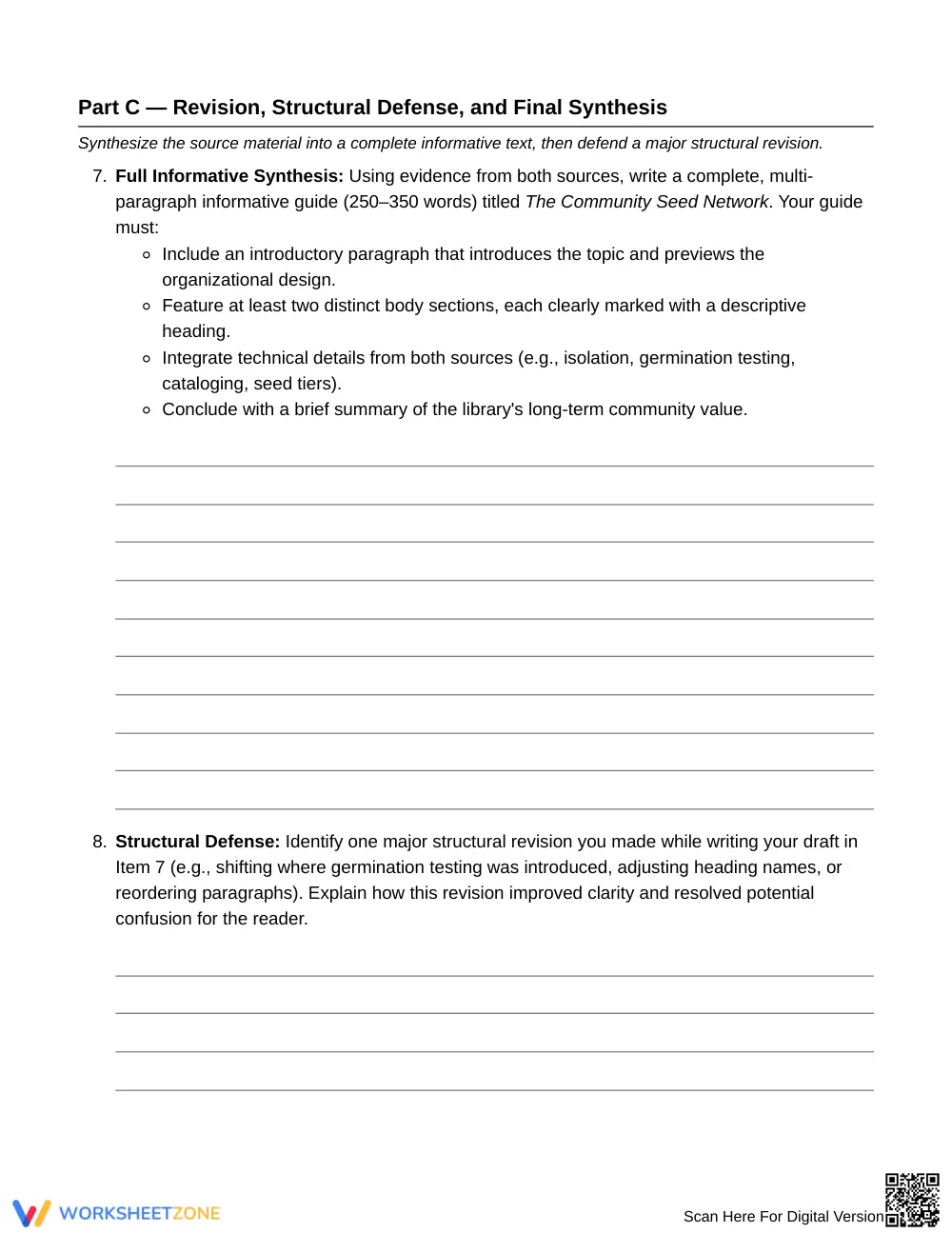
- Independent Practice (Part C, Items 7–8): Students draft a complete 250–350 word synthesized guide featuring section headings and defend a substantive structural revision in writing.
This sequence follows a gradual-release model, transitioning students from structural evaluation to guided composition and independent defense.
Standards Alignment
This activity aligns directly with Common Core standard W.8.2.a: "Introduce a topic clearly, previewing what is to follow; organize ideas, concepts, and information into broader categories; include formatting (e.g., headings), graphics (e.g., charts, tables), and multimedia when useful to aiding comprehension." It also reinforces W.8.2.b by requiring relevant evidence integration. Both standard codes can be copied directly into lesson plans, IEP goals, or district curriculum mapping tools.
How to Use It
Deploy this worksheet after direct instruction on informative text structures and formatting elements. For targeted small-group intervention, have students debate Part A frameworks aloud before writing. During independent drafting in Part B, observe whether students merely summarize facts or explicitly link structural decisions to reader clarity. The complete activity takes approximately 45 to 60 minutes.
Who It's For
Designed for Grade 8 ELA classrooms, this resource supports general education students, honors writers refining structural sophistication, and English language learners benefiting from guided drafting frames. Pair this worksheet with an informative text mentor passage or an anchor chart on organizational structures.
Aligned to Common Core standard W.8.2.a, this resource guides Grade 8 students to introduce topics effectively and organize complex informative ideas through purposeful structures and formatting. Research by Fisher & Frey (2014) highlights that adolescent writers demonstrate significantly higher compositional coherence when guided to evaluate structural models before drafting, rather than treating organization as an afterthought. By analyzing two source texts regarding community seed repositories, students examine how chronological and categorical designs serve distinct communicative goals. Through 8 tiered tasks, learners justify evidence placement, incorporate headings and visual tables, and defend structural revisions in a 250–350 word synthesis. This analytical approach directly develops the organizational architecture required for high school expository writing, providing teachers with actionable evidence of student mastery in logical text structuring and revision analysis.


