




























Views
Downloads


Complete Missing Whole or Part Worksheet | Grade 7 Math

Paste this activity's link or code into your existing LMS (Google Classroom, Canvas, Teams, Schoology, Moodle, etc.).
Students can open and work on the activity right away, with no student login required.
You'll still be able to track student progress and results from your teacher account.
This Grade 7 math resource equips middle school students to master percent calculations by finding unknown parts and wholes. Learners examine foundational relationships, solve real-world context problems with decimals and percents over 100%, and apply algebraic reasoning to evaluate non-routine proportional scenarios with precision.
At a Glance
- Grade: 7 · Subject: Math
- Standard:
7.RP.A.3— Solve multi-step real-world ratio and percent problems using proportions- Skill Focus: Solve for a Missing Whole or Part
- Format: 5 pages · 18 problems · Answer key included · PDF
- Best For: Proportional reasoning practice and percent calculation mastery
- Time: 40–50 minutes
What's Inside
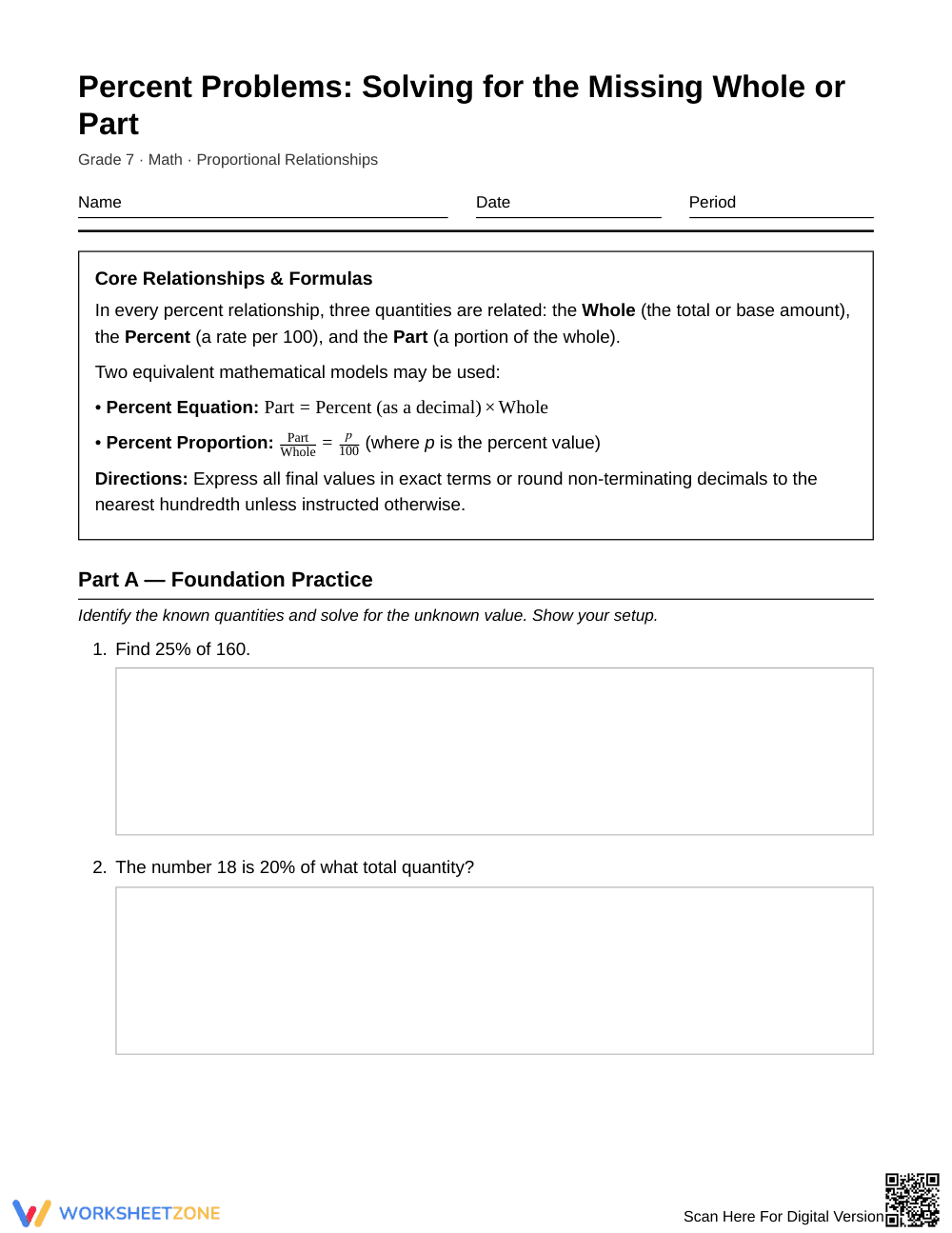
The 5-page printable document includes an 18-problem student worksheet paired with a comprehensive 3-page answer key showing step-by-step solutions. A header reference box provides the core percent equation and percent proportion formulas, supporting students as they work through calculation drills, word problems, rational values, and error-analysis tasks.
Skill Progression
- Guided Practice (Part A, 4 problems): Introduces core part-whole recognition, simple percentage calculations, and equation identification using benchmark values.
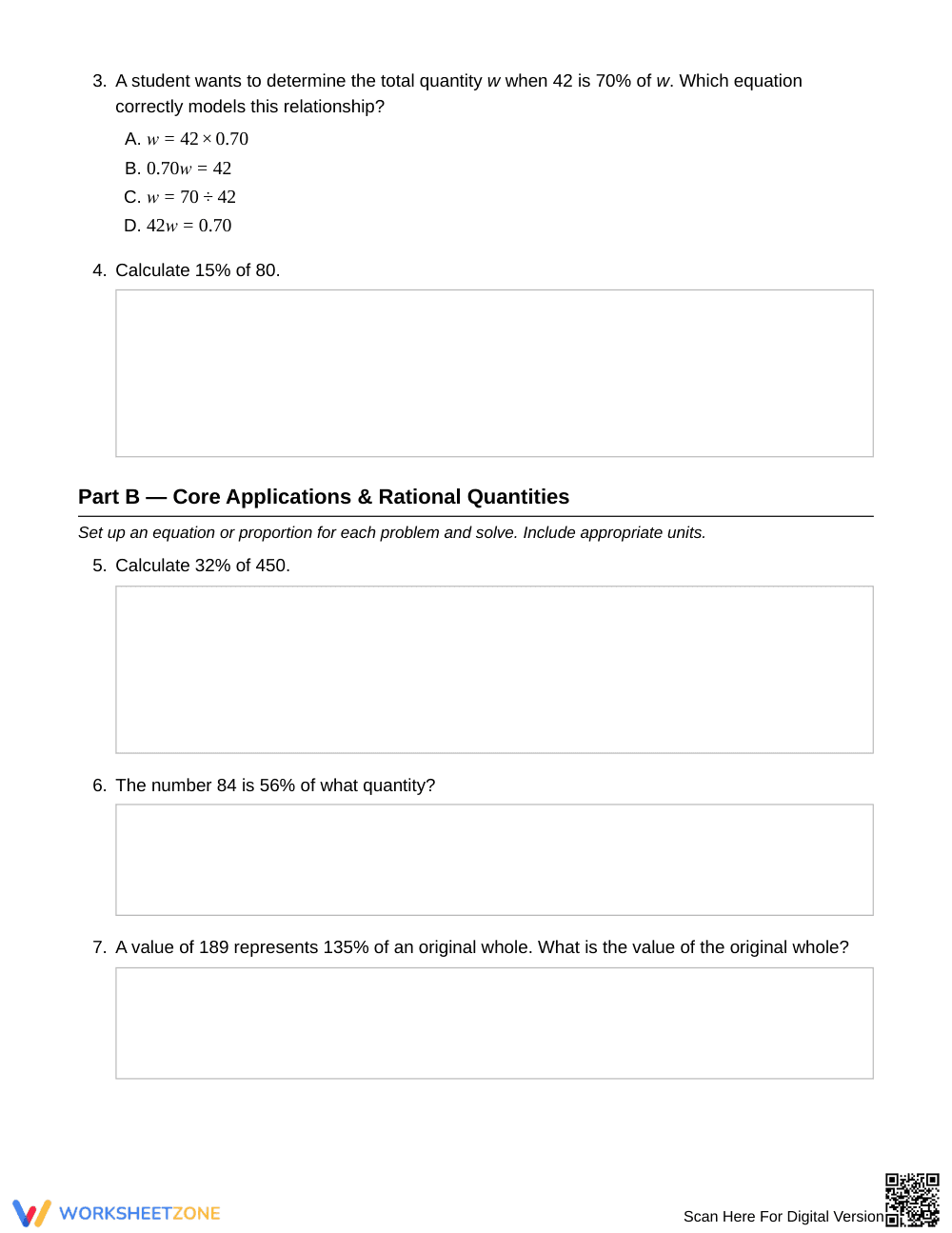
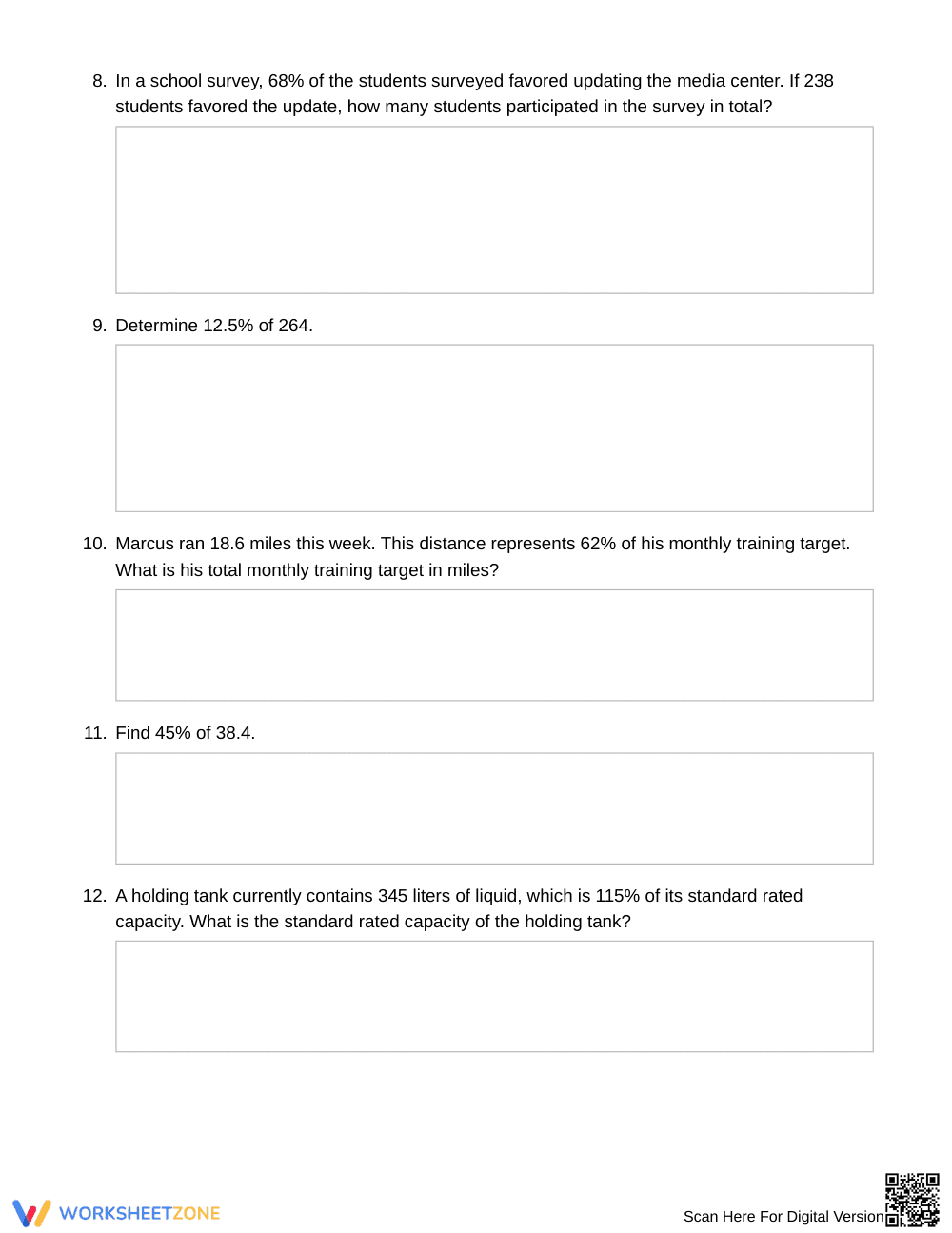
- Supported Practice (Part B, 10 problems): Applies percent equations and proportions to contextual word problems involving rational numbers, survey data, capacity, and percents exceeding 100%.
- Independent Practice (Part C, 4 problems): Challenges students with multi-step club membership modeling, variable-based algebraic derivations, and written misconception analysis.
This structured sequence reflects the gradual release of responsibility model, transitioning students from formula recall to independent mathematical reasoning.
Standards Alignment
This worksheet aligns directly to 7.RP.A.3: "Use proportional relationships to solve multistep ratio and percent problems." It also reinforces 7.EE.B.4 through solving linear equations derived from proportional contexts. Both standard codes can be copied directly into lesson plans, IEP goals, or district curriculum mapping tools.
How to Use It
Deploy this worksheet after direct instruction on the percent equation and percent proportions. Use Part A and Part B during paired practice, observing whether students mistakenly multiply by whole numbers instead of converting percents to decimals or fractions. Assign Part C as an exit ticket or small-group extension. Most students complete the entire set in 40 to 50 minutes.
Who It's For
Designed for Grade 7 general mathematics, accelerated Grade 6 classes, and Grade 8 intervention groups requiring targeted proportional reasoning review. Teachers can pair this resource with visual double-number-line anchor charts or bar models to assist visual learners before transitioning to algebraic setups.
According to Fisher & Frey (2014), structured instructional scaffolds that bridge foundational computation and complex problem-solving substantially improve student achievement in middle school mathematics. This worksheet directly targets standard 7.RP.A.3 by systematically training Grade 7 learners to identify, represent, and compute missing parts or whole quantities across eighteen rigorous prompts. By progressing from direct numeric equations to multi-step real-world scenarios involving rational values and variable formulas, the resource reinforces deep conceptual understanding alongside routine procedural fluency. Students clarify common operational misconceptions regarding base wholes versus partial amounts through structured error analysis and written mathematical justification. Educational researchers emphasize that developing flexible fluency between the percent equation and proportional reasoning solidifies essential algebraic readiness, ensuring that middle school students build durable mathematical models that support advanced secondary coursework across diverse STEM learning environments.


