




























Views
Downloads

Complete Gene Flow Word Search | Grades 9–10 Science

Paste this activity's link or code into your existing LMS (Google Classroom, Canvas, Teams, Schoology, Moodle, etc.).
Students can open and work on the activity right away, with no student login required.
You'll still be able to track student progress and results from your teacher account.
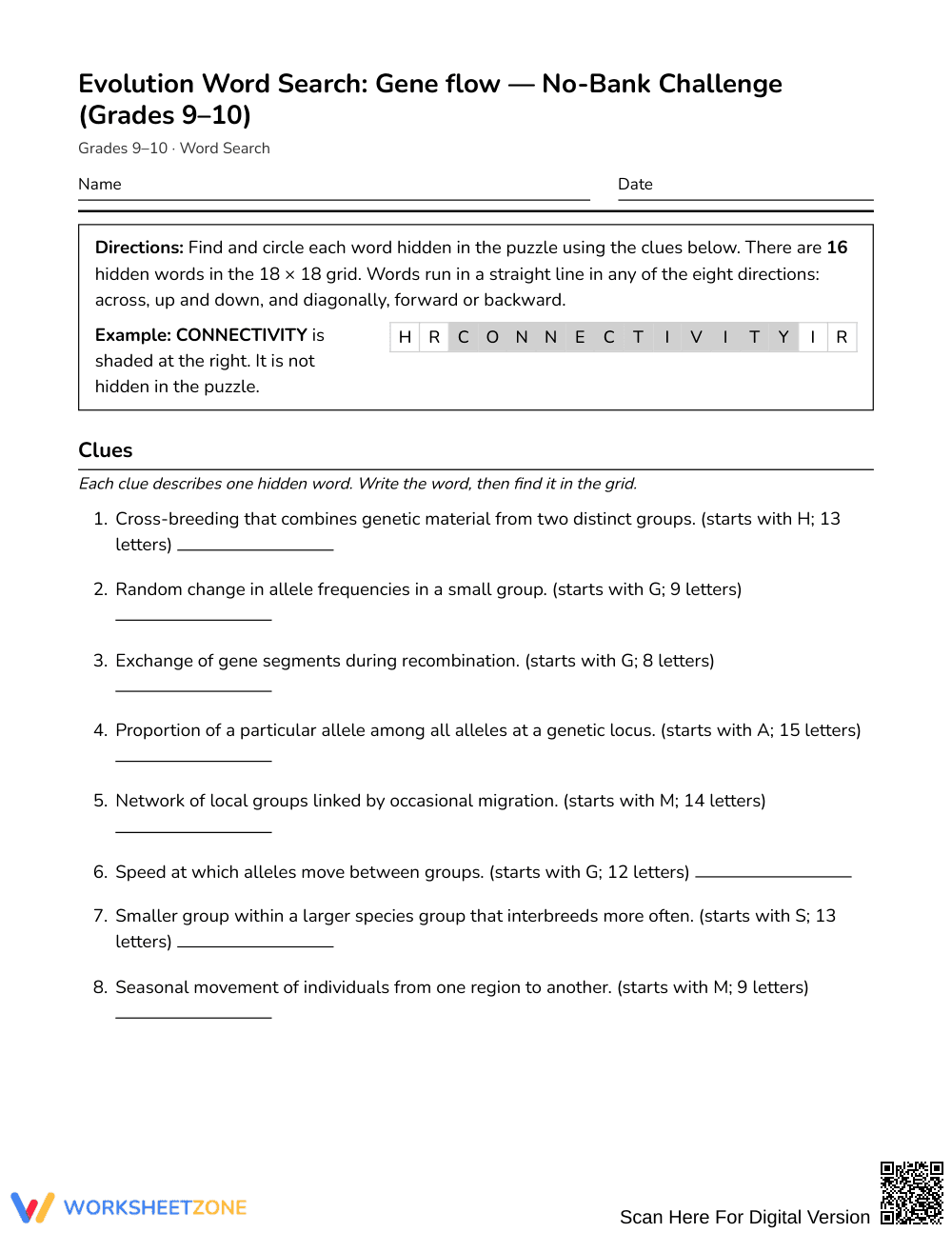
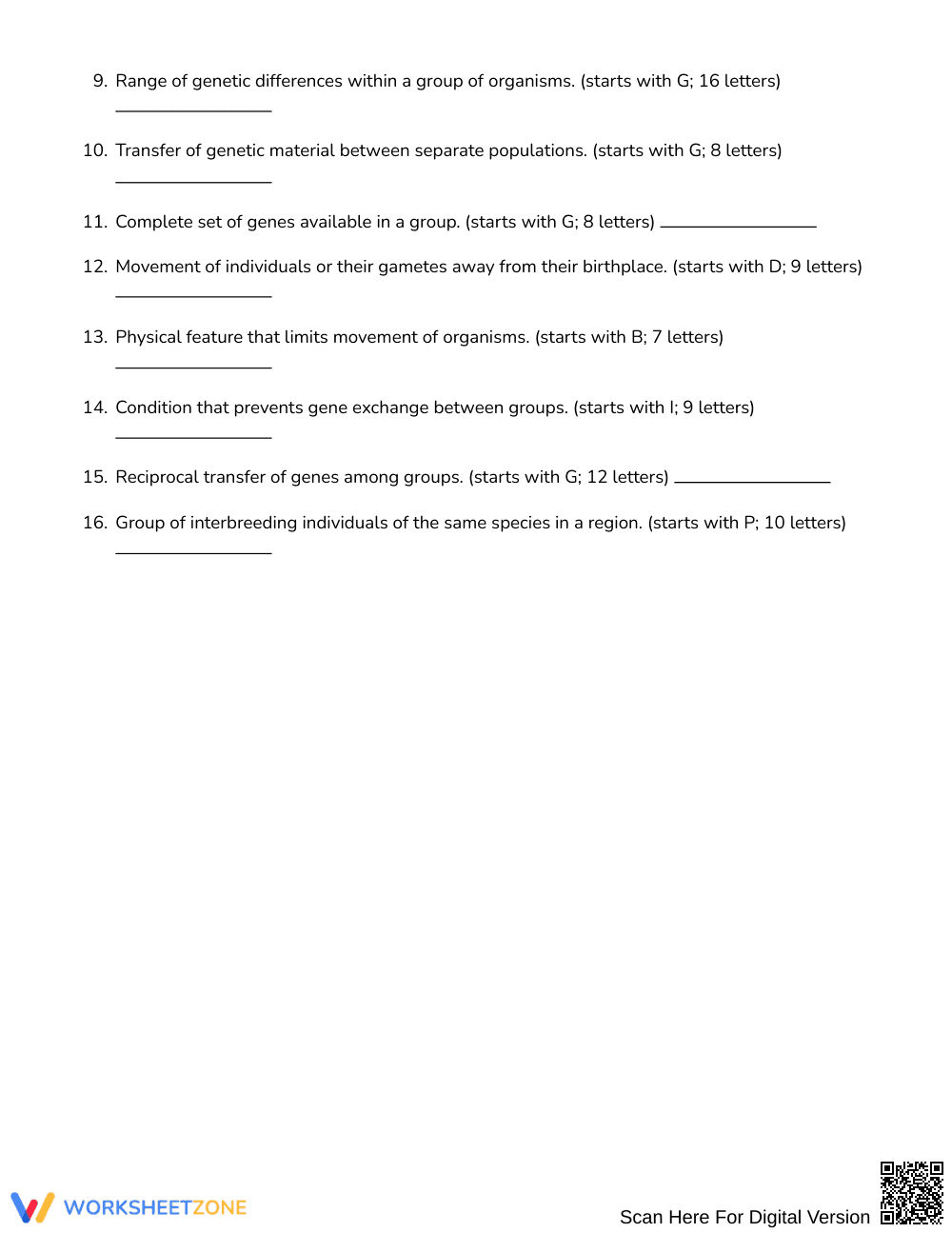
This Grades 9–10 evolution word search strengthens biology vocabulary through active recall and targeted context clues. High school learners analyze 16 rigorous definitions related to gene flow, determine the corresponding scientific terms without a word bank, and locate each target word within the puzzle grid to solidify core genetics concepts.
At a Glance
- Grade: Grades 9–10 · Subject: Science
- Standard: Not standards-assessed — vocabulary enrichment
- Skill Focus: Gene flow terminology
- Format: 3 pages · 16 words · Answer key included · PDF
- Best For: Vocabulary review and reinforcement
- Time: 25–35 minutes
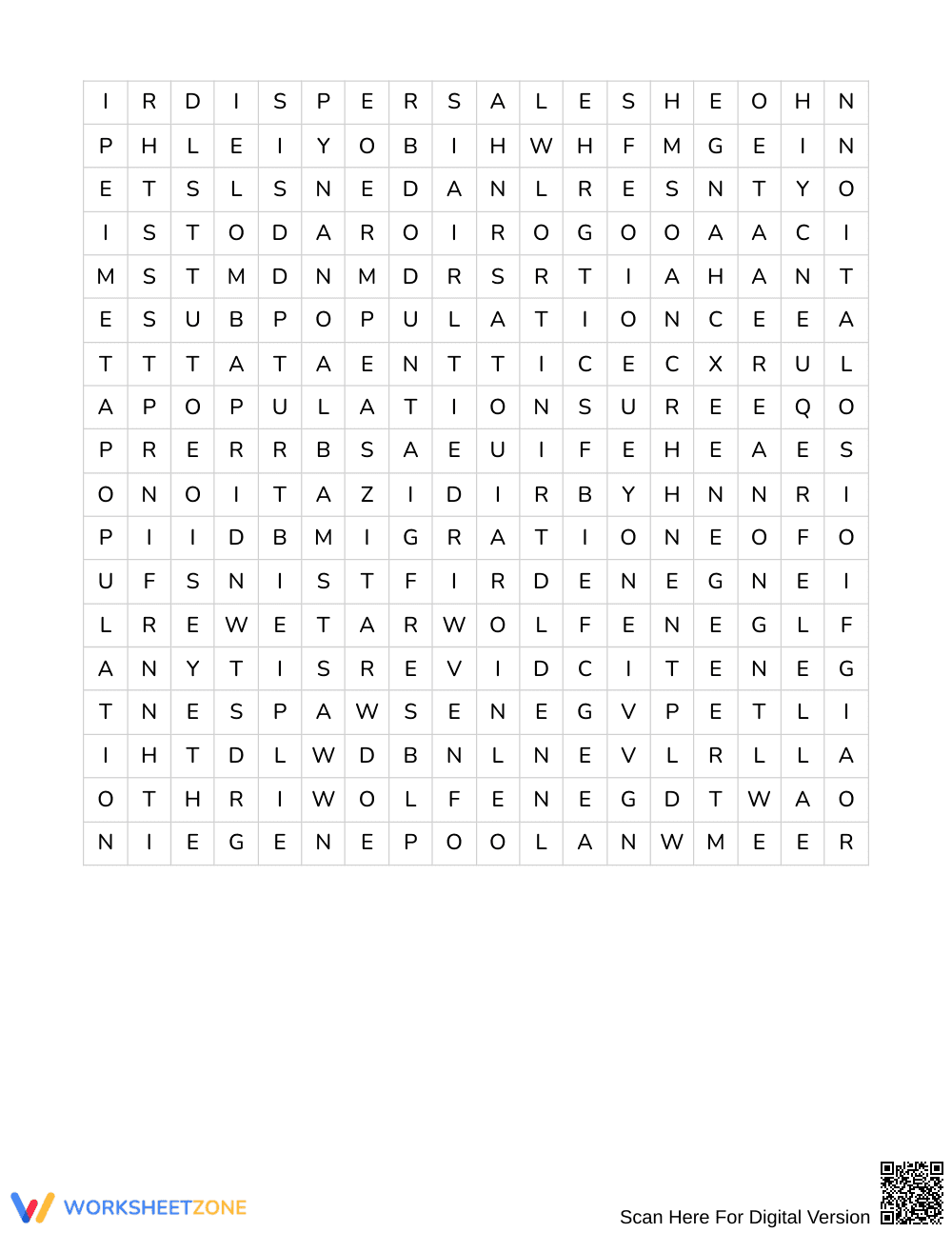
The activity provides an intentional challenge featuring 16 words embedded within a dense grid, accompanied by content-rich scientific clues rather than a passive word list. Across 3 printable pages, students interact with detailed evolutionary definitions, while the comprehensive 3-page answer key provides clear letter-by-letter solutions for fast, reliable verification during independent study or classroom checks.
Puzzle Mechanics
This challenge is built upon a precise 18 x 18 grid designed to test pattern recognition and content recall. Words run in all 8 compass directions: north, northeast, east, southeast, south, southwest, west, and northwest. Because the layout omits a traditional word bank, students must first solve the 16 content clues to identify the hidden terms before locating them across the grid.
Standards Alignment
This resource serves as targeted vocabulary enrichment and is not aligned to a specific state or national content standard. It is designed to reinforce essential academic language and evolutionary concepts across high school biology curricula, providing structured support for complex genetic and ecological mechanisms.
How to Use It
Incorporate this activity after direct instruction on microevolution and population genetics, or use it as a mid-unit review station. During work time, circulate to verify that students can explain why terms like allele frequency and genetic drift fit specific clues before circling letters. Students typically complete the 16 terms in 25 to 35 minutes.
Who It's For
This activity is designed for Grades 9–10 biology and life science students studying evolutionary mechanisms. For students needing additional assistance, teachers can provide initial letter hints for select definitions. Pair this puzzle with an introductory lecture or a population dynamics anchor chart to bridge conceptual theory and technical terminology.
Vocabulary acquisition in secondary science requires deliberate cognitive engagement rather than passive rote memorization. Research by Fisher & Frey (2014) highlights that disciplinary literacy develops most effectively when students actively manipulate domain-specific vocabulary through contextual retrieval practice and definition analysis. By presenting 16 gene flow vocabulary terms through rigorous conceptual definitions rather than a standard word list, this activity compels high school learners to retrieve specialized biological concepts from memory before scanning the 18 x 18 grid. Students engage deeply with foundational terminology including allele frequency, metapopulation, and dispersal across 8 distinct search directions. This structured approach solidifies conceptual schemas necessary for advanced genetic inquiry and evolutionary analysis. Incorporating targeted vocabulary enrichment into Grades 9–10 science instruction bridges abstract population genetics concepts with rigorous scientific discourse, supporting long-term retention and academic literacy across secondary science curricula.


