


























Views
Downloads

Complete Fractional Unit Rates Worksheet | Grade 7 Math
Paste this activity's link or code into your existing LMS (Google Classroom, Canvas, Teams, Schoology, Moodle, etc.).
Students can open and work on the activity right away, with no student login required.
You'll still be able to track student progress and results from your teacher account.
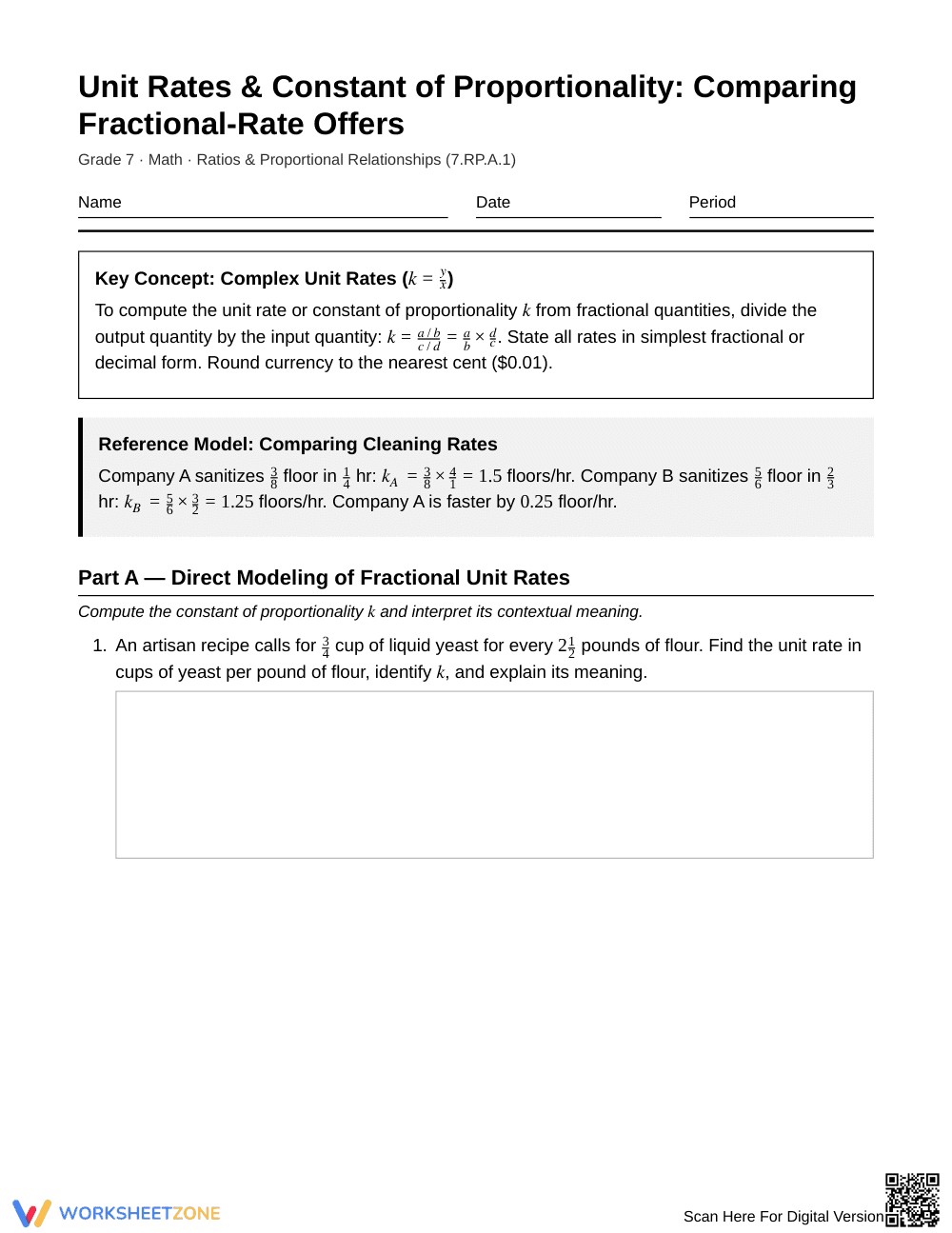
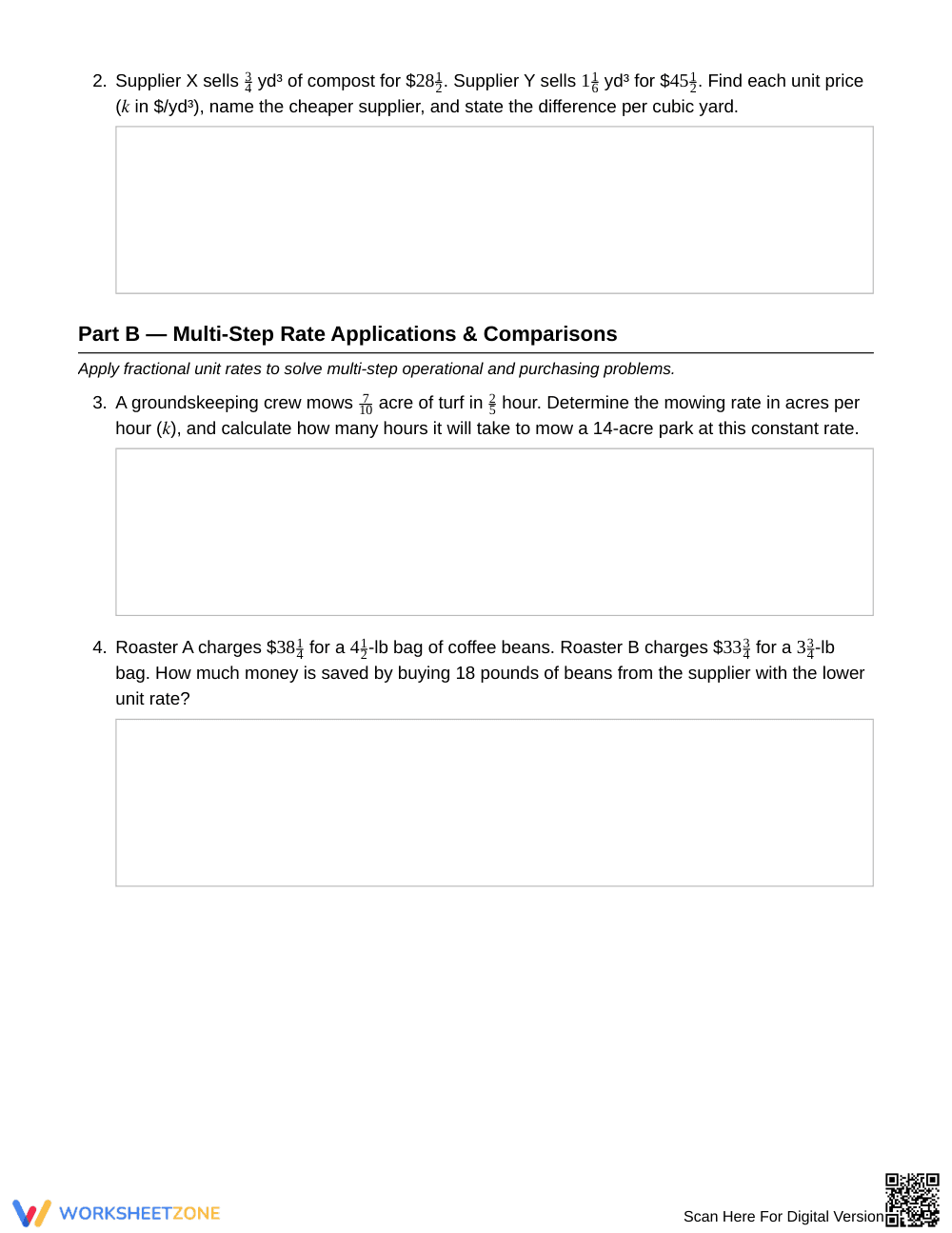
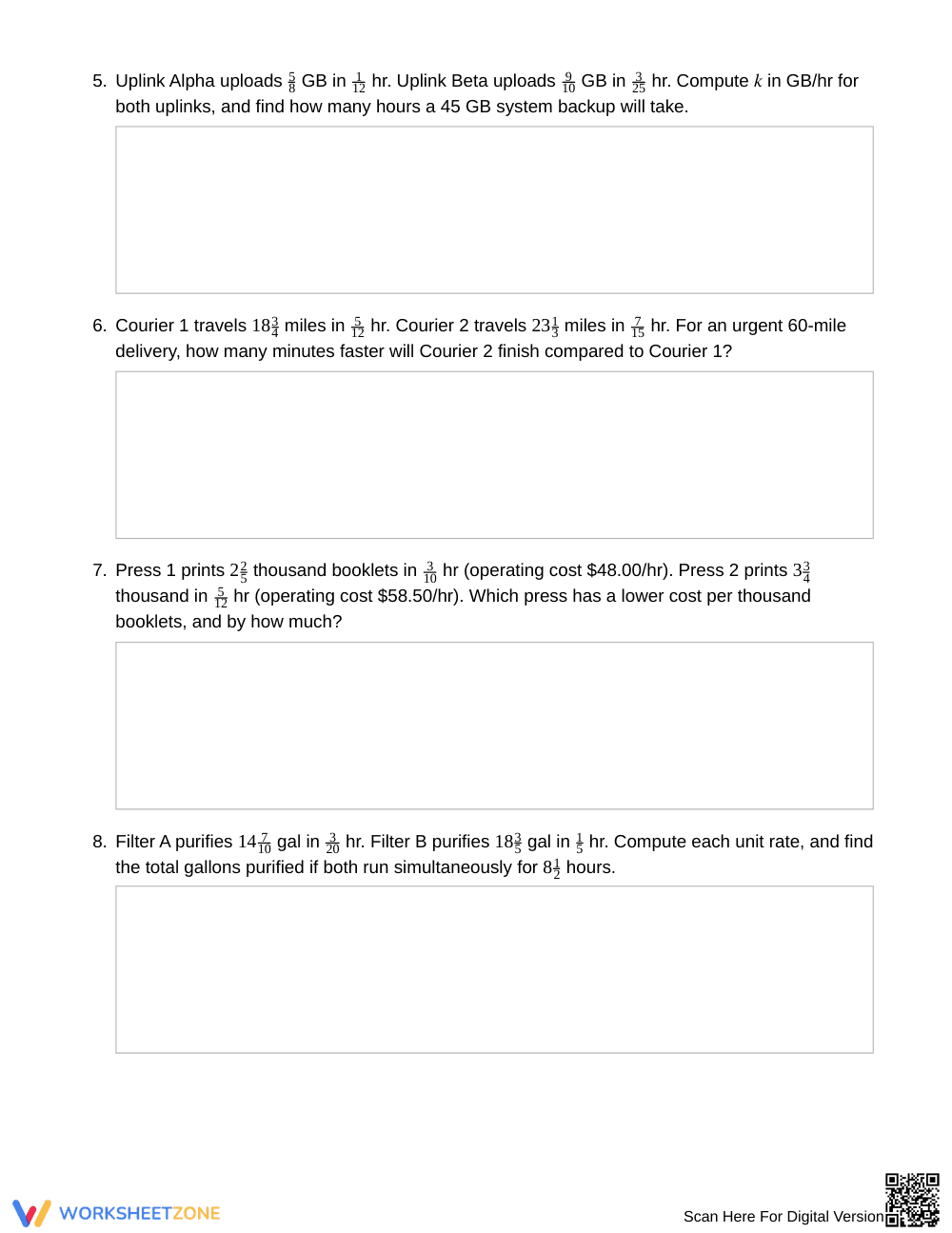
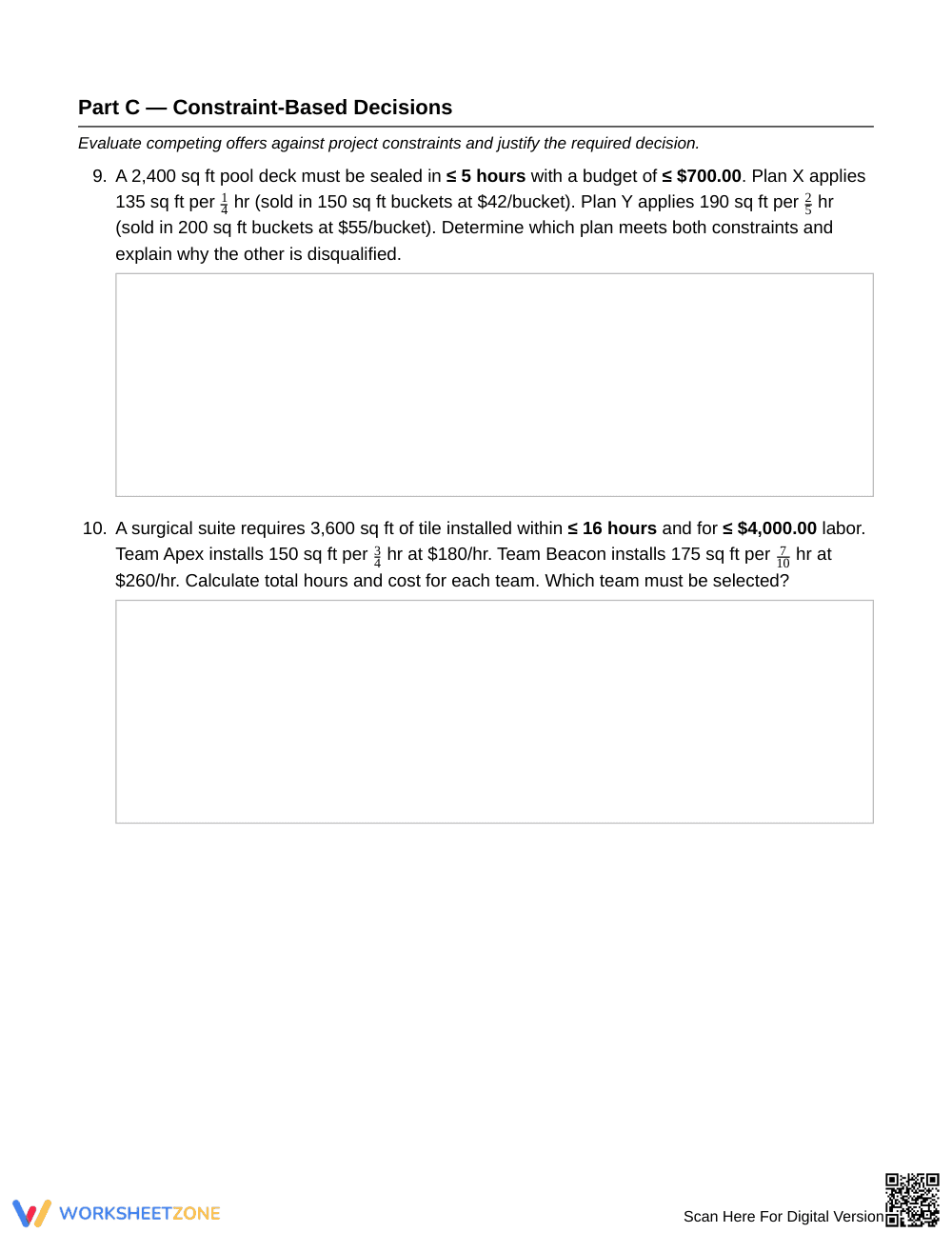
This Grade 7 math worksheet develops student fluency in calculating and comparing complex unit rates with fractional quantities. Students analyze real-world purchasing scenarios, work rates, and operational constraints to determine unit rates, evaluate competing offers, and justify mathematical decisions with precision.
At a Glance
- Grade: 7 · Subject: Math
- Standard:
7.RP.A.1— Compute unit rates associated with ratios of fractions in context- Skill Focus: Compare Fractional-Rate Offers
- Format: 4 pages · 10 problems · Answer key included · PDF
- Best For: Independent practice, partner problem solving, review
- Time: 40–50 minutes
The 4-page resource begins with a clear key concept box and a fully worked reference model demonstrating how to compute rates using complex fraction division. The 10 multi-part tasks require students to set up ratios, compute quotients involving mixed numbers, convert units, and contrast competing vendor pricing. A 2-page detailed answer key provides complete step-by-step calculations and contextual justifications.
Skill Progression
- Guided Practice (Part A): Direct modeling with 2 foundational exercises where students find the constant of proportionality from fractional ratios and interpret its meaning in context.
- Supported Practice (Part B): Multi-step rate applications across 6 complex problems requiring students to calculate total production, evaluate bulk savings, and compare speed or cost efficiencies.
- Independent Practice (Part C): 2 constraint-driven decision scenarios where students evaluate multiple bids against strict time and budget thresholds to justify optimal selections.
This progression follows an intentional gradual-release framework, moving learners from conceptual rate calculation to multi-step comparative decision-making.
Standards Alignment
This worksheet directly addresses `7.RP.A.1`: Compute unit rates associated with ratios of fractions, including ratios of lengths, areas and other quantities measured in like or different units. It also supports `7.RP.A.2` by requiring learners to identify and apply the constant of proportionality across diverse authentic problem contexts. Both standard codes can be copied directly into lesson plans, IEP goals, or district curriculum mapping tools.
How to Use It
Deploy this activity during the guided-to-independent practice transition of your unit rate unit. Alternatively, use Part C as a collaborative problem-solving task for small groups following direct instruction. During class, monitor how students set up complex fractions to verify they place output units over input units before multiplying by the reciprocal. Expected completion time is 40 to 50 minutes.
Who It's For
Designed for Grade 7 general mathematics students, accelerated Grade 6 learners, or Grade 8 students needing targeted intervention with complex fractions. Pair this resource with a visual ratio anchor chart or hands-on double number line models for students requiring foundational scaffolding.
Mastering complex unit rates under standard 7.RP.A.1 requires students to connect algorithmic division of fractions with proportional reasoning in authentic scenarios. According to Fisher & Frey (2014), structured instructional materials that transition from worked reference models to multi-step problem solving significantly improve conceptual retention and mathematical reasoning. This worksheet establishes that bridge by requiring learners to compute unit rates from mixed-number ratios, compare competing business bids, and evaluate operational trade-offs against explicit budget and time limits. By grounding fractional operations in real-world contexts such as groundskeeping, printing costs, and construction quotes, students develop fluency in finding the constant of proportionality while building justification skills. The structured multi-part format ensures learners practice both mechanical computation and critical evaluation, preparing them for advanced algebraic and proportional relationships in secondary mathematics.


