




























Views
Downloads



Complete Evolution Word Search | Grades 10–12 Science

Paste this activity's link or code into your existing LMS (Google Classroom, Canvas, Teams, Schoology, Moodle, etc.).
Students can open and work on the activity right away, with no student login required.
You'll still be able to track student progress and results from your teacher account.
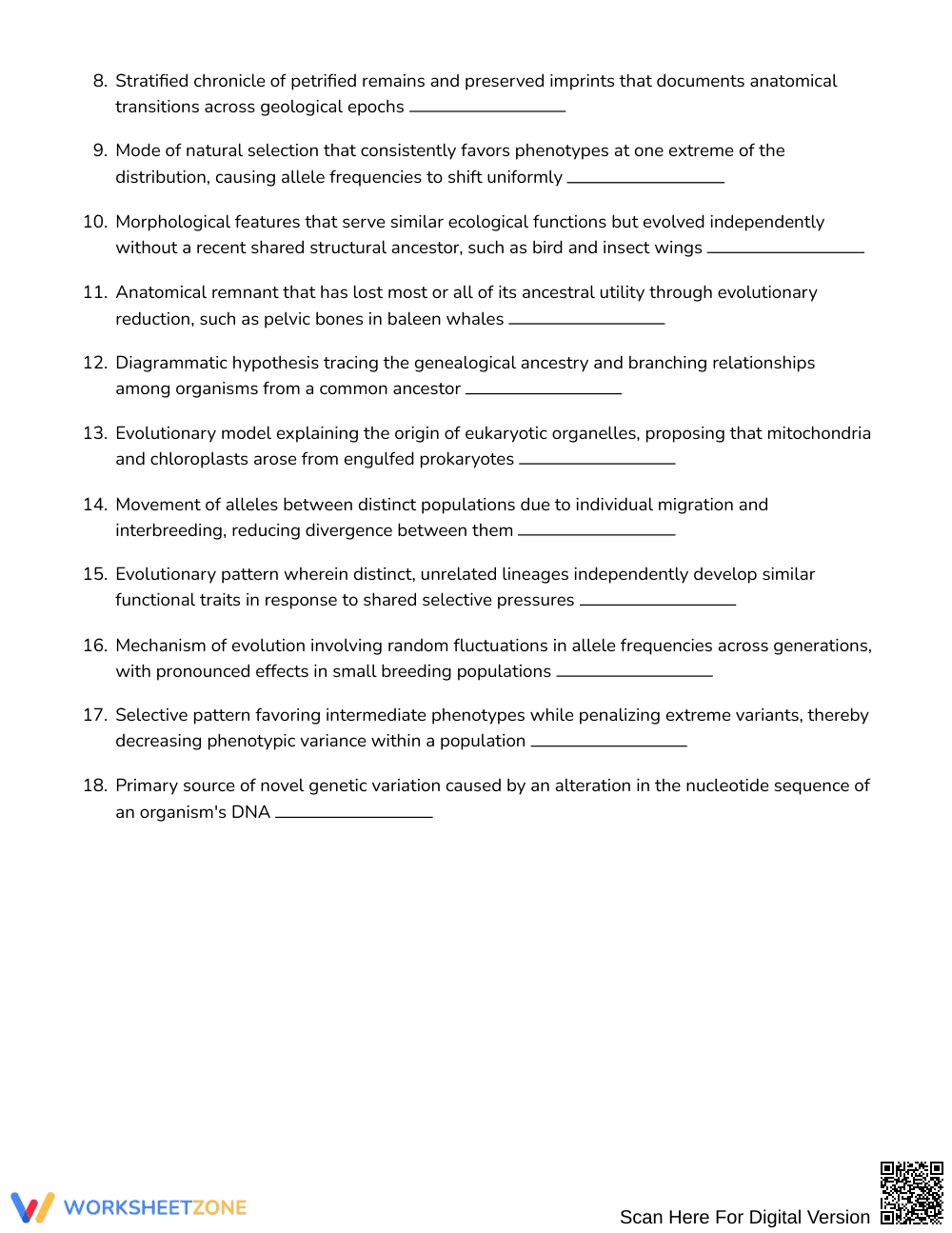
This evolution word search strengthens high school biology students' mastery of core evolutionary mechanisms and empirical evidence. Learners analyze 18 rigorous definition clues covering speciation, genetic drift, and comparative anatomy before locating each hidden term. Designed for high school science classrooms, this activity solidifies critical terminology required for cumulative assessment success.
At a Glance
- Grade: Grades 10–12 · Subject: Science
- Standard: Not standards-assessed — vocabulary enrichment
- Skill Focus: Evolutionary processes and evidence review
- Format: 3 student pages · 18 hidden vocabulary words · 4-page complete answer key included · Printable PDF
- Best For: Cumulative biology unit review and vocabulary reinforcement
- Time: 25–35 minutes
What's Inside
This 3-page science resource presents an academic puzzle featuring 18 hidden vocabulary words paired with substantive, college-preparatory definition clues. Rather than simple recognition, students read detailed descriptions of concepts like endosymbiosis, molecular clocks, and directional selection to identify target words. The set includes a clear student grid, accompanying clue lists, and a comprehensive 4-page answer key showing exact word placements.
How the Puzzle Works
Students engage with an expansive 20 × 20 letter grid containing 18 evolutionary biology terms placed across all 8 cardinal and intercardinal directions: north, northeast, east, southeast, south, southwest, west, and northwest. A shuffled word bank provides reference support, while the demanding definition clues require students to demonstrate content recall before scanning the grid. Forward and backward letter sequences across diagonal, vertical, and horizontal vectors challenge students' visual tracking and pattern-recognition skills.
Standards Alignment
This resource serves as targeted vocabulary enrichment rather than a standards-assessed measurement tool. It is not aligned to a standard code. Instead, it provides supplemental lexical reinforcement across universal high school biology and advanced life science curricula, supporting foundational conceptual comprehension without formal standards testing constraints.
How to Use It
Implement this word search as an active review station immediately after completing direct instruction on natural selection and speciation mechanisms. Alternatively, assign it as an independent warm-up before a cumulative unit exam to activate prior knowledge. As students search for terms, circulate and observe which definition clues cause hesitation; students struggling to match descriptions of homologous structures or genetic drift reveal conceptual gaps needing re-teaching. Expect completion within 25 to 35 minutes.
Who It's For
This review is designed for students in Grades 10–12 enrolled in general biology, honors biology, or introductory AP Biology. For students needing additional scaffolding, allow collaborative peer pairs or permit access to unit glossaries. Advanced learners can write an original ecological example for each term once found. Pair this activity naturally with an evolutionary phylogeny anchor chart or a cladogram analysis lab.
Vocabulary acquisition forms the cognitive backbone of secondary scientific literacy, enabling learners to comprehend complex evolutionary processes and evidence review. According to Fisher & Frey (2014), intentional word-learning strategies that require students to connect technical definitions to conceptual representations significantly improve long-term retention and reading comprehension in technical disciplines. Rather than passively scanning letter blocks, students solving this word search must interpret rich biological clues addressing mechanisms like gene flow, speciation, and vestigial structures before locating targets in a 20 by 20 grid. This dual cognitive demand—semantic retrieval paired with spatial search—transforms a traditional puzzle into an effective review instrument for high school science learners. By consolidating academic language prior to cumulative evaluations, students establish the linguistic automaticity necessary to tackle complex evolutionary problem-solving, data interpretation, and comparative anatomical analysis across subsequent biological investigations.


