


























Views
Downloads
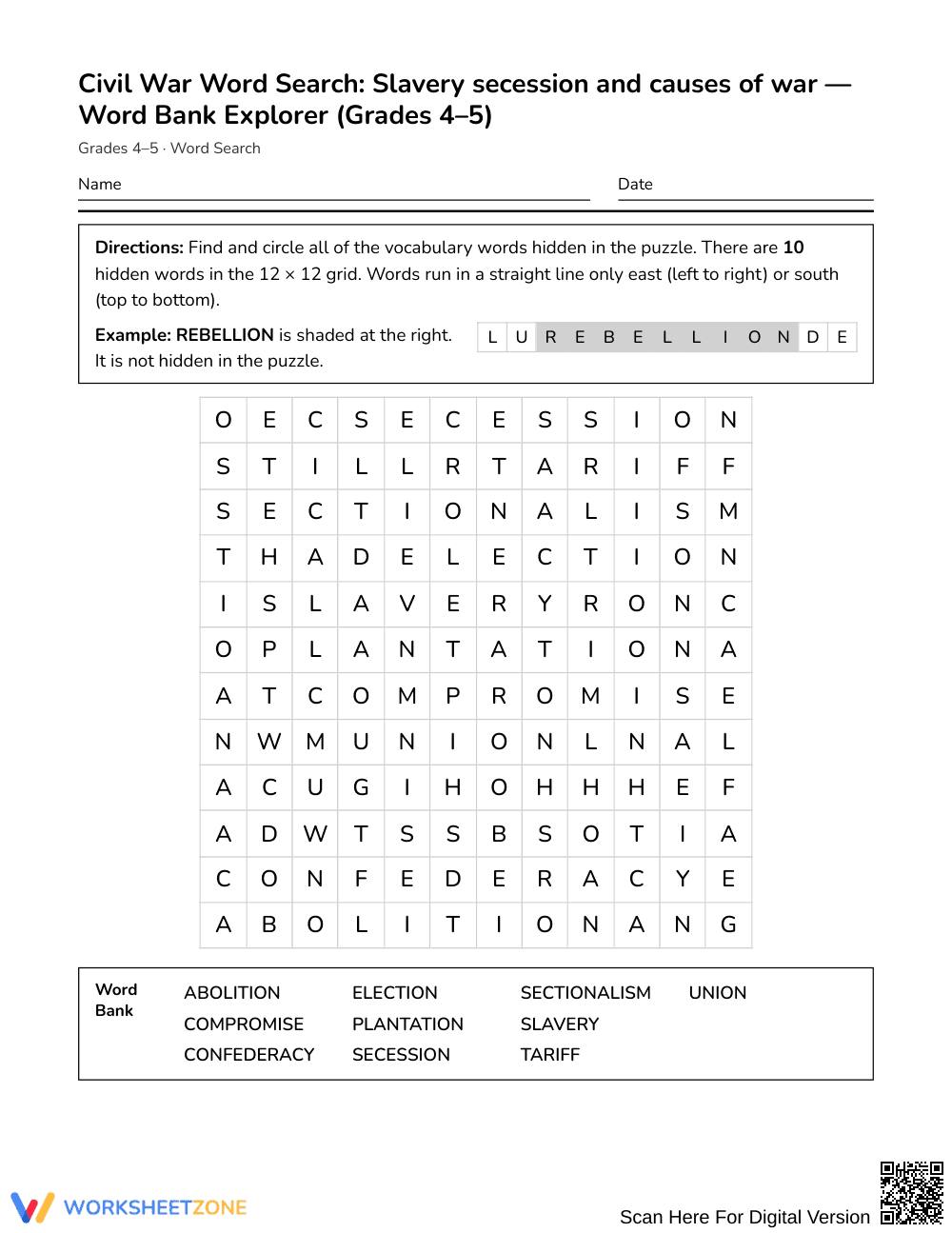

Complete Civil War Word Search | Grades 4–5 Social Studies
Paste this activity's link or code into your existing LMS (Google Classroom, Canvas, Teams, Schoology, Moodle, etc.).
Students can open and work on the activity right away, with no student login required.
You'll still be able to track student progress and results from your teacher account.
This Grades 4–5 Civil War word search reinforces historical vocabulary focused on the sectional crisis, slavery, and secession. Students identify key historical terms across a clear grid to build word recognition, support reading comprehension, and review foundational concepts before unit assessments or during introductory social studies lessons.
At a Glance
- Grade: Grades 4–5 · Subject: Social Studies
- Standard: Not standards-assessed — vocabulary enrichment
- Skill Focus: Slavery, secession, and causes of war
- Format: 1 pages · 10 words · Answer key included · PDF
- Best For: Civil War unit vocabulary review
- Time: 15–20 minutes
What's Inside
This 1-page printable activity features an uncluttered 12 by 12 puzzle grid containing 10 historical vocabulary words, paired with an alphabetical word bank and accompanying definitions. A complete answer key is included across 3 reference pages, allowing educators or students to check letter coordinates quickly during independent work or small-group rotations.
Puzzle Mechanics and Design
The activity is built specifically for intermediate elementary learners seeking focused lexical practice without unnecessary visual complexity:
- Grid Dimensions: A compact 12 by 12 letter grid keeps letter scanning accessible for upper-elementary students.
- Word Placements: All 10 vocabulary terms run strictly East (left to right) and South (top to bottom), avoiding confusing diagonal or reverse orientations.
- Word Bank Layout: Words appear in alphabetical order alongside concise historical descriptions that connect terms like abolition, secession, and tariff to core historical ideas.
Standards Alignment
This activity is designed purely for vocabulary enrichment and is not aligned to a specific state or national content standard. It provides supplementary lexical exposure to strengthen background knowledge during American history instruction.
How to Use It
Deploy this puzzle as an introductory hook at the start of an American Civil War unit to familiarize students with essential terminology before direct instruction begins. Alternatively, use it as a low-stress review activity after reading primary sources on sectionalism and secession. To formatively assess retention, ask students to write one sentence connecting two discovered words after finishing the puzzle. Most students complete the 10 words within 15 to 20 minutes.
Who It's For
This resource is tailored for Grades 4–5 social studies students learning about mid-nineteenth-century American history. The straight East and South placements make it accessible for developing readers and English learners requiring targeted language reinforcement. It pairs naturally with an introductory timeline lesson, a cause-and-effect graphic organizer, or an anchor chart detailing Northern and Southern economic differences.
Explicit vocabulary acquisition plays a decisive role in historical literacy and text comprehension. According to Fisher & Frey (2014), intentional exposure to domain-specific terminology enables intermediate elementary students to access complex informational texts and engage in meaningful academic discourse. This 1-page social studies word search targets 10 foundational historical terms related to the American Civil War, including sectionalism, compromise, and secession. By locating vocabulary across a structured 12 by 12 layout oriented strictly East and South, students reinforce spelling patterns and associative memory. Because this activity serves as vocabulary enrichment rather than a formal standards-based assessment, it functions smoothly alongside textbook readings and direct instruction. Providing an alphabetical word bank with clear definitions ensures that Grades 4–5 learners make direct connections between historical terms and their broader conceptual significance across early United States history units.


