


























Views
Downloads



Complete Cellular Energy & ATP Worksheet | Grade 10 Biology
Paste this activity's link or code into your existing LMS (Google Classroom, Canvas, Teams, Schoology, Moodle, etc.).
Students can open and work on the activity right away, with no student login required.
You'll still be able to track student progress and results from your teacher account.
This Grade 10 Biology worksheet builds student mastery of cellular energy by guiding them through 12 rigorous, scaffolded problems on ATP coupling, chemiosmosis, and metabolic evidence. Students move systematically from foundational mechanism analysis to experimental data interpretation, developing the quantitative and analytical skills needed to explain bioenergetics with confidence.
At a Glance
- Grade: 10 · Subject: Biology
- Standard: Cellular Energy & ATP — Explain how cells couple exergonic and endergonic reactions to sustain life processes
- Skill Focus: Energy coupling, chemiosmosis, and metabolic pathway analysis
- Format: 5 pages · 12 problems · Answer key included · PDF
- Best For: Guided practice after direct instruction
- Time: 45–60 minutes
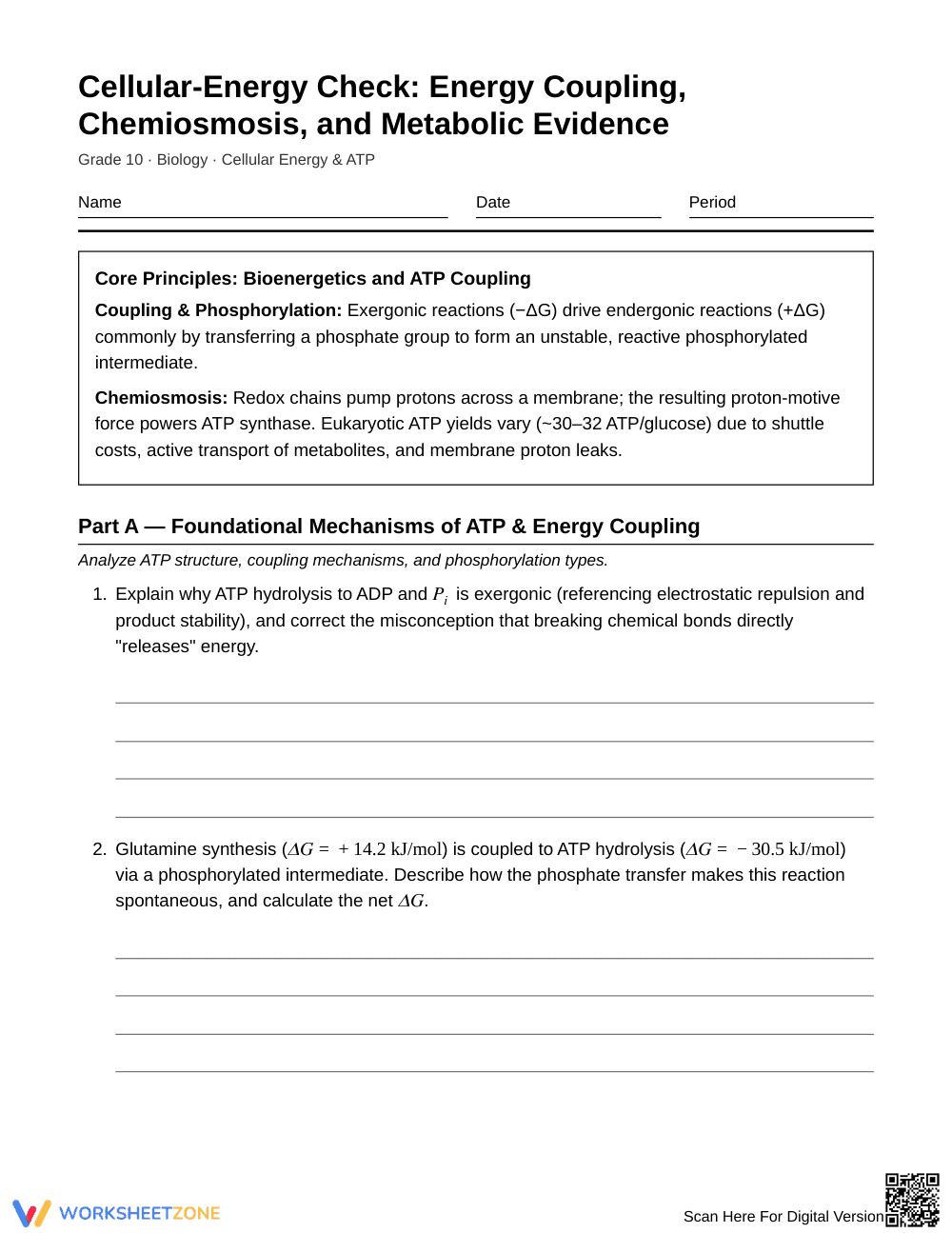
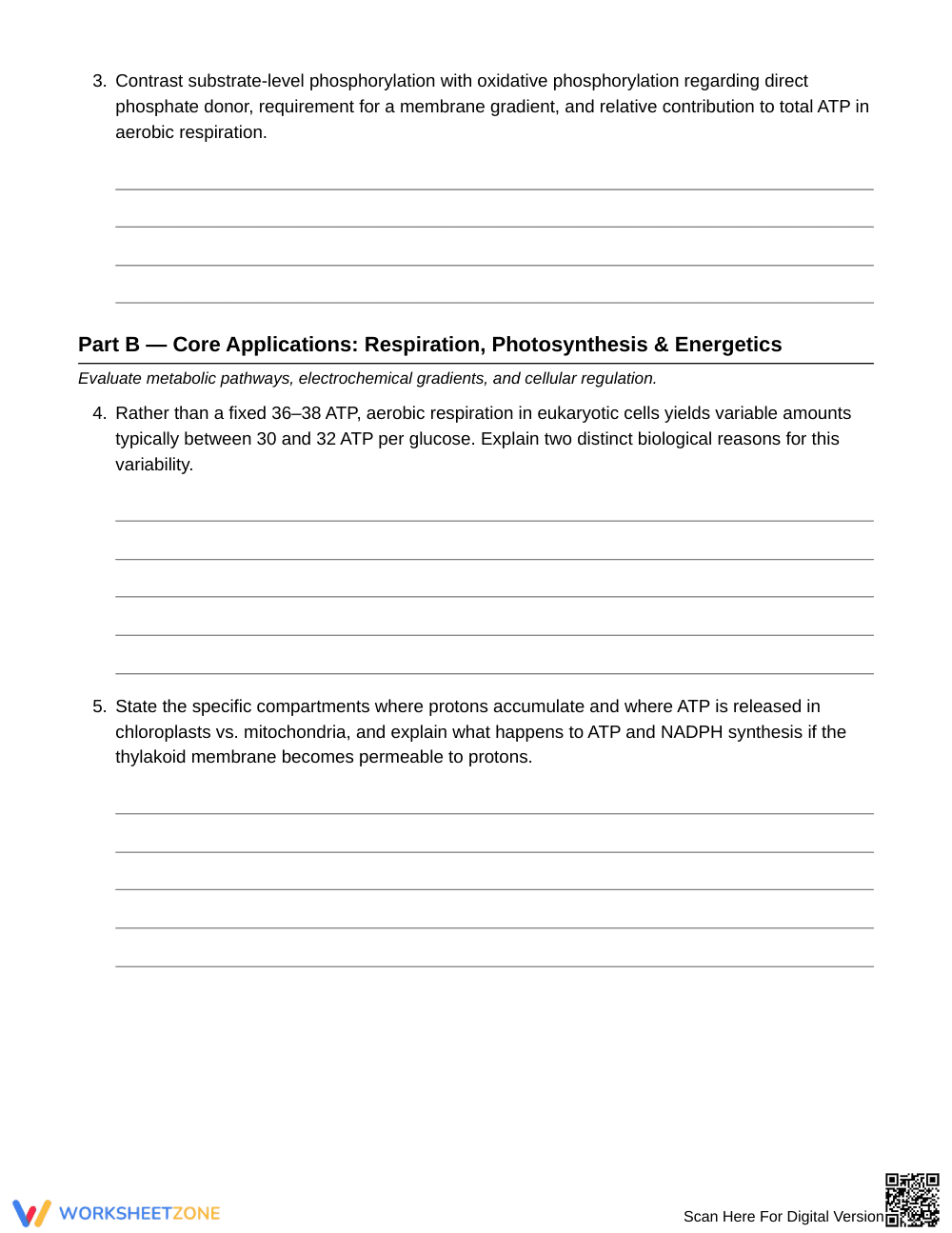
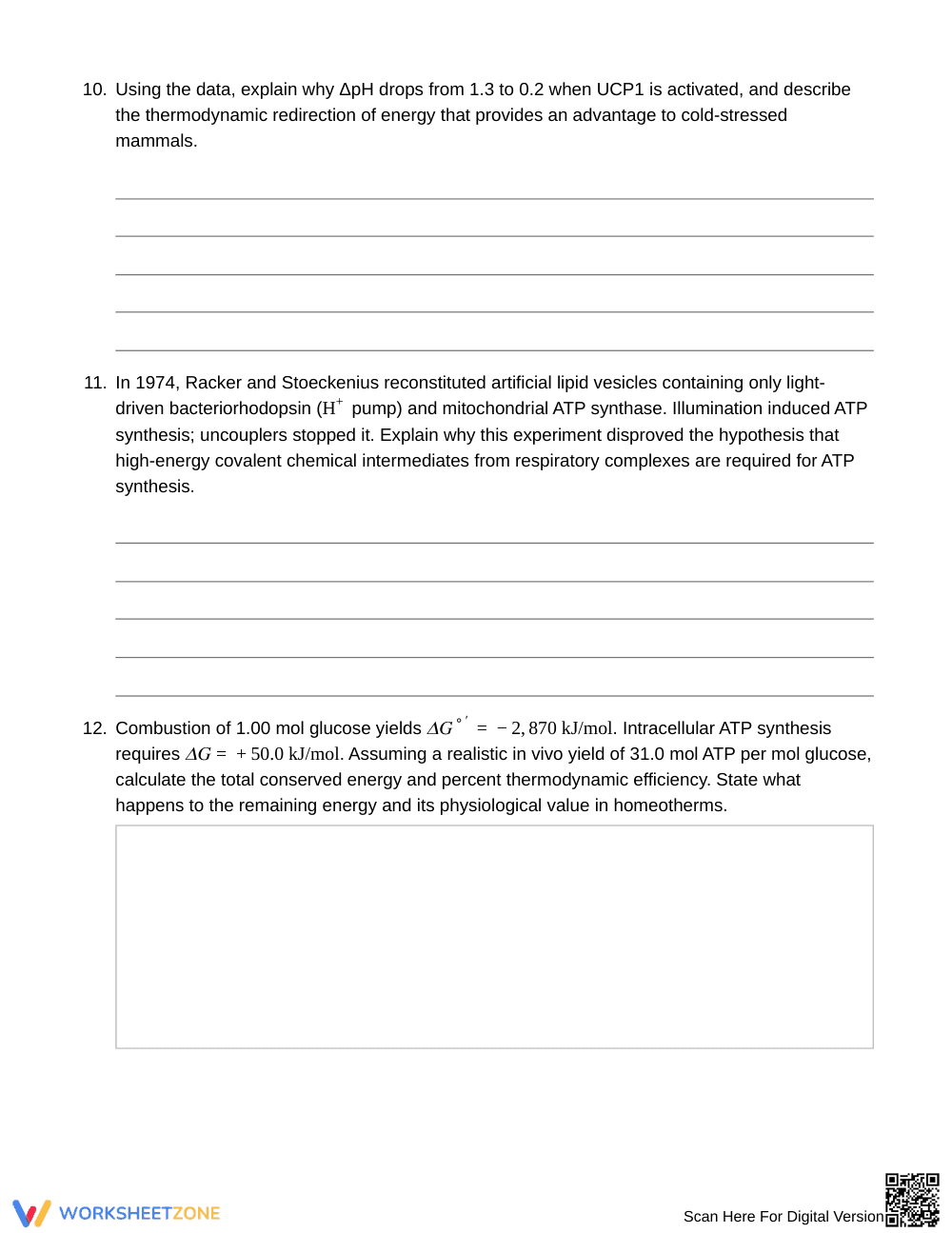
The worksheet spans 5 student-facing pages organized into three structured parts. Part A (3 tasks) targets ATP structure and phosphorylation mechanisms. Part B (6 tasks) explores aerobic respiration, proton gradients across membranes, and cyclic photophosphorylation using a data table on isolated mitochondria. Part C (3 tasks) presents synthetic experimental scenarios, including brown adipose tissue thermogenesis, the landmark Racker-Stoeckenius reconstitution experiment, and thermodynamic efficiency calculations.
- Guided practice (Part A, 3 problems): A reference box defines energy coupling and phosphorylation types. Students correct a common misconception about phosphate bond energy before calculating net ΔG for a coupled reaction.
- Supported practice (Part B, 6 problems): Scaffolds gradually decrease as students interpret a synthetic data table on mitochondria treated with inhibitors, justifying reduction potentials and gradient dynamics.
- Independent practice (Part C, 3 problems): Students independently analyze experimental data, evaluate reconstitution experiments supporting the chemiosmotic model, and calculate percent thermodynamic efficiency from first principles.
Use Part A as a formative check immediately following direct instruction on ATP hydrolysis to address misconceptions early. Assign Parts B and C for paired practice or independent homework; most students complete all 12 problems in 45–60 minutes. For differentiation, provide struggling learners with a pathway diagram, while advanced students derive theoretical maximum efficiency using combustion values.
This 5-page, 12-problem Grade 10 Biology worksheet addresses energy coupling, chemiosmosis, and metabolic evidence within the Cellular Energy and ATP unit. Students explain ATP hydrolysis thermodynamics, calculate net free-energy changes for coupled reactions, interpret mitochondrial respiration data, and evaluate the Racker-Stoeckenius reconstitution experiment as evidence for the chemiosmotic model. The thermodynamic efficiency calculation—using an in vivo yield of 31.0 mol ATP per mol glucose and a ΔG of +50.0 kJ/mol per ATP—grounds abstract biological concepts in quantitative reasoning. According to Fisher and Frey (2014), structured gradual-release instructional frameworks significantly improve student transfer of complex science concepts when instructional scaffolds are systematically reduced across an intentional task sequence, a core design principle embedded throughout this learning resource. A complete answer key is included for all 12 items, supporting efficient formative assessment and accurate progress monitoring across diverse classroom settings.


