




























Views
Downloads
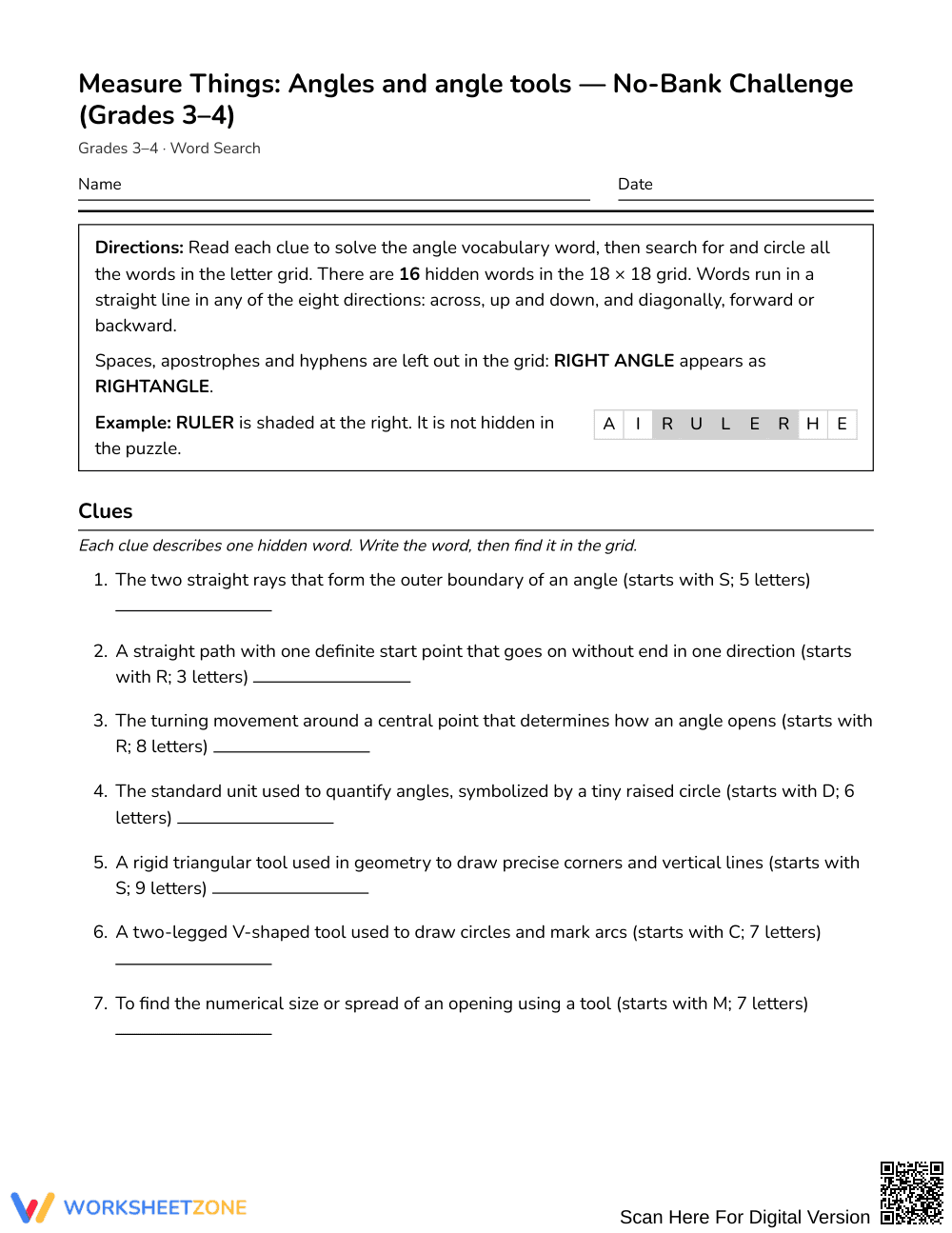
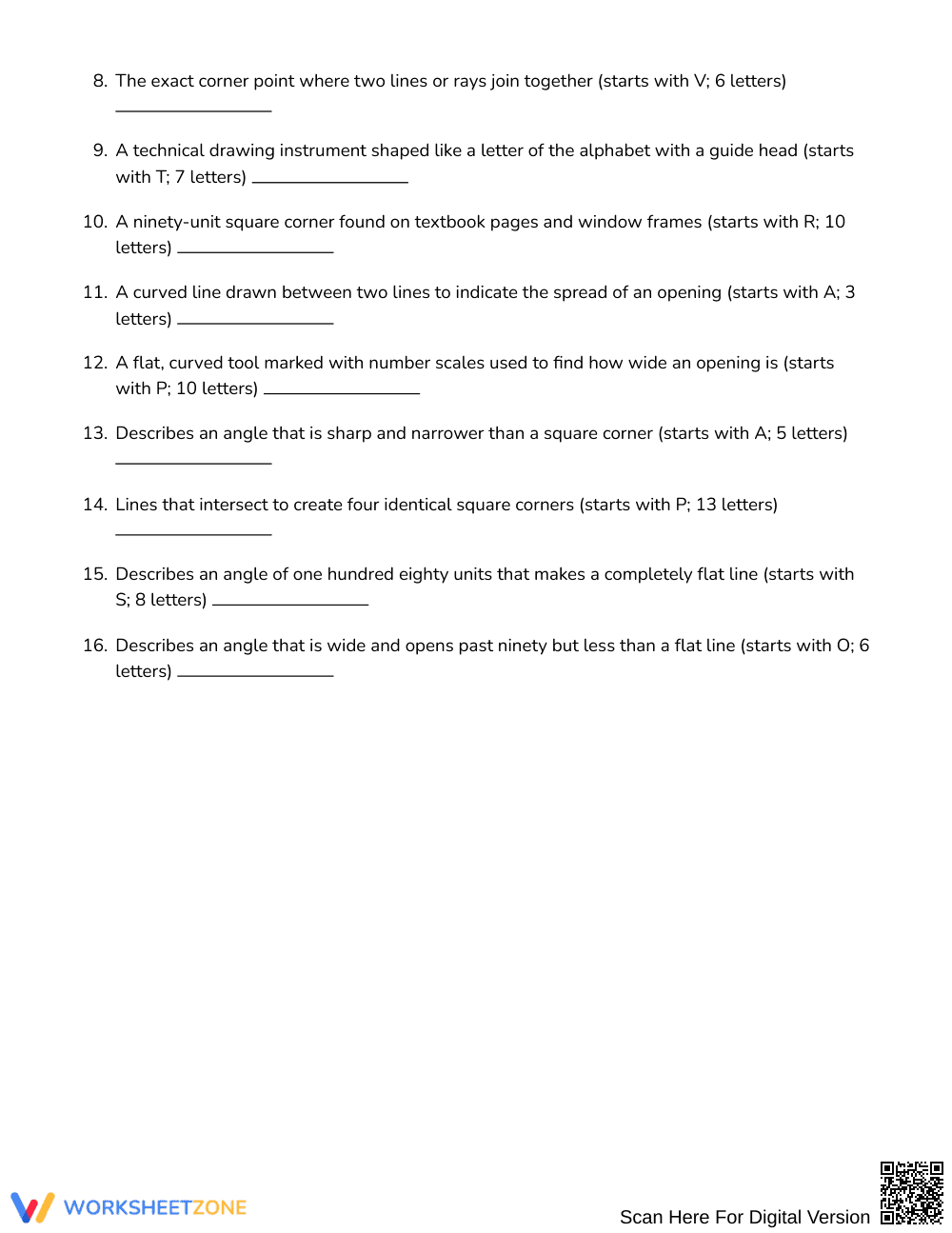


Complete Angles and Tools Word Search | Grades 3–4 Math

Paste this activity's link or code into your existing LMS (Google Classroom, Canvas, Teams, Schoology, Moodle, etc.).
Students can open and work on the activity right away, with no student login required.
You'll still be able to track student progress and results from your teacher account.
This math word search strengthens upper elementary geometry comprehension by challenging students to identify and locate 16 essential terms related to angles and angle tools. Rather than simply scanning for a given list, learners read conceptual clues to recall target terminology, reinforcing spatial vocabulary and geometric measurement concepts.
At a Glance
- Grade: Grades 3–4 · Subject: Math
- Standard: Not standards-assessed — vocabulary enrichment through active retrieval of geometric terms
- Skill Focus: Angles, angle types, measurement units, and drawing instruments
- Format: 3 pages · 16 words · Full answer key included · Printable PDF
- Best For: Geometry unit review, vocabulary reinforcement, and fast finishers
- Time: 20–30 minutes of focused engagement
What’s Inside: This 3-page printable set features 16 hidden vocabulary words without an overt word bank. Students solve 16 definitional clues identifying geometric tools and angle concepts before locating each term. A complete 3-page answer key provides the full word list and a marked grid displaying every solution.
Puzzle Mechanics: Designed as a no-bank challenge, this activity requires active vocabulary recall rather than passive word matching. The puzzle features an 18 x 18 grid with 16 hidden terms running in all 8 compass directions: north, northeast, east, southeast, south, southwest, west, and northwest. Learners read 16 clues to determine target words before searching the grid.
Standards Alignment: This activity is designed for vocabulary enrichment and is not aligned to a specific grade-level standard. It provides supplementary terminology practice that supports general geometric awareness, reinforcing foundational terms such as protractor, vertex, acute, and degree across Grades 3–4 math instruction.
How to Use It: Assign this word search after direct instruction on angle classifications to consolidate geometric vocabulary. It also works as an engaging math station or early-finisher task. Formative assessment tip: check whether students identify terms from definitions independently or need tool diagrams for words like "perpendicular" and "set square." Expected completion time is 20 to 30 minutes.
Who It's For: This resource supports Grades 3–4 math students learning angle terminology and drawing tools. For extra scaffolding, provide an anchor chart of geometry tools or permit paired clue-solving. Pair this activity with a hands-on protractor demonstration where students measure physical angles in geometric shapes.
Vocabulary acquisition in elementary mathematics requires deliberate exposure to formal geometric terminology alongside active cognitive processing. As documented by Fisher & Frey (2014), meaningful vocabulary instruction depends on students interacting with domain-specific terms through purposeful retrieval rather than passive rote memorization. This Grades 3–4 angles word search eliminates traditional word lists, requiring learners to retrieve 16 specific terms—such as vertex, protractor, and perpendicular—by interpreting precise definitional clues before locating words within an 18 x 18 letter matrix. By engaging both semantic language decoding and visual search mechanisms across eight directional orientations, the puzzle reinforces essential mathematical language without creating unnecessary instructional burden. Educational practitioners can effectively deploy clue-driven vocabulary tasks to verify student comprehension during upper elementary geometry units while sustaining focus and high student engagement during independent student seatwork or small-group math center rotations.


