


























Views
Downloads



Essential Size Comparison Worksheet | Kindergarten Math
Paste this activity's link or code into your existing LMS (Google Classroom, Canvas, Teams, Schoology, Moodle, etc.).
Students can open and work on the activity right away, with no student login required.
You'll still be able to track student progress and results from your teacher account.
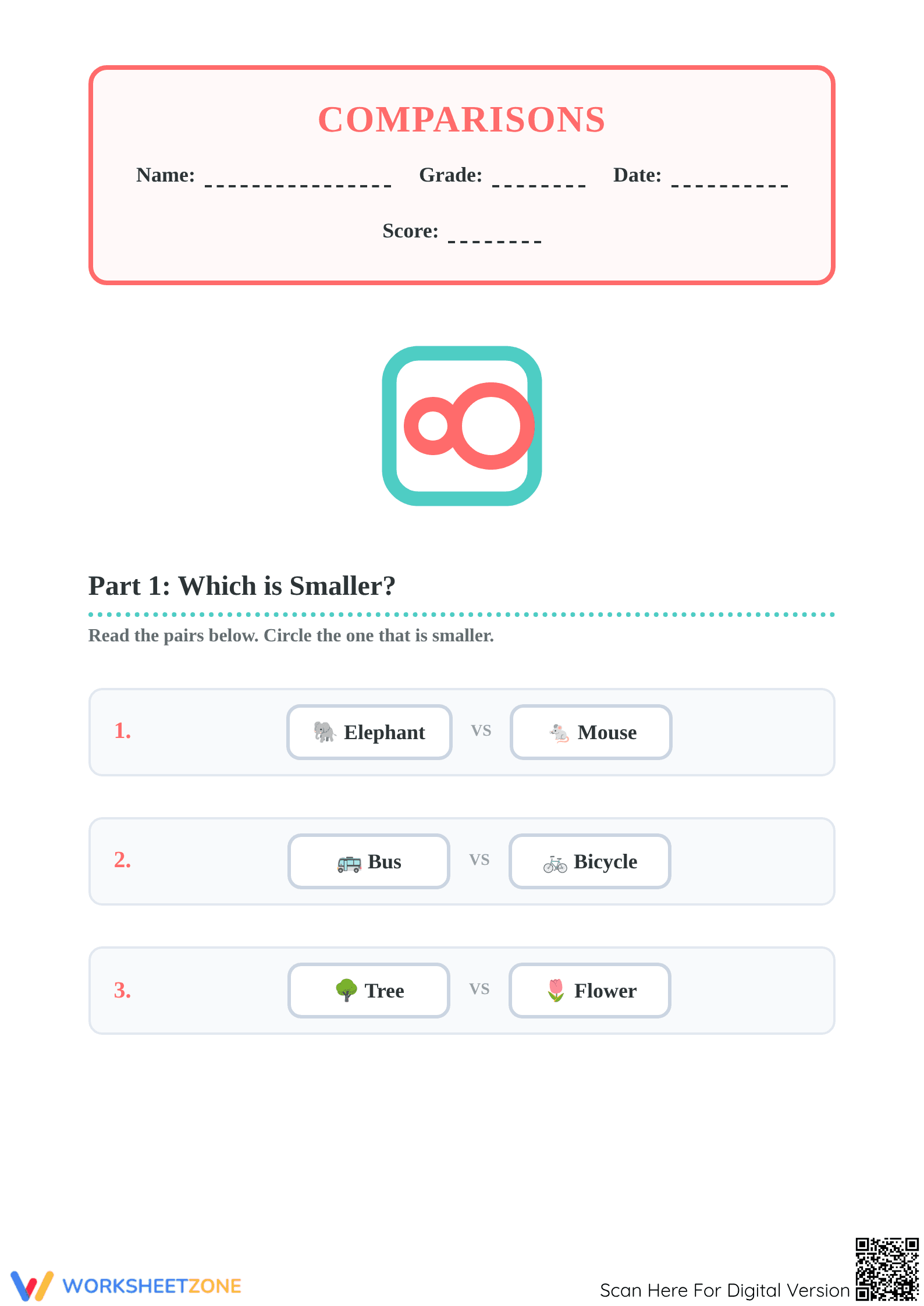
This Kindergarten Math Comparison worksheet provides structured practice for early learners to identify physical attributes like size, length, and height. Students engage in matching and coloring tasks that transform abstract concepts into concrete visual comparisons, building confidence in mathematical vocabulary and visual discrimination.
At a Glance
- Grade: Kindergarten · Subject: Math
- Standard:
CCSS.MATH.CONTENT.K.MD.A.2— Directly compare two objects with a measurable attribute in common like height- Skill Focus: Size, Length, and Height Comparison
- Format: 4 pages · 17 problems · Answer key included · PDF
- Best For: Independent math centers and early finishers
- Time: 15–20 minutes
What's Inside
This comprehensive four-page PDF features interactive tasks for young learners. The first page includes matching exercises for opposites, while subsequent pages focus on "bigger," "shorter," and "taller" through coloring. The document includes a full answer key for quick verification. Each page uses clear icons and large illustrations to support students who are still developing reading skills.
Zero-Prep Workflow
Target teacher preparation time is under two minutes. First, print the four-page set directly from the PDF (30 seconds). Second, distribute the packets to students with basic coloring supplies (30 seconds). Third, review the work using the included answer key for instant formative feedback (60 seconds). Its self-contained design makes it an ideal choice for emergency sub plans or quick transitions.
Standards Alignment
The primary standard addressed is `CCSS.MATH.CONTENT.K.MD.A.2`: "Directly compare two objects with a measurable attribute in common, to see which object has 'more of'/'less of' the attribute." This worksheet specifically targets identifying "more" in height, size, and length. Both standard codes can be copied directly into lesson plans, IEP goals, or district curriculum mapping tools to ensure instructional and documentation compliance.
How to Use It
Deploy this worksheet during the independent practice phase of a lesson on measurable attributes. It serves as an effective formative assessment tool; observe whether students identify the correct object without verbal prompting to gauge mastery. We expect most Kindergarten students to complete the full packet in 15 to 20 minutes, depending on their fine motor coloring speed and level of engagement.
Who It's For
This resource is tailored for Kindergarten but provides excellent remediation for Grade 1 students or challenges for advanced Preschoolers. Pair this worksheet with a physical classroom hunt where students find objects "taller" than their desk to bridge the gap. These pages support inclusive classrooms by providing clear visual cues for learners with diverse needs.
According to the NAEP 2024 framework for early mathematics, the ability to compare attributes of objects is a foundational precursor to formal measurement. This worksheet directly supports this developmental milestone by providing repetitive, high-contrast visual stimuli that allow students to practice comparative logic. Research from Fisher & Frey (2014) emphasizes that visual scaffolds—such as the clear illustrations provided here—are essential for helping young learners internalize mathematical vocabulary. By focusing on "bigger," "shorter," and "taller," the resource helps students move from intuitive understanding to precise mathematical description. This alignment with the `CCSS.MATH.CONTENT.K.MD.A.2` standard ensures that students are actively engaging with the core requirements of the Kindergarten measurement strand. Educators can utilize these tasks to build a robust evidentiary base for student progress in early geometry and measurement, ensuring readiness for higher-grade mathematical concepts.


