


























Views
Downloads

Essential Fraction Comparison Worksheet: Proper & Mixed
Paste this activity's link or code into your existing LMS (Google Classroom, Canvas, Teams, Schoology, Moodle, etc.).
Students can open and work on the activity right away, with no student login required.
You'll still be able to track student progress and results from your teacher account.
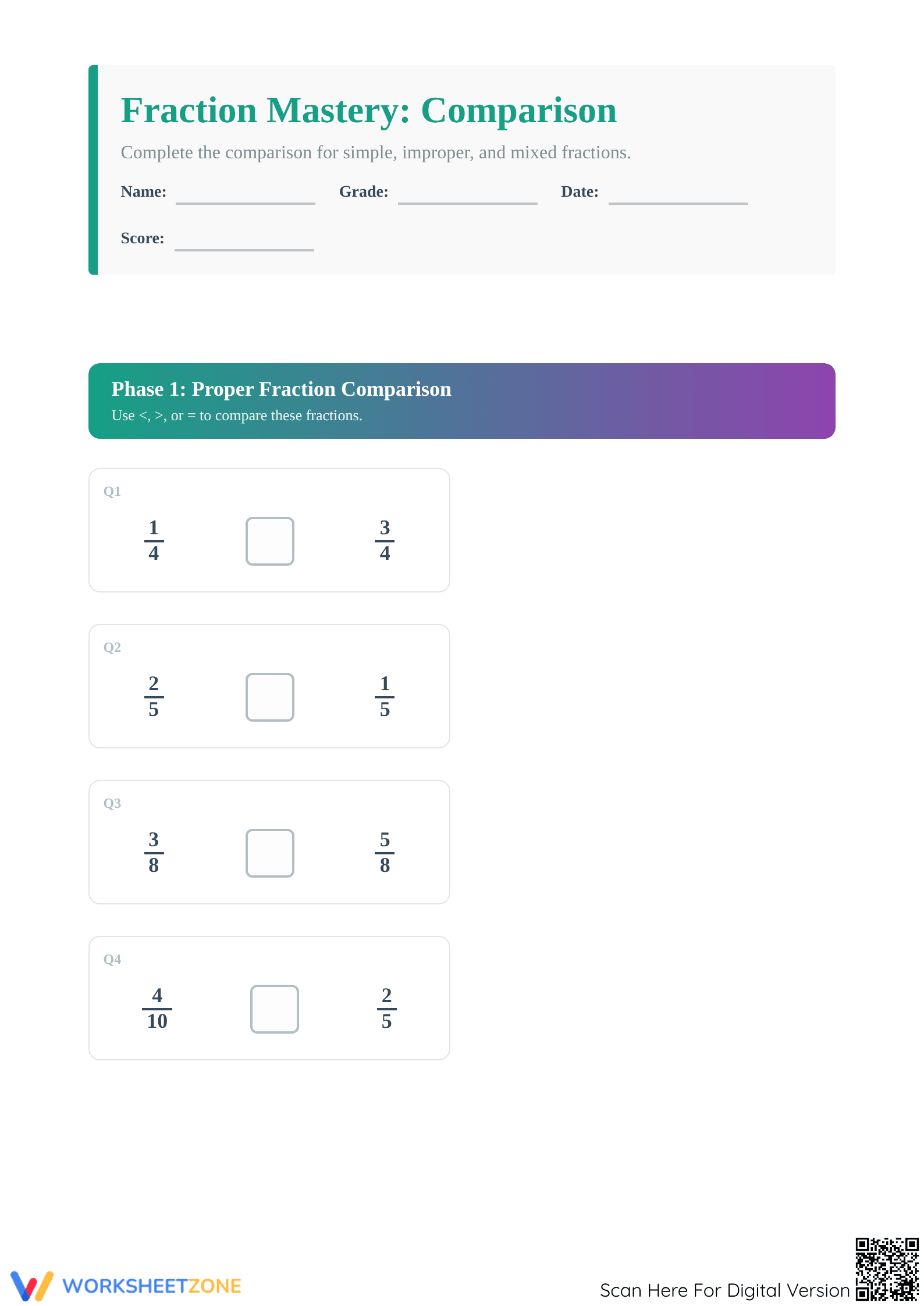
This comprehensive fraction comparison worksheet set helps students master the relationship between different numerical representations. Students will evaluate and compare proper fractions, improper fractions, and mixed numbers using relational symbols. This systematic approach ensures a deep understanding of fraction magnitude, which is essential for success in higher-level rational number operations and future algebraic thinking.
At a Glance
- Grade: 4–6 · Subject: Math
- Standard:
CCSS.MATH.CONTENT.4.NF.A.2— Compare fractions with different numerators and denominators by creating common denominators- Skill Focus: Fraction Comparison (Proper, Improper, Mixed)
- Format: 5 pages · 28 problems · Answer key included · PDF
- Best For: Independent practice and fraction revision
- Time: 30–45 minutes
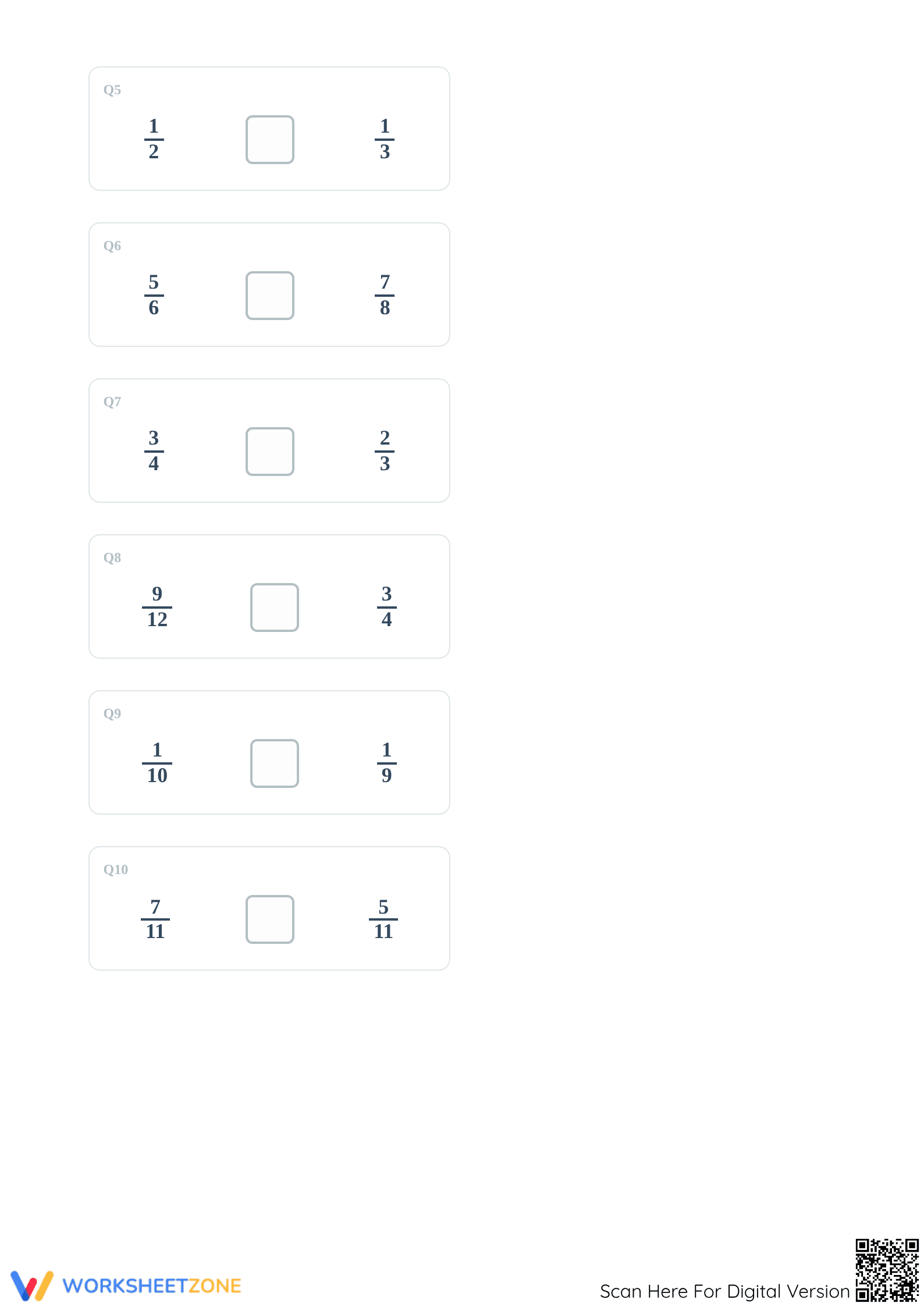
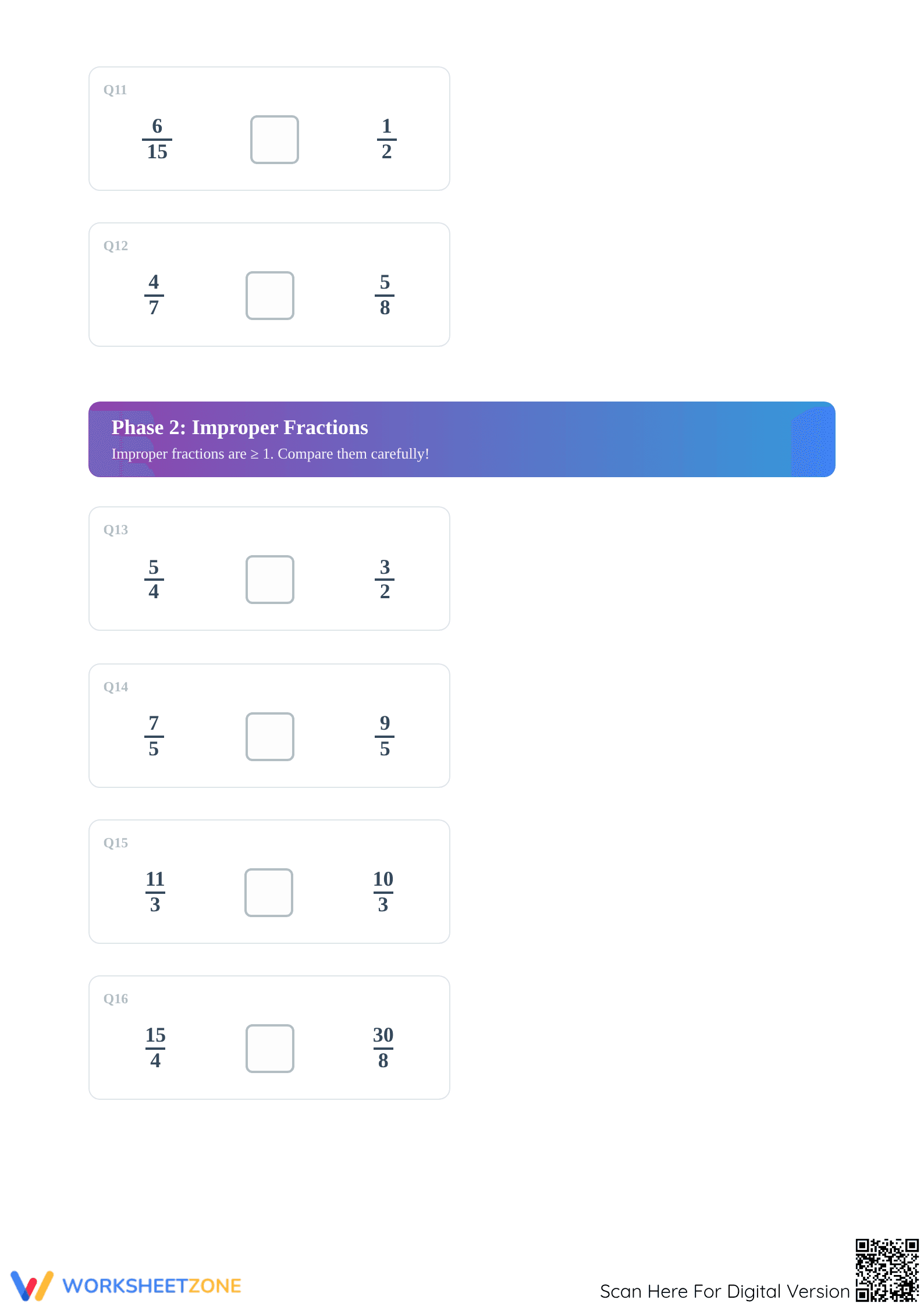
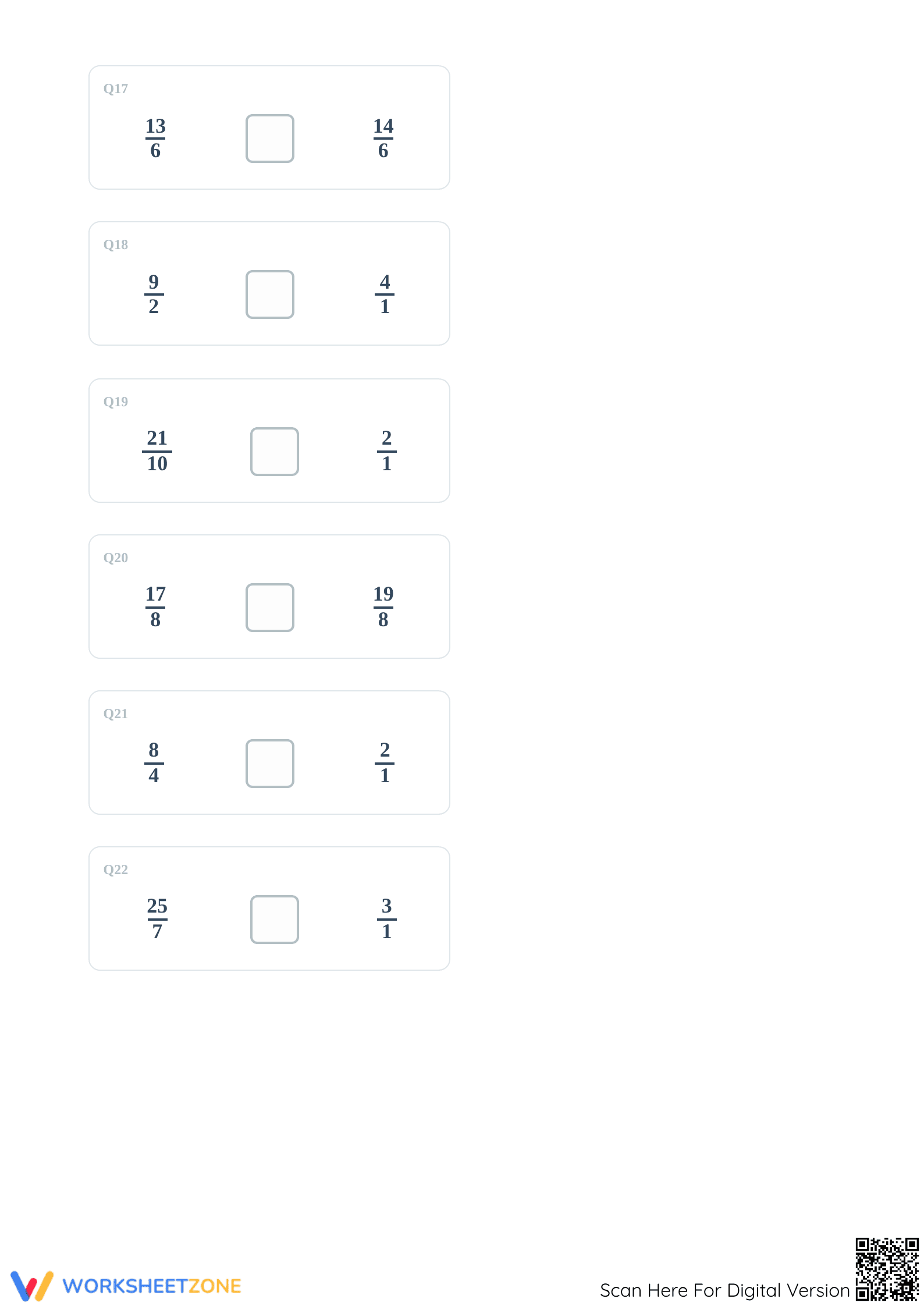
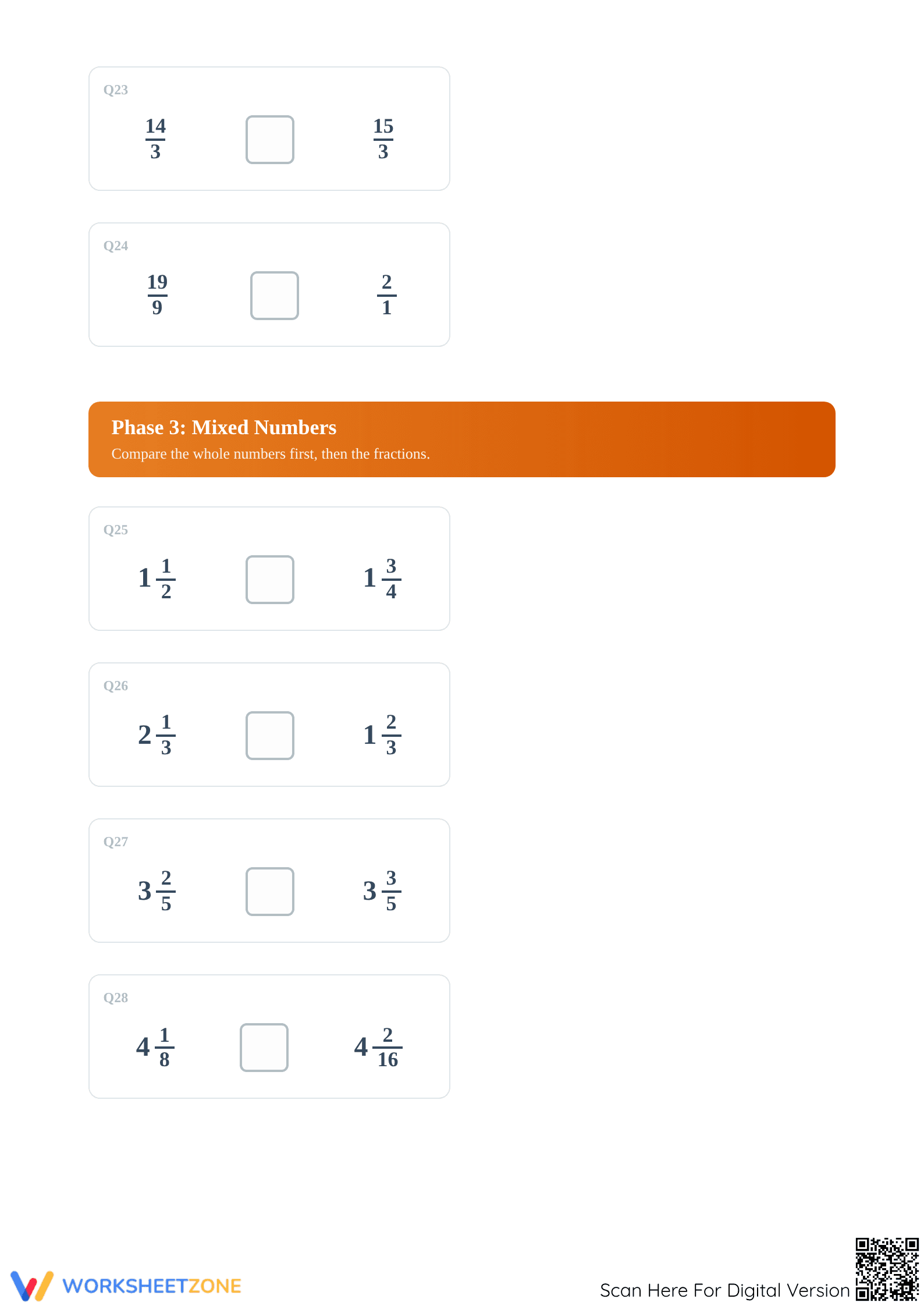
Inside this 5-page resource, you will find 28 structured problems divided into three distinct phases. The layout is clean and focused, allowing students to work through Proper Fraction Comparison, Improper Fractions, and Mixed Numbers without visual clutter. A complete answer key is provided to facilitate quick grading and self-correction during math rotations or independent study sessions.
Skill Progression
- Guided practice: Problems 1–12 provide foundational practice with proper fractions, using similar denominators in early questions to build confidence before introducing unlike denominators.
- Supported practice: Problems 13–24 transition to improper fractions, requiring students to visualize values greater than one and understand their relationship to unit fractions.
- Independent practice: The final section integrates mixed numbers (Q25–28), demanding higher-order reasoning to compare complex structures by looking at whole number parts first and then fractional remainders.
This sequence follows a gradual-release model, moving from familiar concepts to more complex rational number comparisons.
Standards Alignment
This worksheet is primarily aligned to `CCSS.MATH.CONTENT.4.NF.A.2`: "Compare two fractions with different numerators and different denominators, e.g., by creating common denominators or numerators, or by comparing to a benchmark fraction such as 1/2." It also supports foundational skills for Grade 5 operations with unlike denominators. Both standard codes can be copied directly into lesson plans, IEP goals, or district curriculum mapping tools.
How to Use It
This resource is ideal for a mid-unit formative assessment. After teaching common denominator strategies, assign the first two pages as a check for understanding. Use the later pages on mixed numbers as an enrichment activity for students who demonstrate early mastery. The 28 items can also be used as a multi-day bell-ringer series, with students completing one phase each morning. Expect a total completion time of 30 to 45 minutes for the entire set.
Who It's For
While designed for Grade 4 and Grade 5 students, this set is a valuable intervention tool for Grade 6 and middle schoolers who struggle with fraction magnitude. It pairs naturally with visual area models or number line tasks to provide a complete instructional cycle. The clear sectioning makes it an excellent choice for special education settings where task-chunking is required.
This worksheet aligns with the gradual release of responsibility model (Fisher & Frey, 2014), providing a structured sequence from simple proper fractions to complex improper and mixed numbers. It helps students overcome the common misconception that larger denominators always mean smaller values, a hurdle identified in NAEP assessments. The 28 practice items build procedural fluency and reinforce conceptual understanding for CCSS.MATH.CONTENT.4.NF.A.2. Educators can identify student reasoning gaps, and the answer key offers immediate feedback, a proven strategy for improving outcomes in middle-grade mathematics.


