


























Views
Downloads
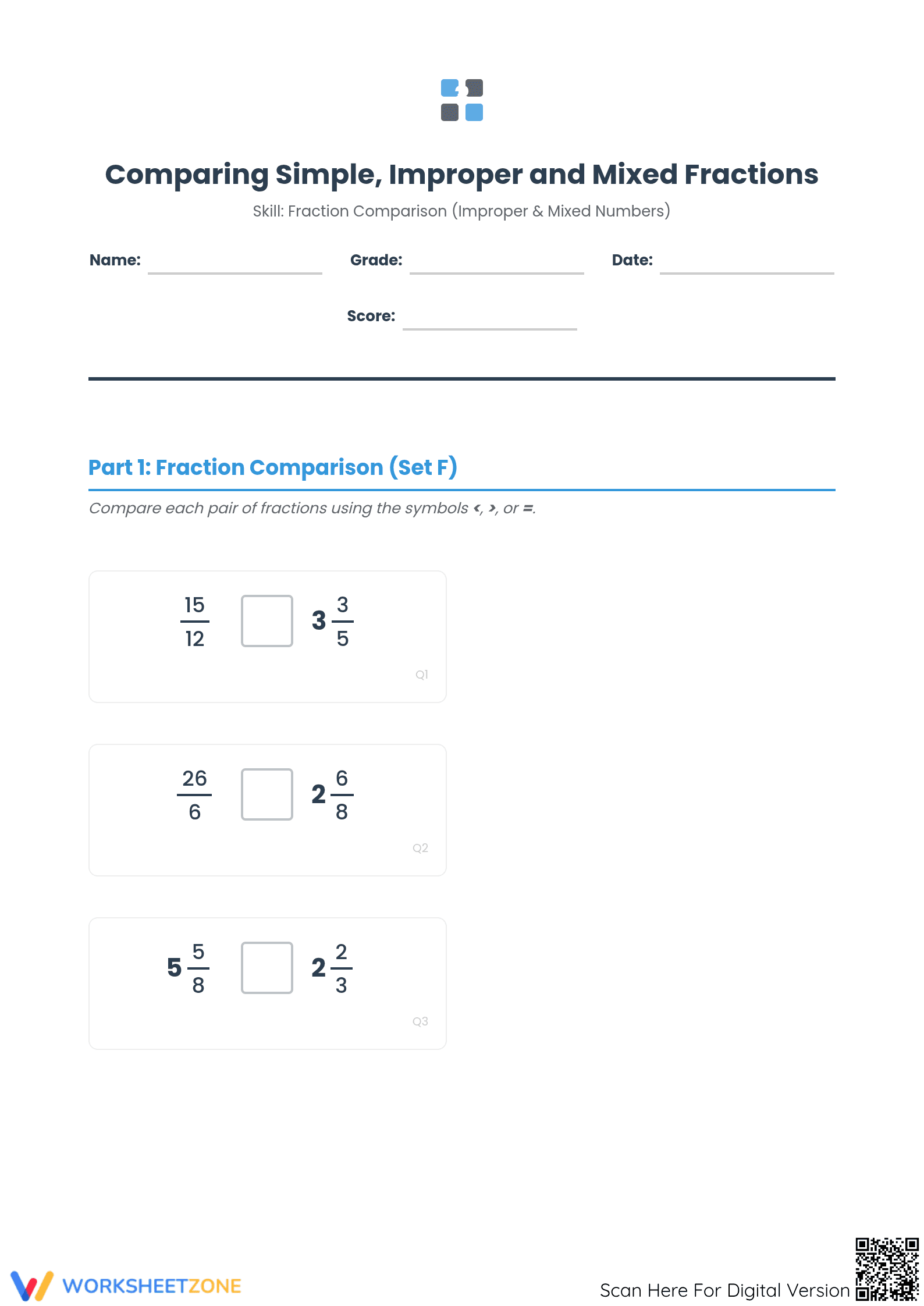
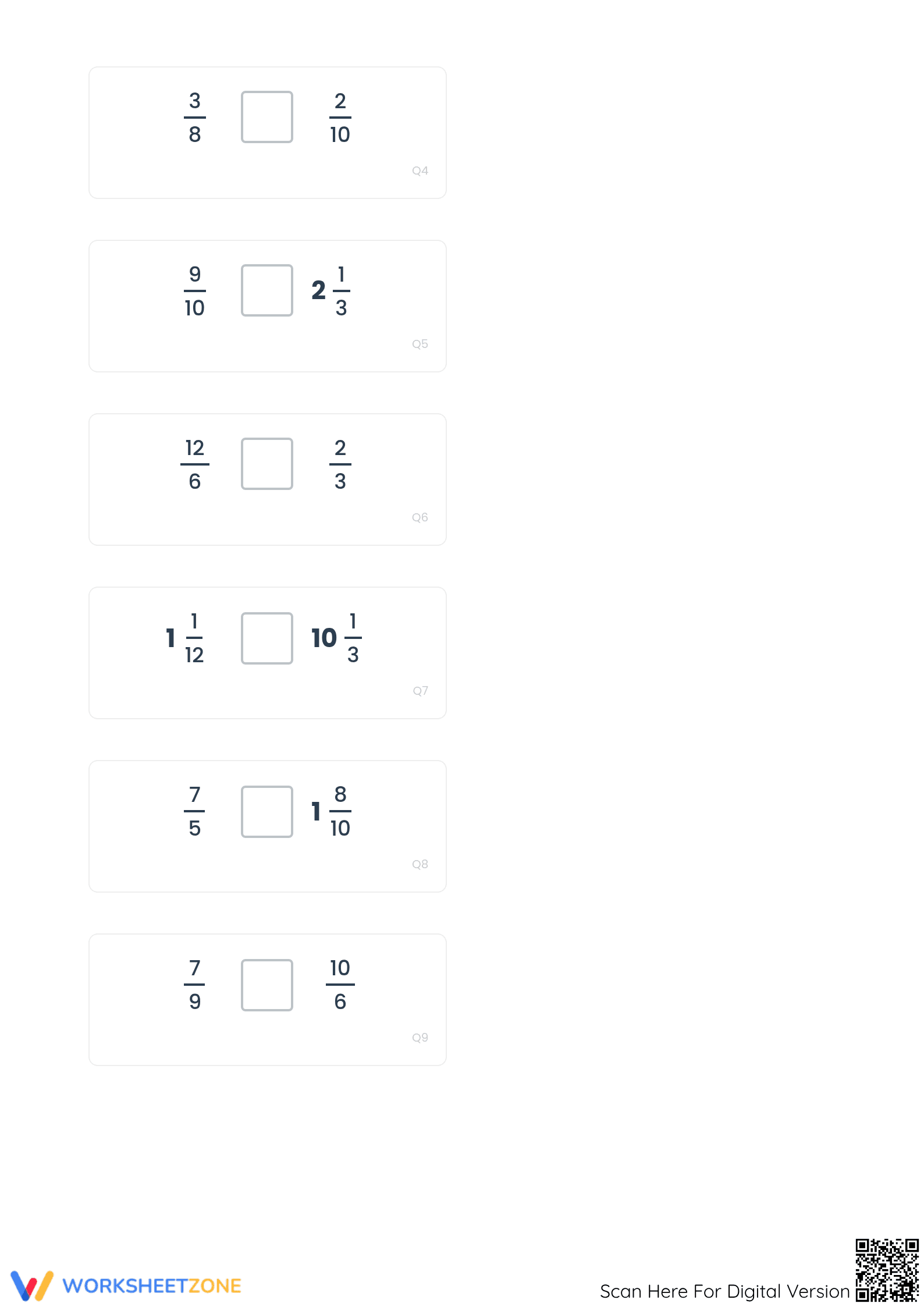
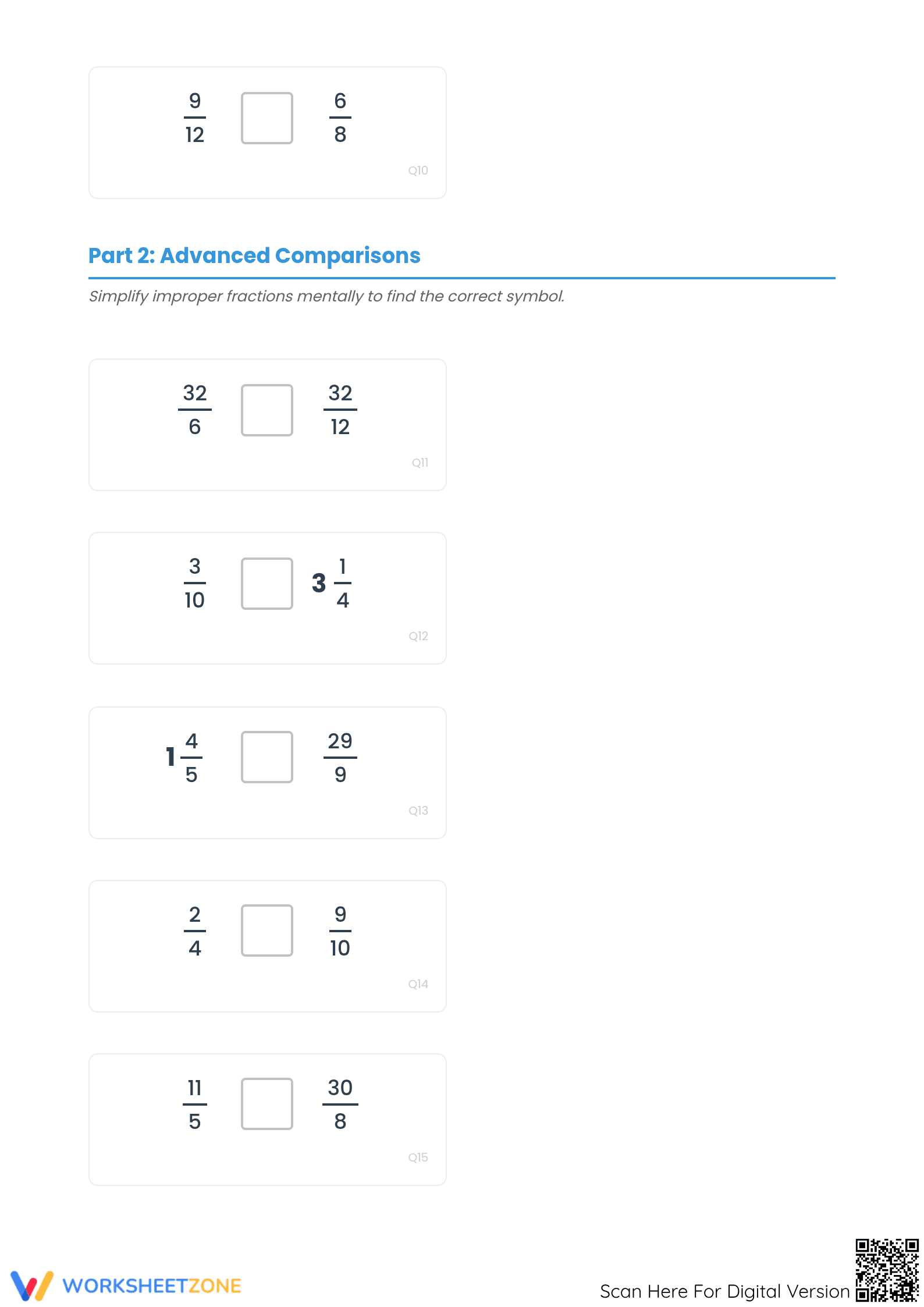
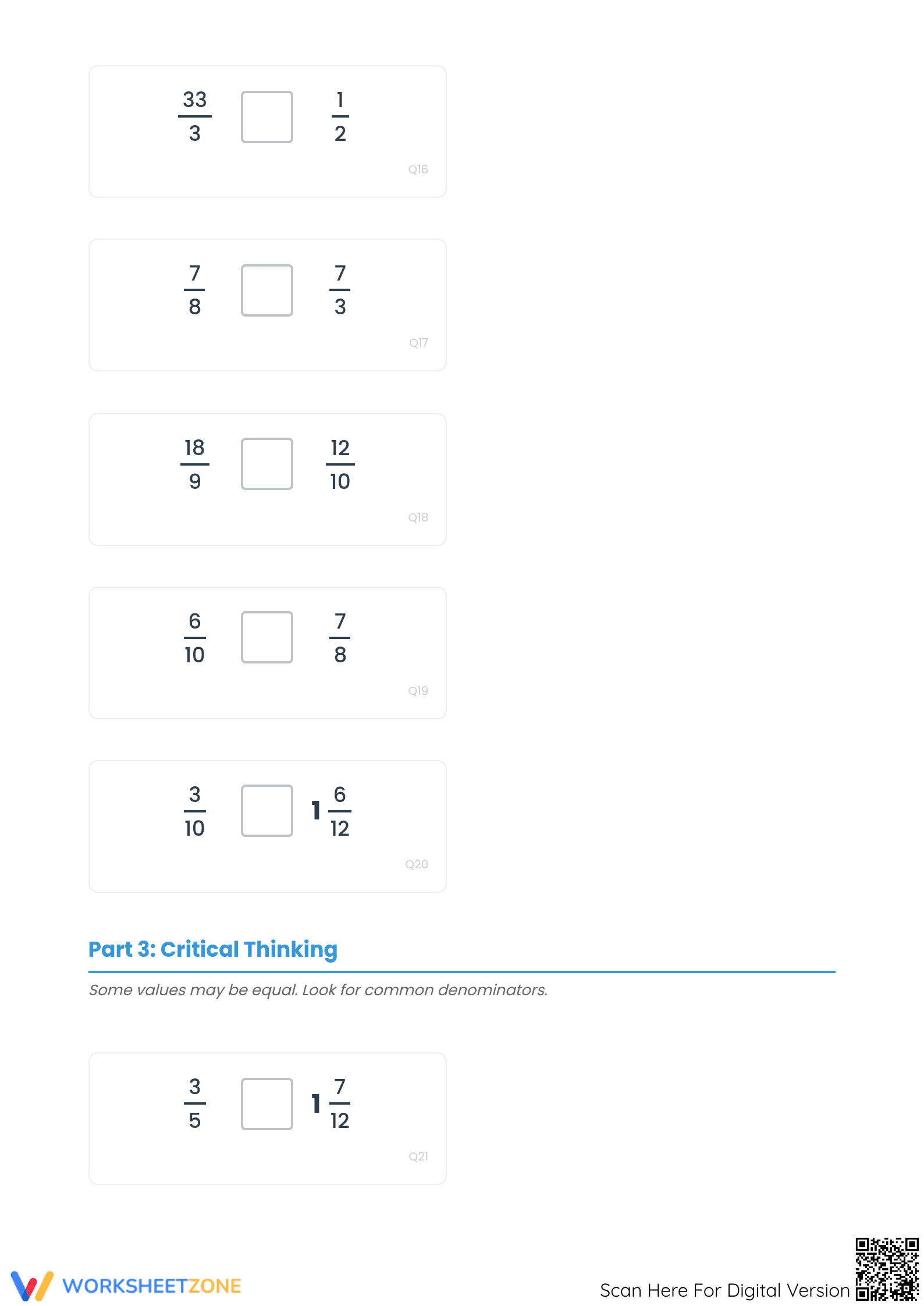

Printable Comparing Simple, Improper and Mixed Fractions
Paste this activity's link or code into your existing LMS (Google Classroom, Canvas, Teams, Schoology, Moodle, etc.).
Students can open and work on the activity right away, with no student login required.
You'll still be able to track student progress and results from your teacher account.
Comparing different types of fractions is a pivotal skill in upper elementary mathematics. This comprehensive five-page worksheet set provides students with rigorous practice in evaluating the relationships between simple, improper, and mixed fractions. By mastering these comparisons, learners develop a deep conceptual understanding of numerical magnitude and part-whole relationships essential for higher-level algebra.
At a Glance
- Grade: 4 · Subject: Math — Fractions
- Standard:
CCSS.MATH.CONTENT.4.NF.A.2— Compare two fractions with different numerators and denominators by creating common denominators- Skill Focus: Simple, Improper, and Mixed Fraction Comparison
- Format: 5 pages · 27 problems · Answer key included · PDF
- Best For: Independent practice and formative math assessment
- Time: 30–45 minutes
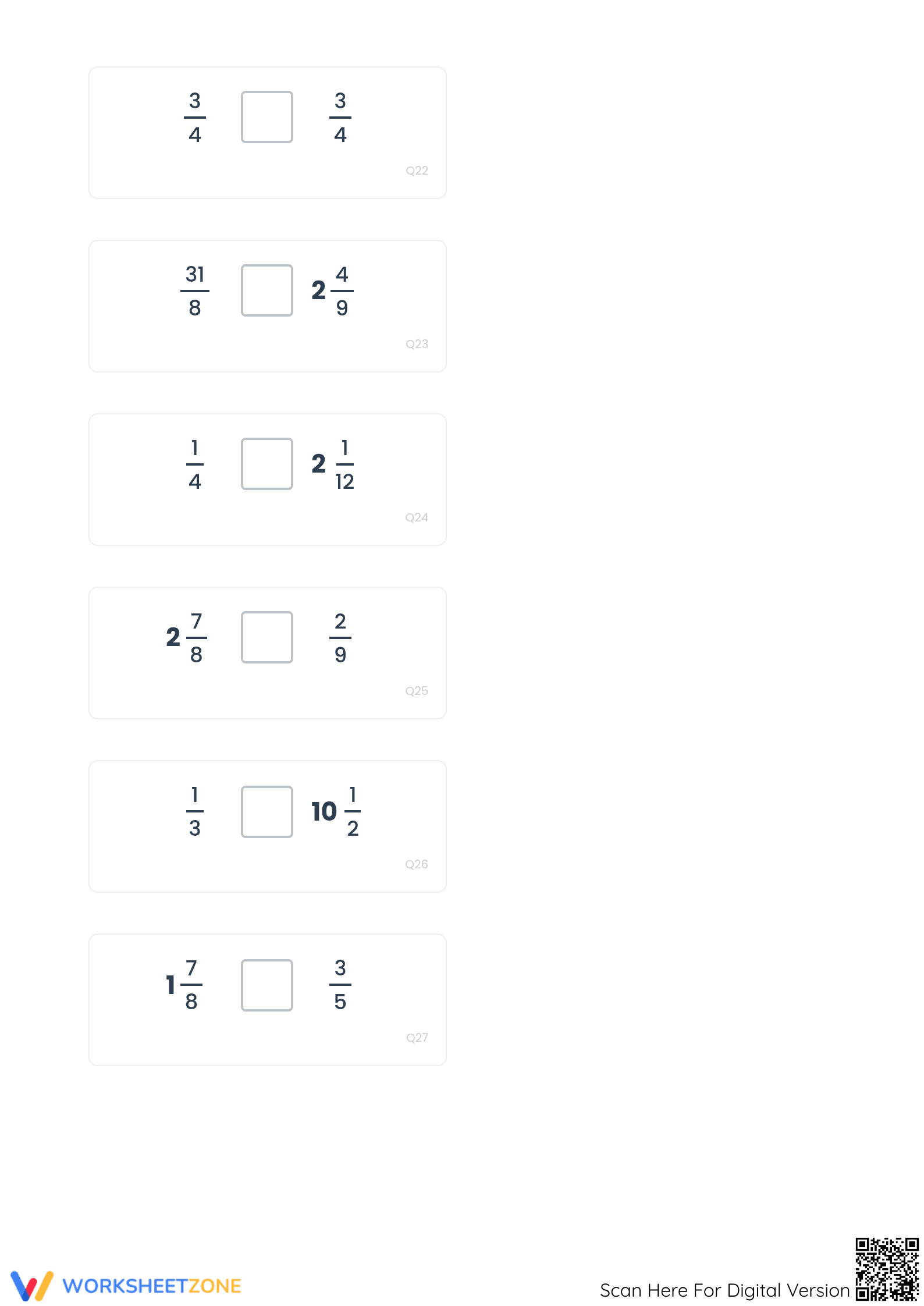
This resource contains three distinct sections across five printable pages. Students progress through 27 total tasks, ranging from basic comparison sets to advanced mental simplification and critical thinking challenges. The layout features clear question boxes with symbols for less than, greater than, or equal to. A full answer key is provided for immediate grading.
- Guided Practice: Part 1 introduces fraction comparison (Set F) with 10 problems focused on visual recognition and basic magnitude between simple and mixed numbers.
- Supported Practice: Part 2 presents Advanced Comparisons where students must simplify improper fractions mentally to find the correct relationship across 10 challenging items.
- Independent Practice: Part 3 focuses on Critical Thinking with 7 problems requiring students to identify equal values and utilize common denominators for precise evaluation.
This structure follows a gradual-release model, moving from standard procedures to high-order mental math and reasoning.
The primary focus of this worksheet is CCSS.MATH.CONTENT.4.NF.A.2. This standard requires students to compare two fractions with different numerators and different denominators, e.g., by creating common denominators or numerators, or by comparing to a benchmark fraction. Students record the results of comparisons with symbols and justify the conclusions. This standard code can be copied directly into lesson plans, IEP goals, or district curriculum mapping tools.
Assign this worksheet during the independent practice phase of a lesson on mixed number relationships. Teachers can use the first page as a check for understanding to see if students are ready for the mental simplification in Part 2. Completion time generally ranges from 30 to 45 minutes depending on student fluency with common denominators. Use the results to identify if students are over-relying on whole number comparisons.
This resource is ideal for Grade 4 and Grade 5 students working on the Numbers and Operations—Fractions domain. It provides necessary scaffolding for students struggling with improper fractions while offering extension for advanced learners through the mental math section. Pair this with a fraction tile anchor chart or a direct instruction lesson on converting mixed numbers to improper forms.
Effective mathematical instruction requires a balance of procedural fluency and conceptual understanding, particularly when transitioning from simple fractions to complex mixed and improper forms. According to the NAEP framework, student performance in fraction comparison is a leading indicator of later success in proportional reasoning and algebraic readiness. This 27-task worksheet set directly addresses this need by requiring students to utilize multiple strategies, including mental simplification and denominator alignment, to determine numerical relationships accurately. Research from ScienceDirect TpT Analysis indicates that structured, multi-part practice sets significantly improve retention of fraction magnitude concepts compared to isolated drill exercises. By targeting CCSS.MATH.CONTENT.4.NF.A.2, this resource ensures that students are not just guessing based on whole-number bias but are engaging in the rigorous mental transformations required for true mathematical mastery. Educators can use these tasks to identify specific misconceptions regarding the value of improper fractions versus mixed numbers effectively.


