


























Views
Downloads

Printable Comparing Fractions Worksheet | Grade 4-6
Paste this activity's link or code into your existing LMS (Google Classroom, Canvas, Teams, Schoology, Moodle, etc.).
Students can open and work on the activity right away, with no student login required.
You'll still be able to track student progress and results from your teacher account.
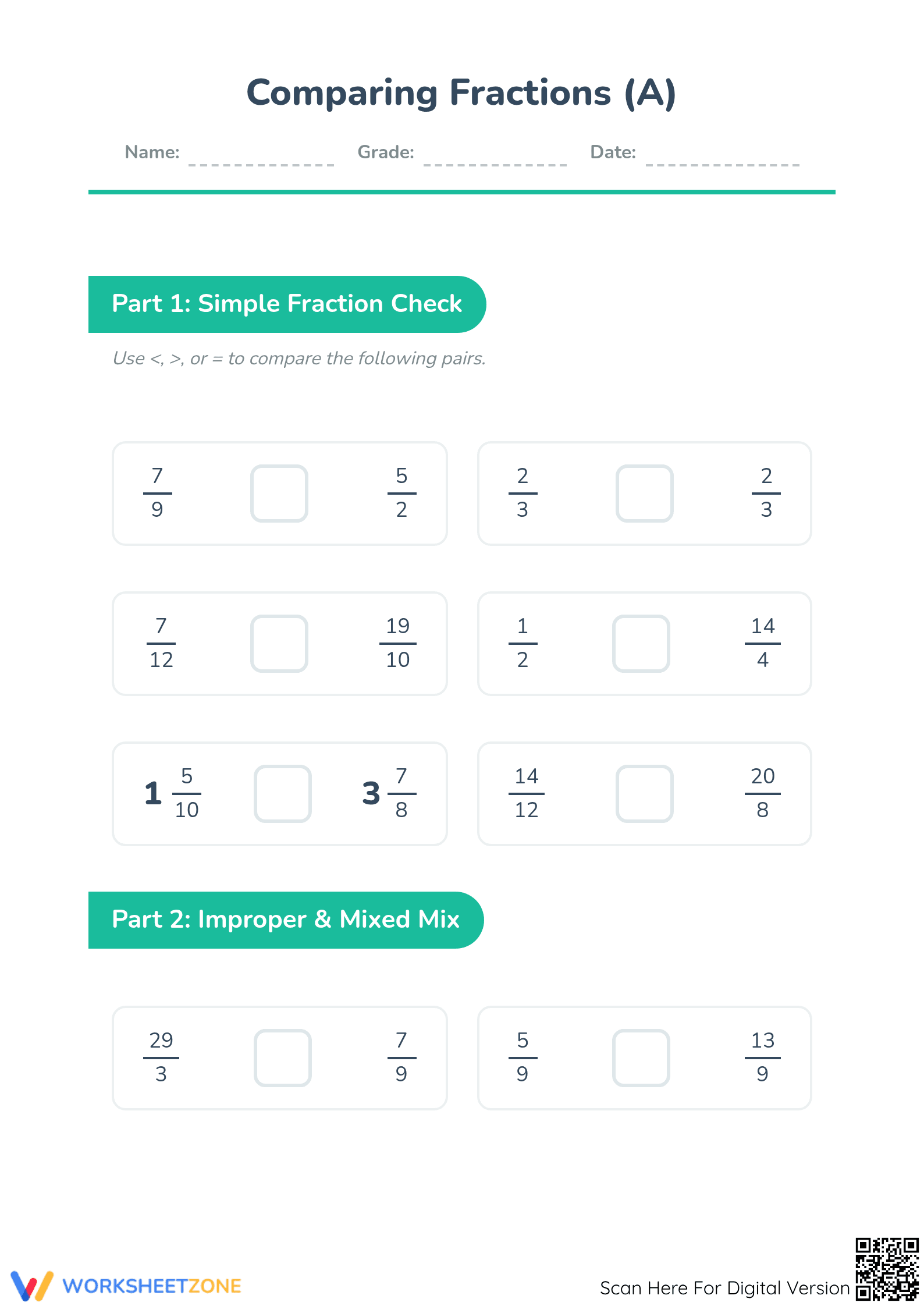
This comprehensive worksheet set focuses on the essential skill of comparing various types of fractions. Students move beyond basic visual models to analyze relationships between proper, improper, and mixed fractions using inequality symbols. Learners develop the numerical fluency required for more complex operations with unlike denominators.
At a Glance
- Grade: 4 · Subject: Math
- Standard:
4.NF.A.2— Compare two fractions with different numerators and denominators using inequality symbols- Skill Focus: Comparing proper, improper, and mixed fractions
- Format: 3 pages · 30 problems · Answer key included · PDF
- Best For: Individual practice and formal skill assessment
- Time: 25–35 minutes
What's Inside
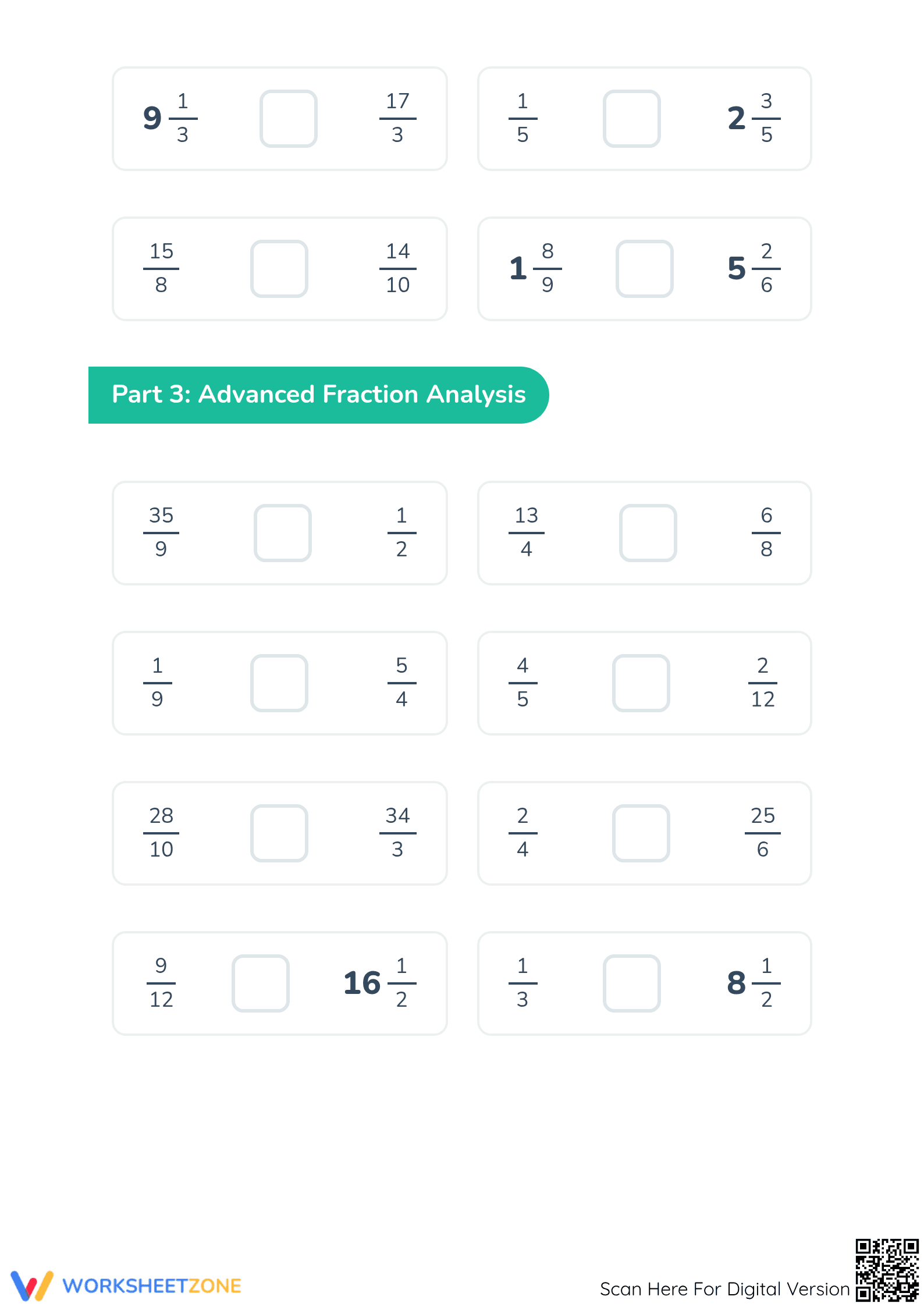
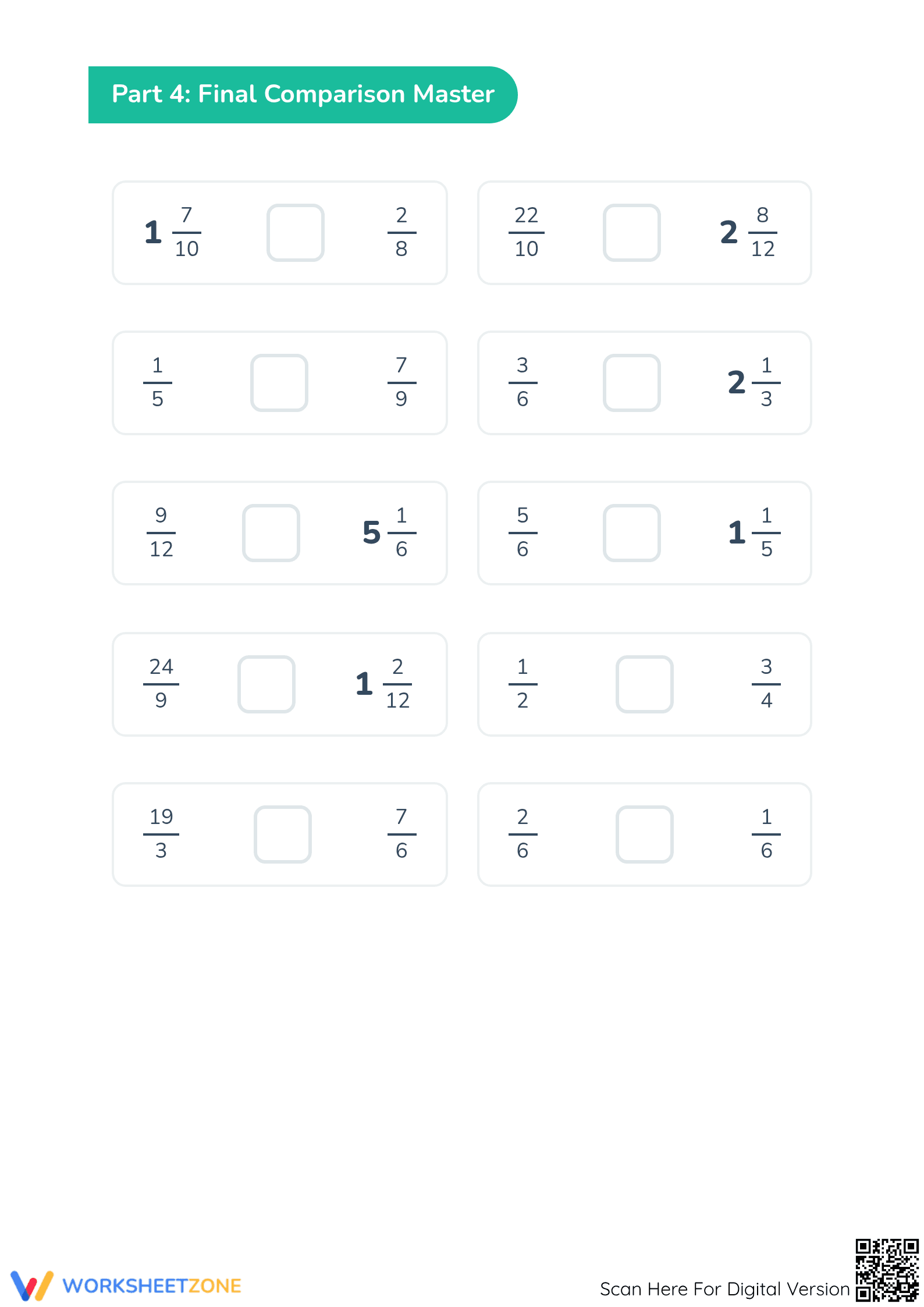
This 3-page printable pack features a scaffolded structure divided into four distinct parts. It contains thirty total problems that challenge students to compare fractions with different numerators and denominators. The layout is clean and spacious, providing dedicated boxes for students to write comparison symbols. A complete answer key is provided to facilitate quick grading or self-correction.
Skill Progression
- Guided Practice (Part 1): Students begin with six simple fraction checks to establish baseline proficiency with proper fractions and basic mixed numbers.
- Supported Practice (Parts 2 & 3): The difficulty increases as students compare improper fractions with mixed numbers, requiring them to convert between forms to determine value.
- Independent Practice (Part 4): The final section, "Final Comparison Master," presents ten complex pairs that require high-level fraction analysis without scaffolds.
This progression follows the gradual-release model, transitioning students from fundamental recognition to absolute mastery of fraction comparisons.
Standards Alignment
The primary focus of this resource is `CCSS.MATH.CONTENT.4.NF.A.2`, which requires students to compare two fractions with different numerators and different denominators by creating common denominators or numerators. It also supports 5.NF.A.1 by reinforcing the foundational understanding of fraction magnitude necessary for computation. Both standard codes can be copied directly into lesson plans, IEP goals, or district curriculum mapping tools.
How to Use It
This worksheet is ideal for use during the independent practice phase of a lesson on fraction relationships. Teachers can assign Part 1 as a warm-up to check for prior knowledge before moving into the more complex improper and mixed fraction comparisons. Use the final page as a formative assessment to identify students who may need additional intervention with fraction conversions. Expected completion time is roughly thirty minutes.
Who It's For
This resource is designed for Grade 4 and Grade 5 students working toward mastery of the Number and Operations—Fractions domain. It is particularly effective for students who struggle with the conceptual difference between improper fractions and mixed numbers. Pair this worksheet with a visual anchor chart showing fraction bars or number lines to support visual learners during the transition to abstract comparison.
Mastering the ability to compare fractions is a pivotal milestone in elementary mathematics that directly influences success in middle school algebra. According to the RAND AIRS 2024 report, students who demonstrate high proficiency in fraction magnitude comparison are significantly more likely to succeed in advanced rational number operations. This worksheet aligns with the standard 4.NF.A.2, requiring students to justify their comparisons through common denominators or benchmark fractions. Research from Fisher & Frey (2014) emphasizes that scaffolded practice sets, like the four-part progression used here, are essential for moving students from surface-level recognition to deep procedural fluency. By systematically introducing improper and mixed fractions into the comparison set, this resource ensures that students are not merely relying on visual cues but are developing the robust mental models required for higher-order mathematical reasoning in later grades.


