


























Views
Downloads

Printable Comparing Fractions Worksheet | Grade 4-5 Math
Paste this activity's link or code into your existing LMS (Google Classroom, Canvas, Teams, Schoology, Moodle, etc.).
Students can open and work on the activity right away, with no student login required.
You'll still be able to track student progress and results from your teacher account.
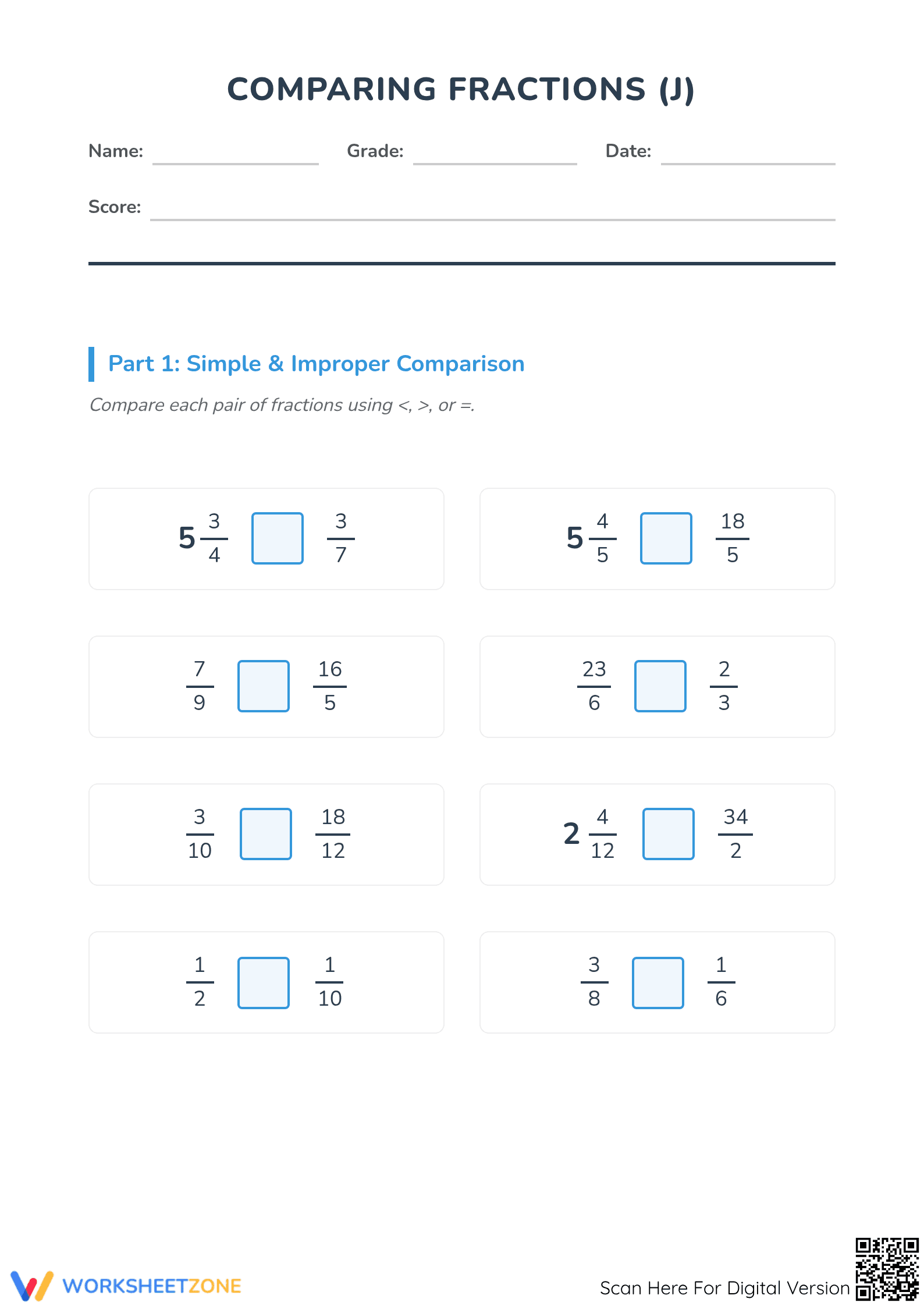
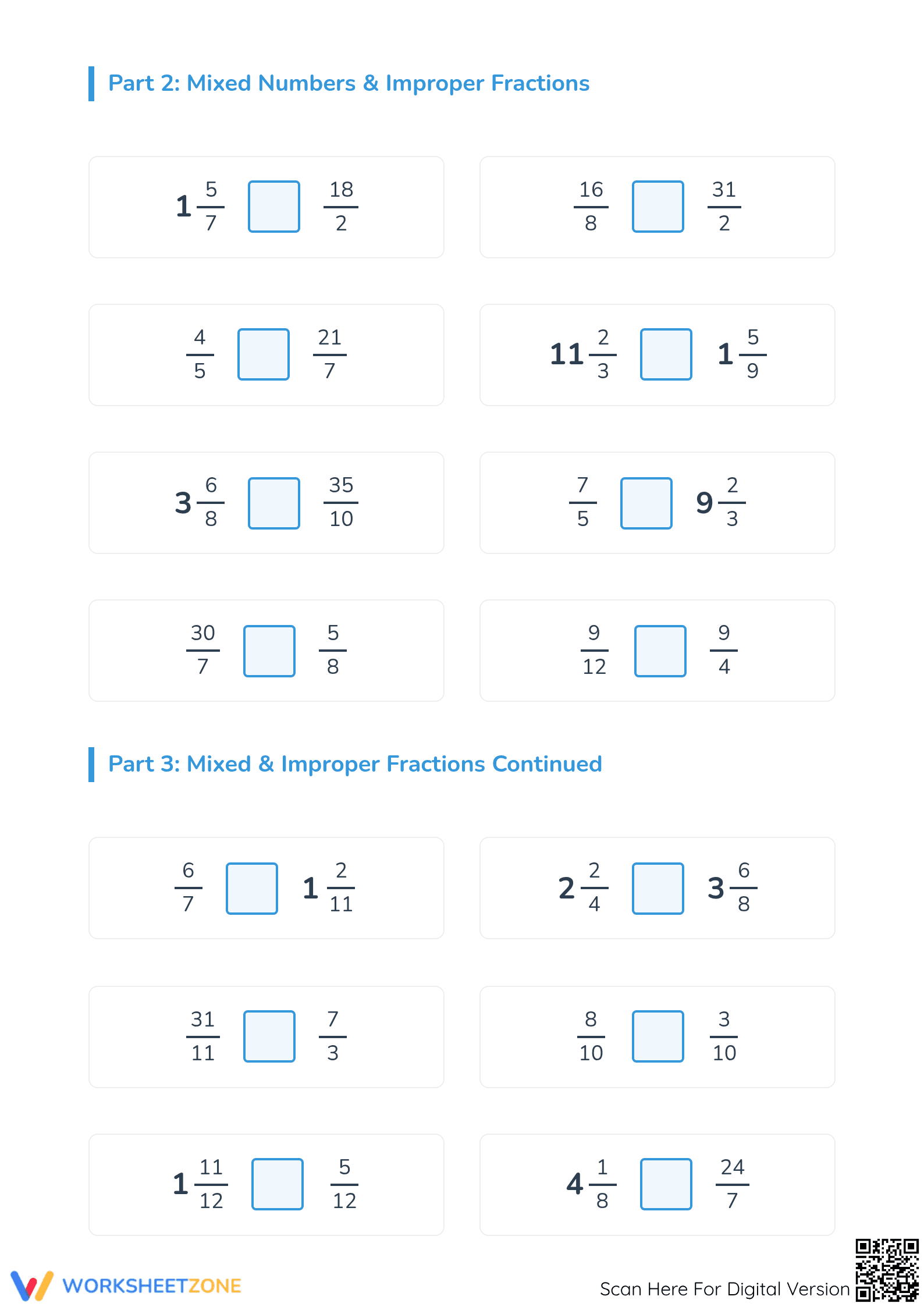
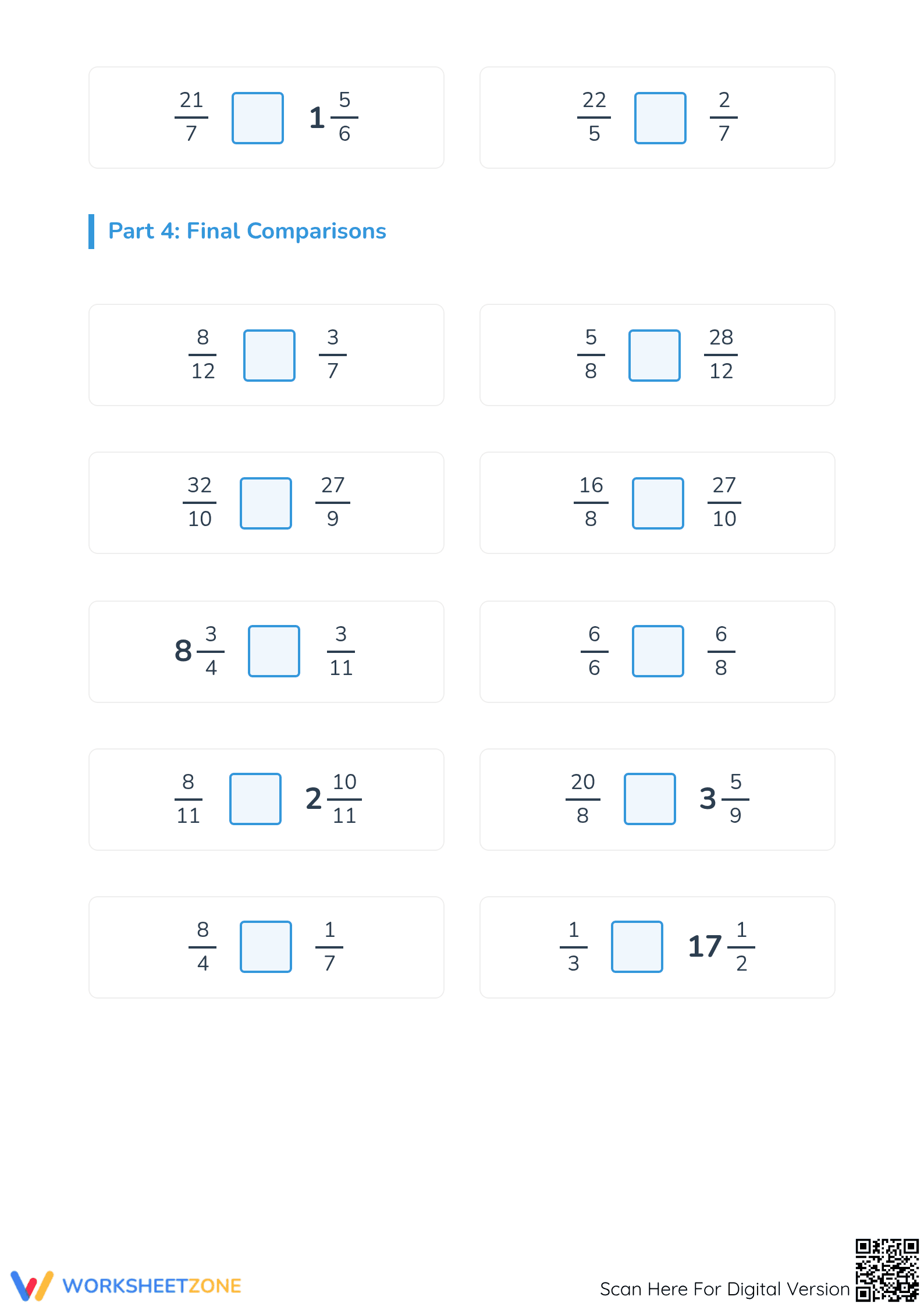
This comprehensive 3-page math worksheet focuses on comparing simple, improper, and mixed fractions. Students will develop a deeper understanding of fractional values as they navigate 34 unique comparison problems. By using relational symbols, learners solidify their ability to evaluate and compare diverse fraction formats in a structured environment. This resource ensures students achieve fluency with complex fractions.
At a Glance
- Grade: 4 · Subject: Math (Fractions)
- Standard:
4.NF.A.2— Compare two fractions with different numerators and denominators using relational symbols- Skill Focus: Comparing Mixed, Improper, and Simple Fractions
- Format: 3 pages · 34 problems · Answer key included · PDF
- Best For: Independent practice and fraction review sessions
- Time: 25–40 minutes
What's Inside
This PDF includes three full pages of practice divided into four distinct sections. Part 1 covers simple and improper fraction comparisons, while Parts 2 and 3 bridge the gap between mixed numbers and improper fractions. The final section, Part 4, provides a comprehensive review of all fraction types. A complete answer key is provided to facilitate quick grading and immediate student feedback.
Skill Progression
- Guided practice: Part 1 introduces comparisons between basic fraction types, establishing a baseline of understanding with 8 initial tasks.
- Supported practice: Parts 2 and 3 introduce mixed numbers, requiring students to convert or visualize values across 16 problems with increasing complexity.
- Independent practice: The final section presents 10 mixed-review problems where students must independently apply their knowledge to various fraction combinations without categorical prompting.
This structure utilizes a gradual-release model to ensure students move from basic identification to complex mathematical reasoning.
Standards Alignment
The primary focus of this worksheet is `4.NF.A.2`, which requires students to compare two fractions with different numerators and different denominators. It also supports 5.NF.A.1 by reinforcing the foundations needed for adding and subtracting fractions with unlike denominators. Both standard codes can be copied directly into lesson plans, IEP goals, or district curriculum mapping tools.
How to Use It
This resource is ideal for use during the independent practice portion of a lesson or as a comprehensive homework assignment. Teachers can use the first page as a formative assessment to identify students who struggle with improper fraction conversion before moving to mixed numbers. Expected completion time ranges from 25 to 40 minutes depending on student familiarity with finding common denominators.
Who It's For
This worksheet is designed for fourth and fifth-grade students mastering fraction relationships. It serves as an excellent intervention tool for older students who require additional practice with mixed number comparisons. The clear layout and segmented parts make it easy to pair with visual anchor charts or manipulative-based direct instruction lessons.
Research from EdReports 2024 emphasizes that mathematical mastery in the upper elementary grades depends heavily on a student's ability to navigate and compare non-integer values fluently. This worksheet aligns with those findings by providing 34 problems that span simple, improper, and mixed fraction formats. By requiring students to apply the `4.NF.A.2` standard through direct comparison, the resource facilitates the foundations for later success in algebraic thinking and complex rational number operations. Fisher & Frey (2014) highlight that structured practice with diverse representations—such as switching between improper fractions and mixed numbers—is critical for cognitive retention in mathematics. This resource provides that exact structure, ensuring that learners are not merely memorizing procedures but are building an authentic understanding of relative value. The inclusion of a clear answer key allows for the immediate corrective feedback recommended by the NAEP for improving student outcomes in urban and rural educational settings.


