


























Views
Downloads


Essential Comparing Fractions Worksheet | Grade 4-6 Math
Paste this activity's link or code into your existing LMS (Google Classroom, Canvas, Teams, Schoology, Moodle, etc.).
Students can open and work on the activity right away, with no student login required.
You'll still be able to track student progress and results from your teacher account.
This comprehensive math worksheet empowers students to master the complex skill of comparing proper, improper, and mixed fractions. By engaging with 40 structured problems, learners develop a deep conceptual understanding of fractional values across multiple formats. This resource ensures students can confidently determine relationships between various fraction types, leading to increased mathematical fluency and accuracy.
At a Glance
- Grade: 4–6 · Subject: Math (Fractions)
- Standard:
CCSS.MATH.CONTENT.4.NF.A.2— Compare two fractions with different numerators and different denominators by creating common denominators- Skill Focus: Proper, Improper, and Mixed Fractions
- Format: 4 pages · 40 problems · Answer key included · PDF
- Best For: Independent practice and fraction review sessions
- Time: 30–45 minutes
What's Inside
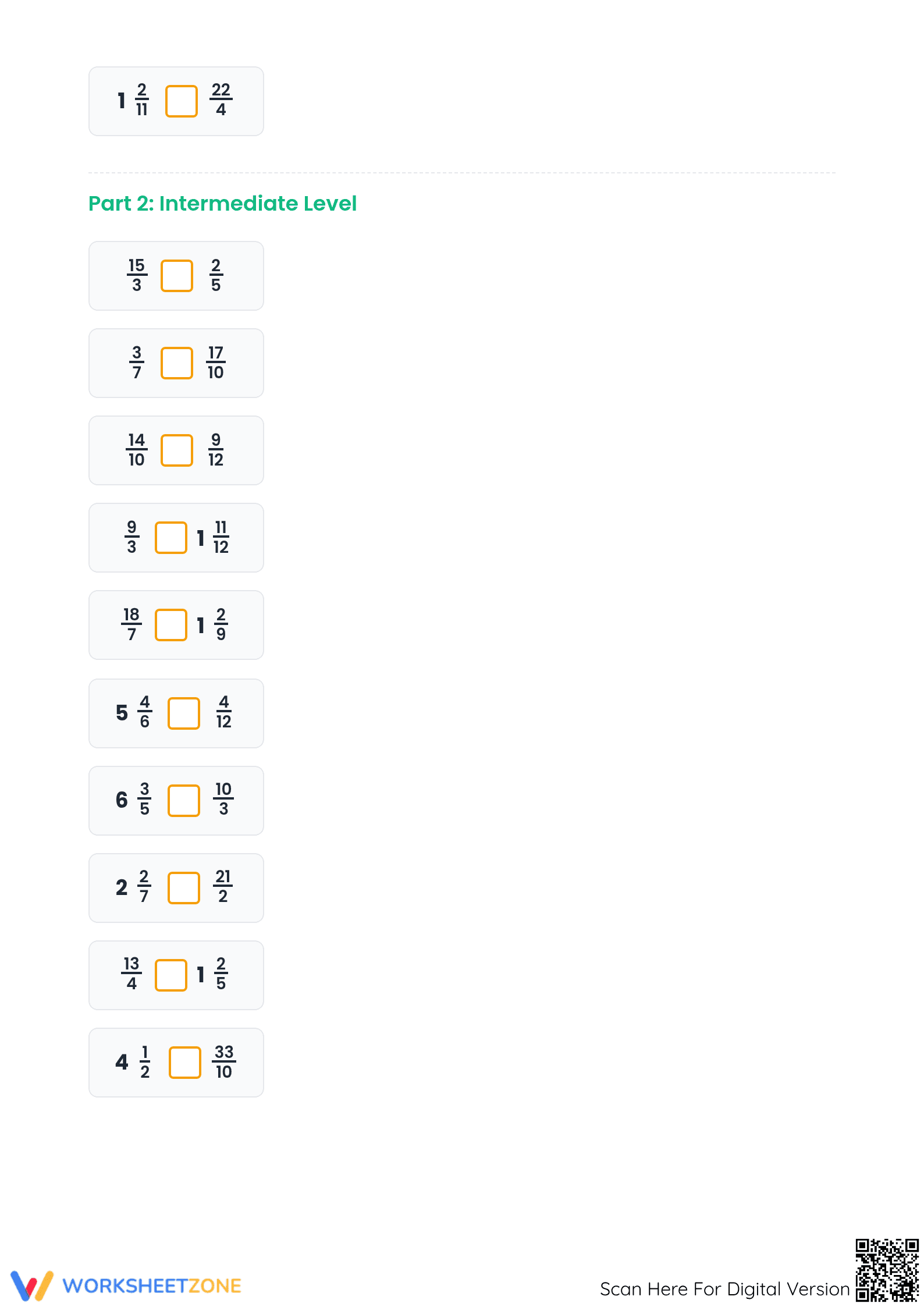
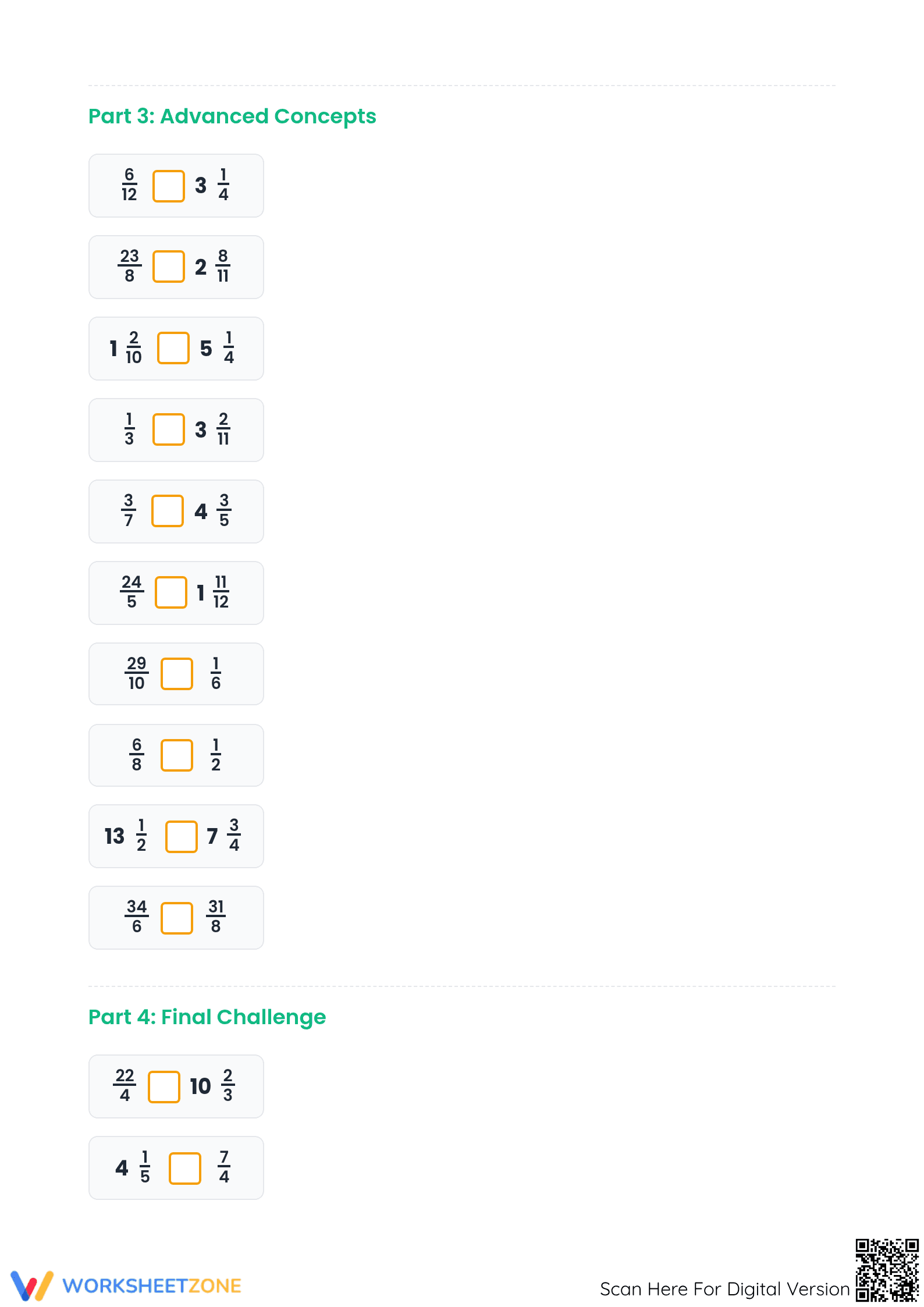
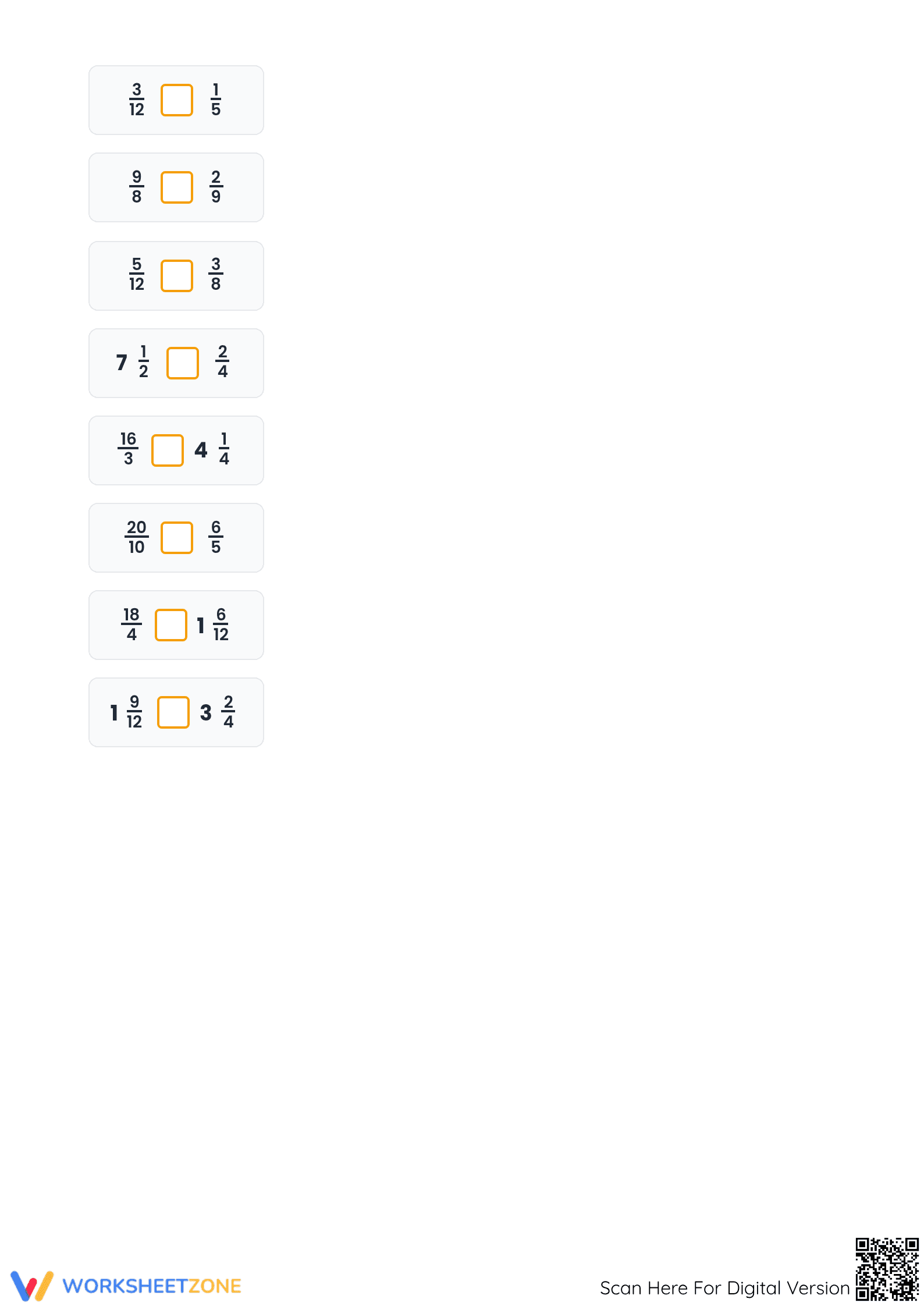
This four-page PDF includes 40 curated problems divided into four sections: Primary, Intermediate, Advanced, and Final. The layout provides ample space for comparison symbols (<, >, or =) in dedicated boxes. A four-page answer key is included for rapid grading or self-correction. The clean design focuses entirely on mathematical operations.
Skill Progression
- Guided practice: Initial problems use simpler fractions to establish basic strategies.
- Supported practice: Intermediate sections introduce mixed numbers and larger improper fractions.
- Independent practice: The Final Challenge presents complex pairings testing synthesized strategies without scaffolding.
This scaffolded approach follows the gradual release model, building confidence before high-difficulty comparisons.
Standards Alignment
The worksheet is strictly aligned to CCSS.MATH.CONTENT.4.NF.A.2: "Compare two fractions with different numerators and different denominators, e.g., by creating common denominators or numerators, or by comparing to a benchmark fraction such as 1/2." It also supports 5th-grade standards involving operations with unlike denominators. Both standard codes can be copied directly into lesson plans, IEP goals, or district curriculum mapping tools.
How to Use It
Deploy this worksheet after a direct instruction lesson on improper and mixed fractions. It serves as an excellent formative assessment during the "You Do" phase of instruction. Teachers should observe students during the Intermediate section to identify those struggling with conversion versus those struggling with the comparison itself. Expected completion time for the full 40-item set is approximately 40 minutes, though it can be assigned in sections over multiple days.
Who It's For
This resource is designed for Grade 4 and 5 students first mastering fraction comparisons, as well as Grade 6 students requiring remedial support or fluency practice. It pairs naturally with visual fraction models or number line anchor charts to provide a concrete reference for abstract comparisons. The progressive difficulty makes it suitable for inclusive classrooms where students may be working at different speeds.
The effective comparison of proper, improper, and mixed fractions is a critical milestone in middle-grade mathematics, serving as a prerequisite for algebraic reasoning and complex operations. According to the ScienceDirect TpT Analysis (2024), scaffolded problem sets that transition from basic proper fractions to multi-format comparisons significantly reduce cognitive load during the acquisition phase. This worksheet addresses the common misconception that larger numbers in a fraction always indicate a greater value, specifically targeting the CCSS.MATH.CONTENT.4.NF.A.2 standard through 40 repetitive yet increasingly complex tasks. Research highlights that frequent, focused practice with mixed numbers is essential for developing the mathematical endurance required for high-stakes testing. By providing 40 opportunities for comparison with an included answer key, this resource facilitates the high-volume practice needed to move fraction relationships from working memory to long-term mastery.


