


























Views
Downloads

Essential Comparing Fractions Worksheet | Grade 4-6 Ready
Paste this activity's link or code into your existing LMS (Google Classroom, Canvas, Teams, Schoology, Moodle, etc.).
Students can open and work on the activity right away, with no student login required.
You'll still be able to track student progress and results from your teacher account.
This essential math worksheet enables students to master comparing fractions through a structured, multi-step progression. By navigating common denominators, improper fractions, and mixed numbers, learners develop the fluency required for advanced rational number operations. This printable resource ensures students can confidently determine relative values using inequality symbols across thirty targeted practice problems.
At a Glance
- Grade: 4–6 · Subject: Math
- Standard:
CCSS.MATH.CONTENT.4.NF.A.2— Compare two fractions with different numerators and different denominators using symbols- Skill Focus: Comparing mixed and improper fractions
- Format: 3 pages · 30 problems · Answer key included · PDF
- Best For: Independent review and timed skills sprints
- Time: 25–35 minutes
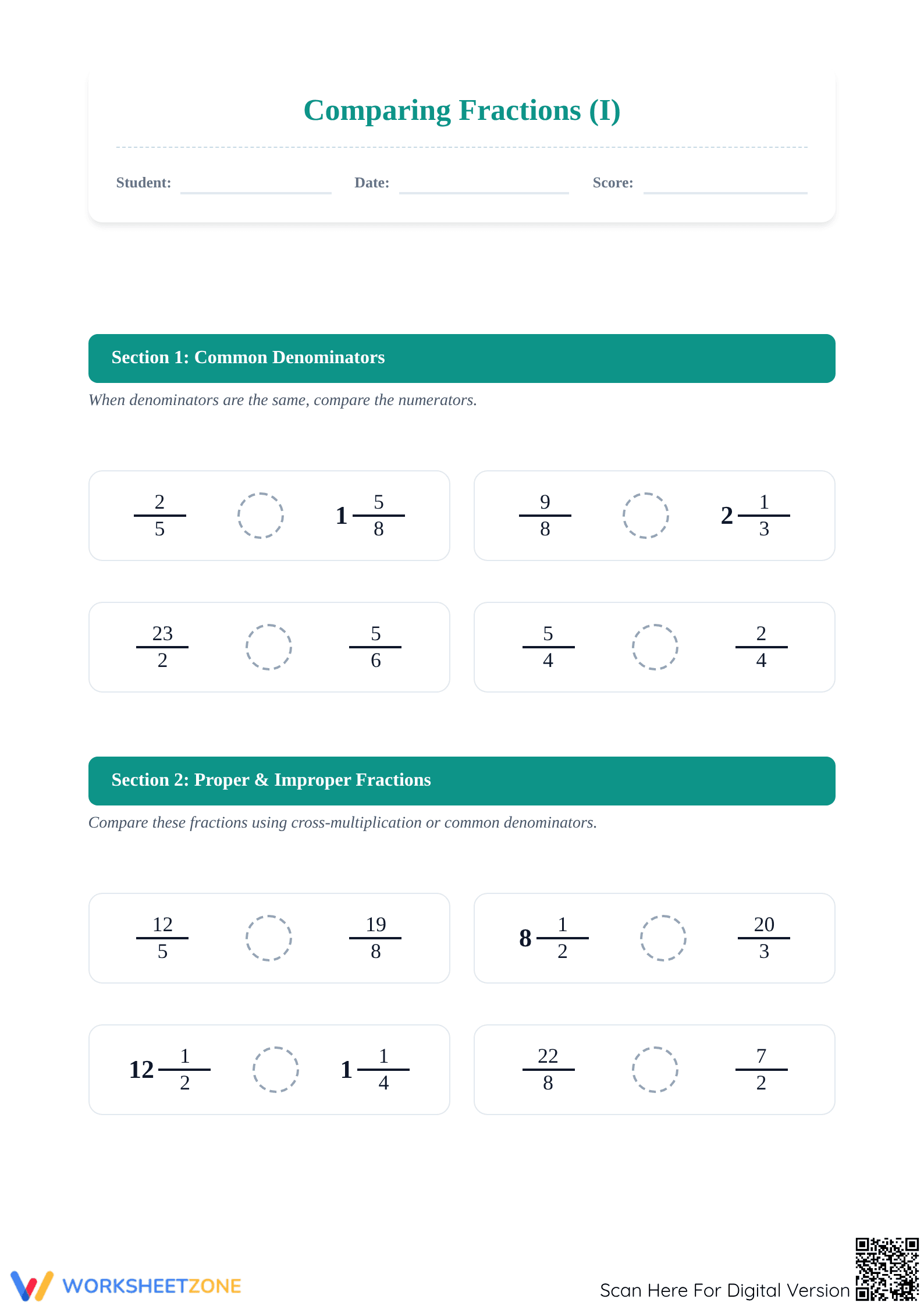
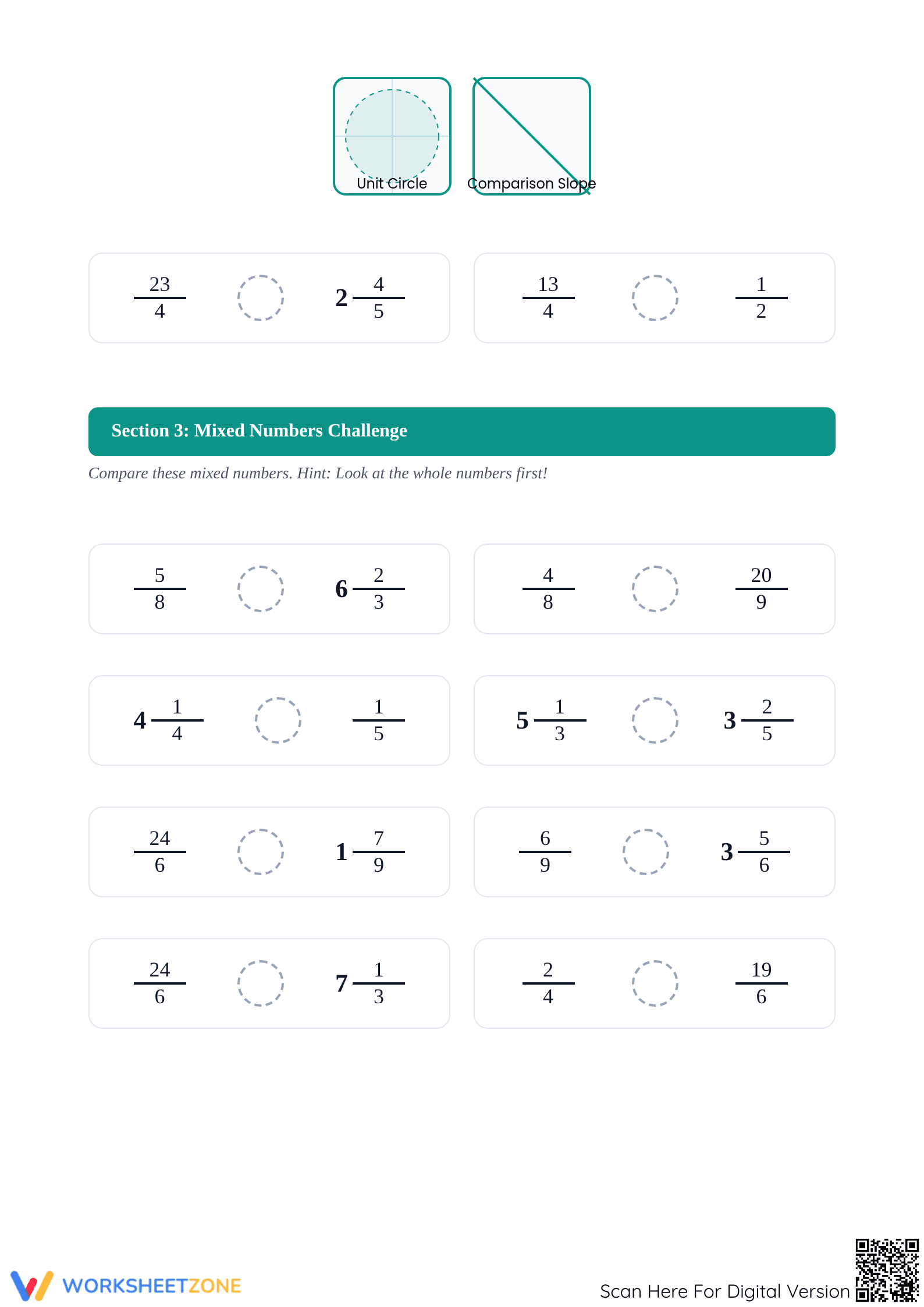
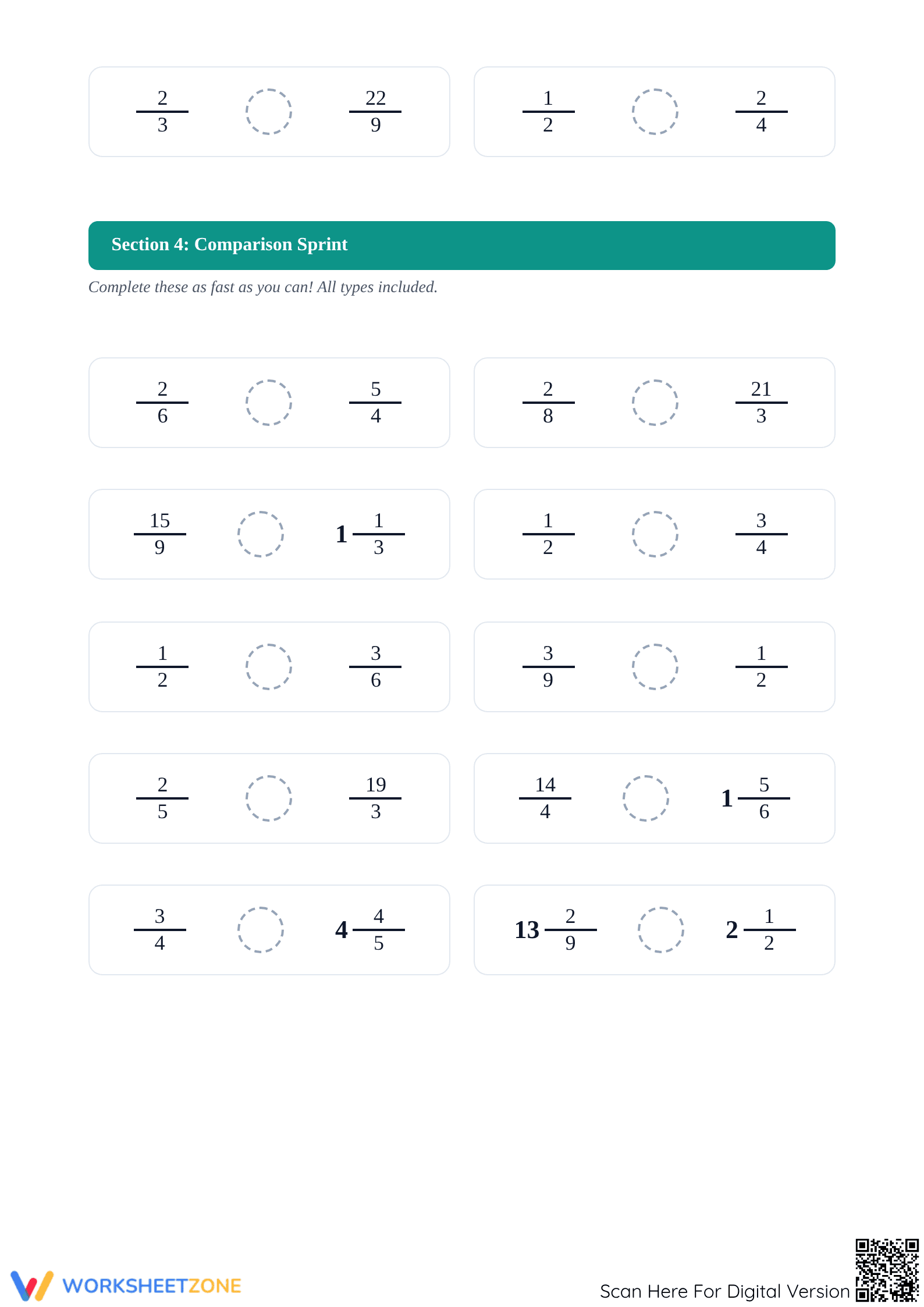
This three-page PDF package contains four distinct sections designed to scaffold student understanding. It includes eight problems on common denominators, eight proper and improper fraction comparisons, eight mixed number challenges, and a final six-problem "Comparison Sprint." The layout features clear workspace circles for entering inequality symbols, high-contrast typography, and a comprehensive answer key for immediate feedback.
Zero-Prep Workflow
Teachers can implement this resource in under two minutes with a simple three-step workflow. First, print the three-page set for each student or group. Second, distribute the materials as a "bell-ringer" or main lesson activity, requiring no external manipulatives. Finally, use the provided answer key for rapid grading or peer review. This efficient structure makes it an ideal choice for sudden substitute plans or recurring skills maintenance.
Standards Alignment
The primary focus is CCSS.MATH.CONTENT.4.NF.A.2, which requires comparing two fractions with different numerators and denominators. The worksheet also supports Grade 5 and 6 fluency goals regarding mixed number recognition and value estimation. Both standard codes can be copied directly into lesson plans, IEP goals, or district curriculum mapping tools to ensure instructional compliance and tracking.
How to Use It
Use this worksheet as a summative assessment after direct instruction on cross-multiplication or finding common denominators. During independent work, observe if students are converting mixed numbers to improper fractions or vice versa as a strategy for comparison. Most students will complete the entire thirty-problem set in approximately thirty minutes, making it a perfect fit for a standard class period.
Who It's For
This resource is designed for Grade 4, 5, and 6 students, as well as middle school learners requiring remedial support with rational numbers. It serves as a natural pairing with fraction number line models or anchor charts depicting equivalent values. The clear sectioning allows for easy differentiation by assigning specific pages based on individual student mastery levels.
Research conducted by RAND AIRS (2024) indicates that scaffolded practice in comparing non-unit fractions is critical for developing the proportional reasoning necessary for success in middle school algebra. This worksheet directly addresses this developmental milestone by moving students through three levels of complexity: same denominators, varying denominators, and mixed-value comparisons. By providing thirty distinct tasks, the resource ensures sufficient repetition for neural encoding of fraction magnitude. Standardized assessment data from NAEP consistently show that students who master the comparison of improper and mixed fractions early in their mathematical careers perform significantly better on complex word problems and multi-step equations later. The inclusion of a timed sprint section aligns with cognitive load theory, helping to transition skills from slow, effortful processing to automaticity. This alignment to CCSS.MATH.CONTENT.4.NF.A.2 ensures that students are meeting rigorous national benchmarks through evidence-based instructional design.


