


























Views
Downloads

Comparing Improper and Mixed Fractions | Printable Math
Paste this activity's link or code into your existing LMS (Google Classroom, Canvas, Teams, Schoology, Moodle, etc.).
Students can open and work on the activity right away, with no student login required.
You'll still be able to track student progress and results from your teacher account.
Master the logic of numerical relationships with this comprehensive fraction comparison resource. Students will evaluate pairs of proper, improper, and mixed fractions using inequality symbols to determine relative value. This practice builds the essential fluency required for advanced operations like addition and subtraction of unlike denominators in later mathematical units.
At a Glance
- Grade: 4 · Subject: Math
- Standard:
4.NF.A.2— Compare two fractions with different numerators and different denominators using symbols- Skill Focus: Proper, Improper, and Mixed Fractions Comparison
- Format: 5 pages · 29 problems · Answer key included · PDF
- Best For: Fractions unit revision and mastery checks
- Time: 30–45 minutes
What's Inside
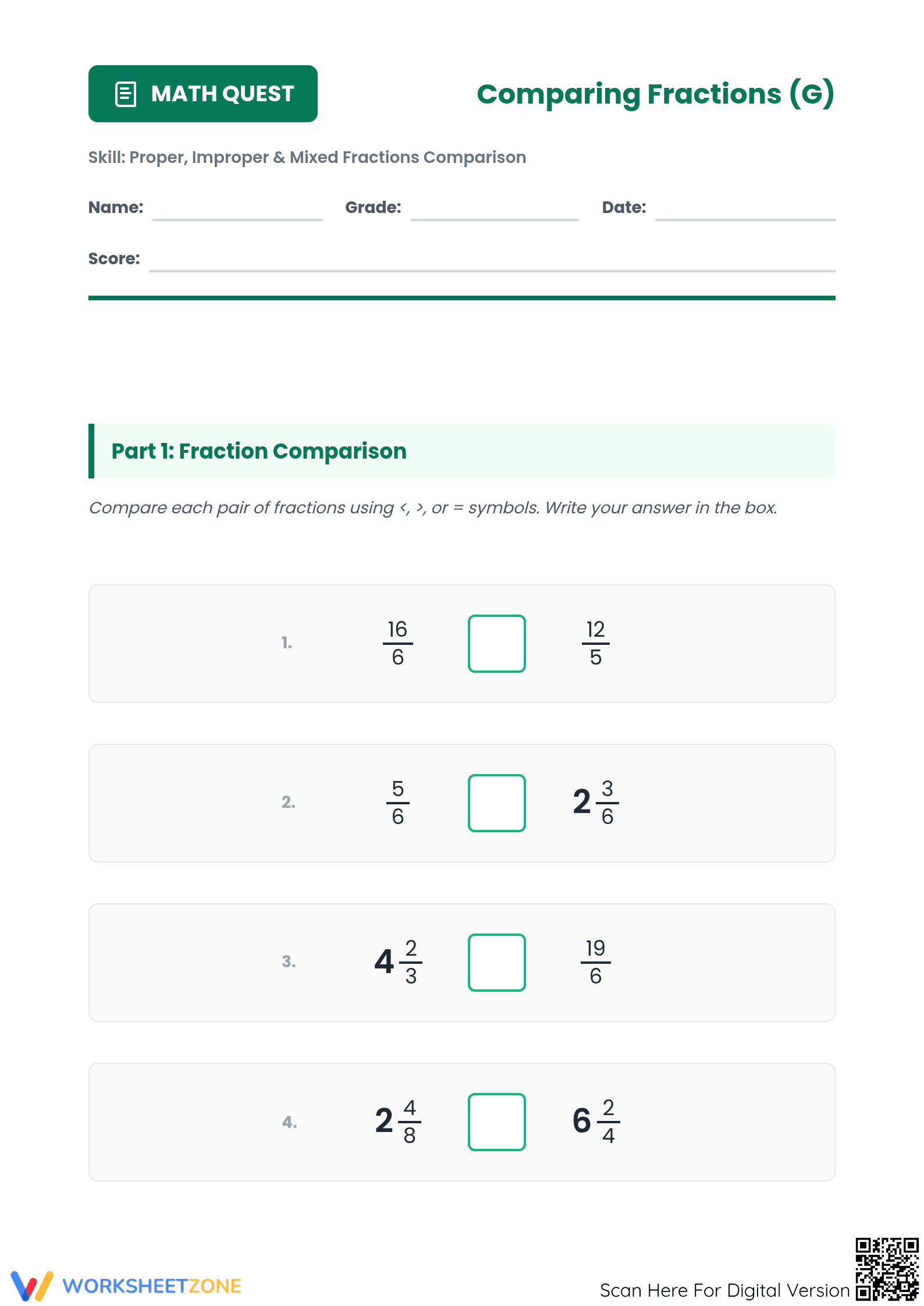
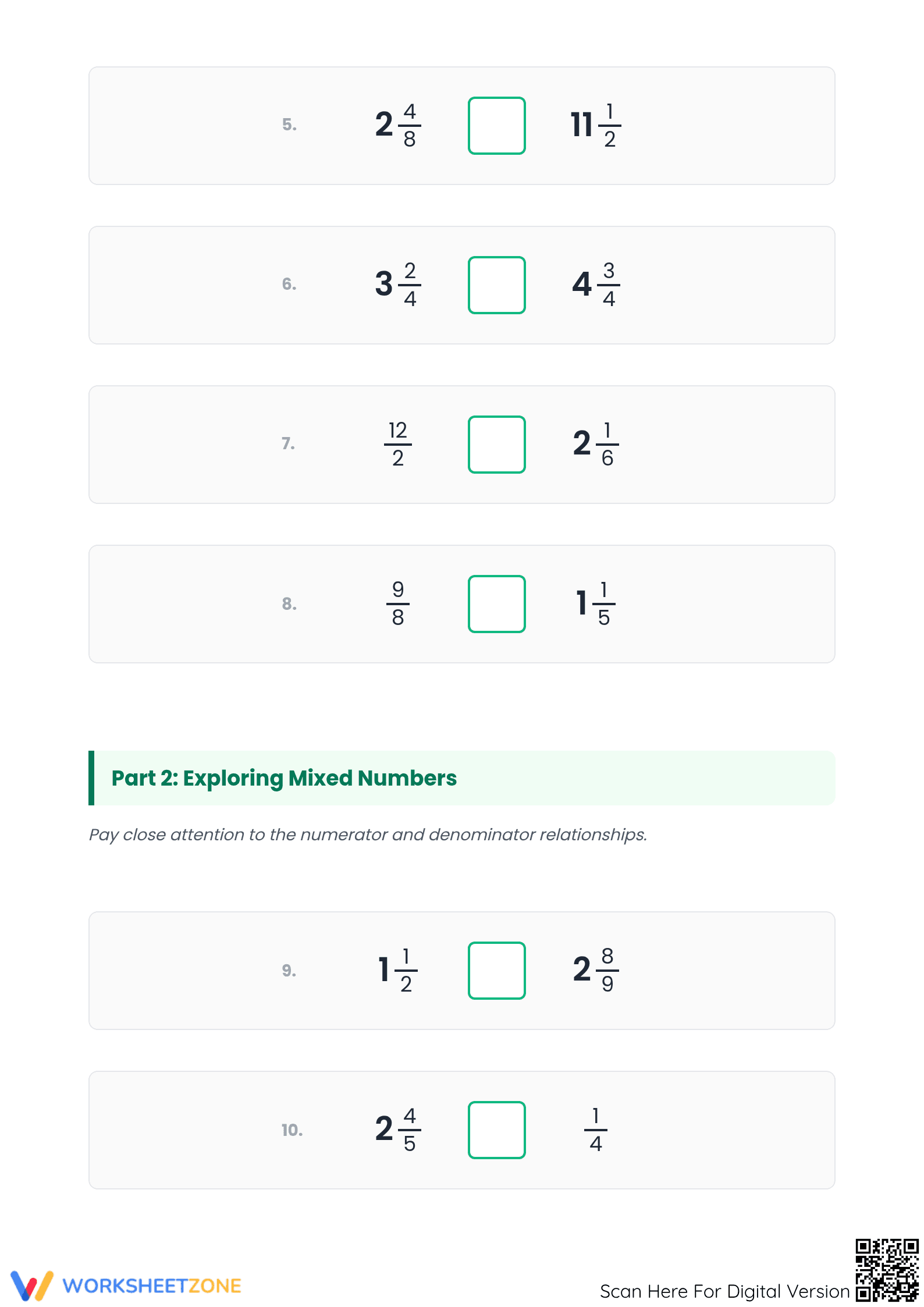
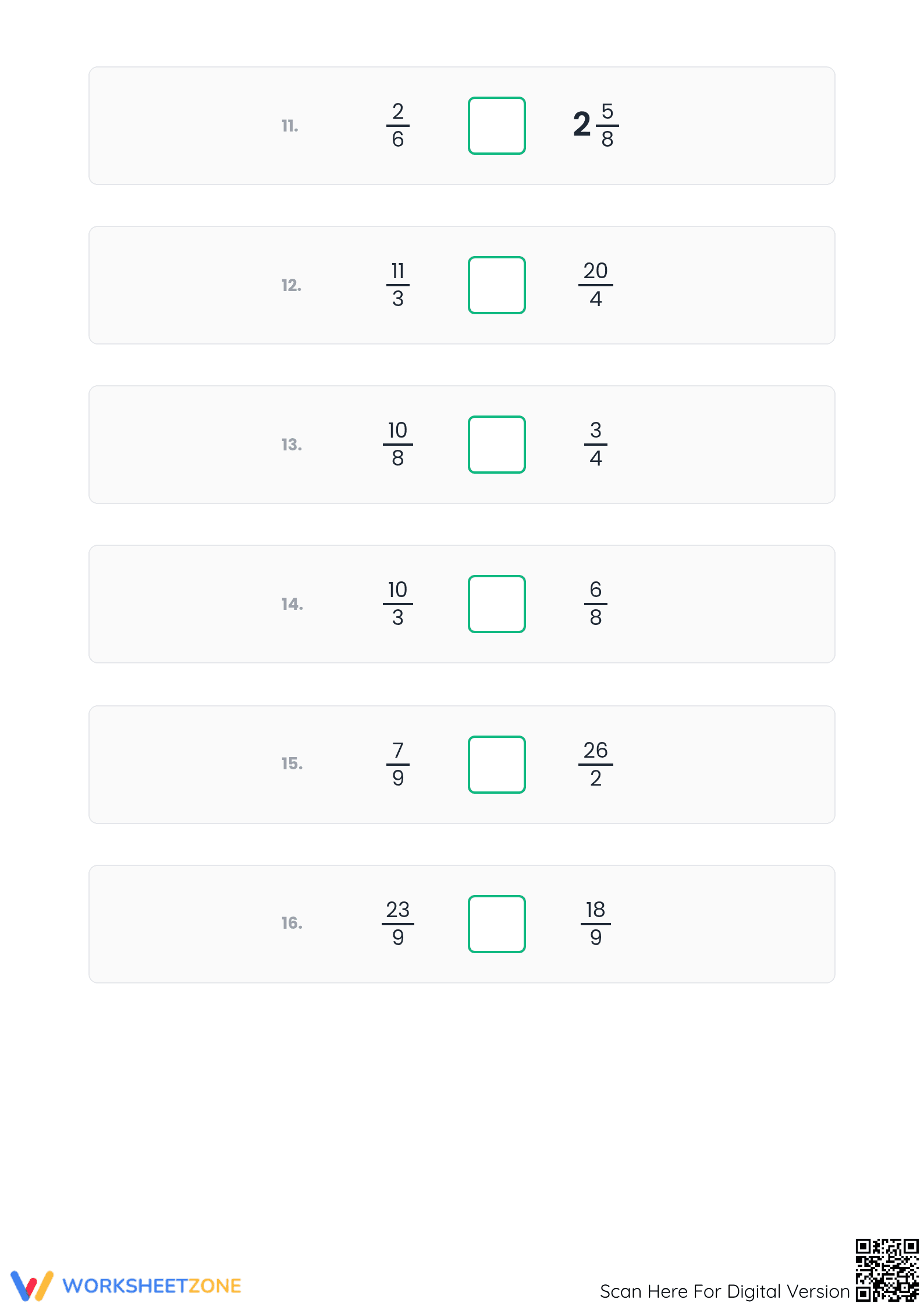
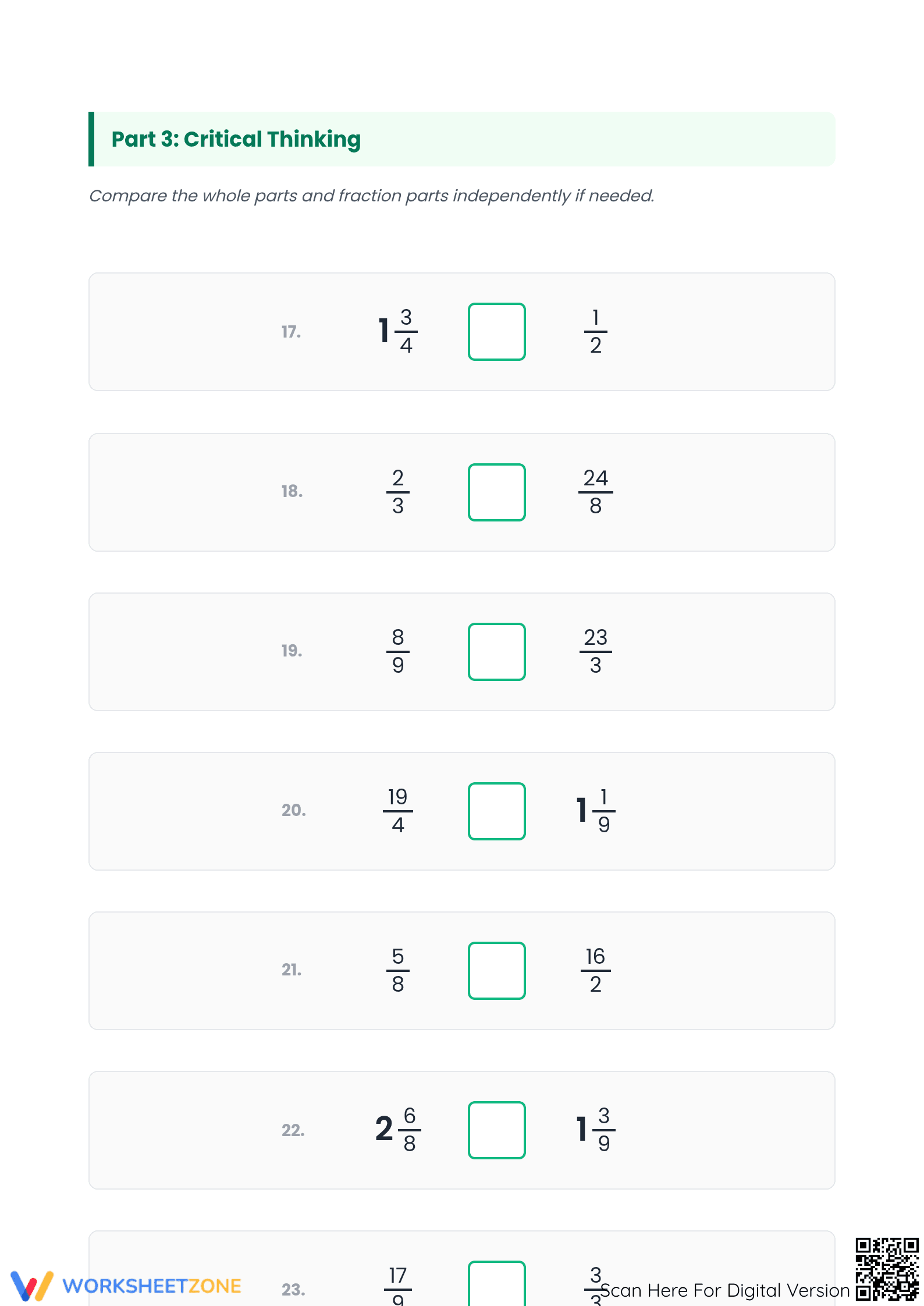
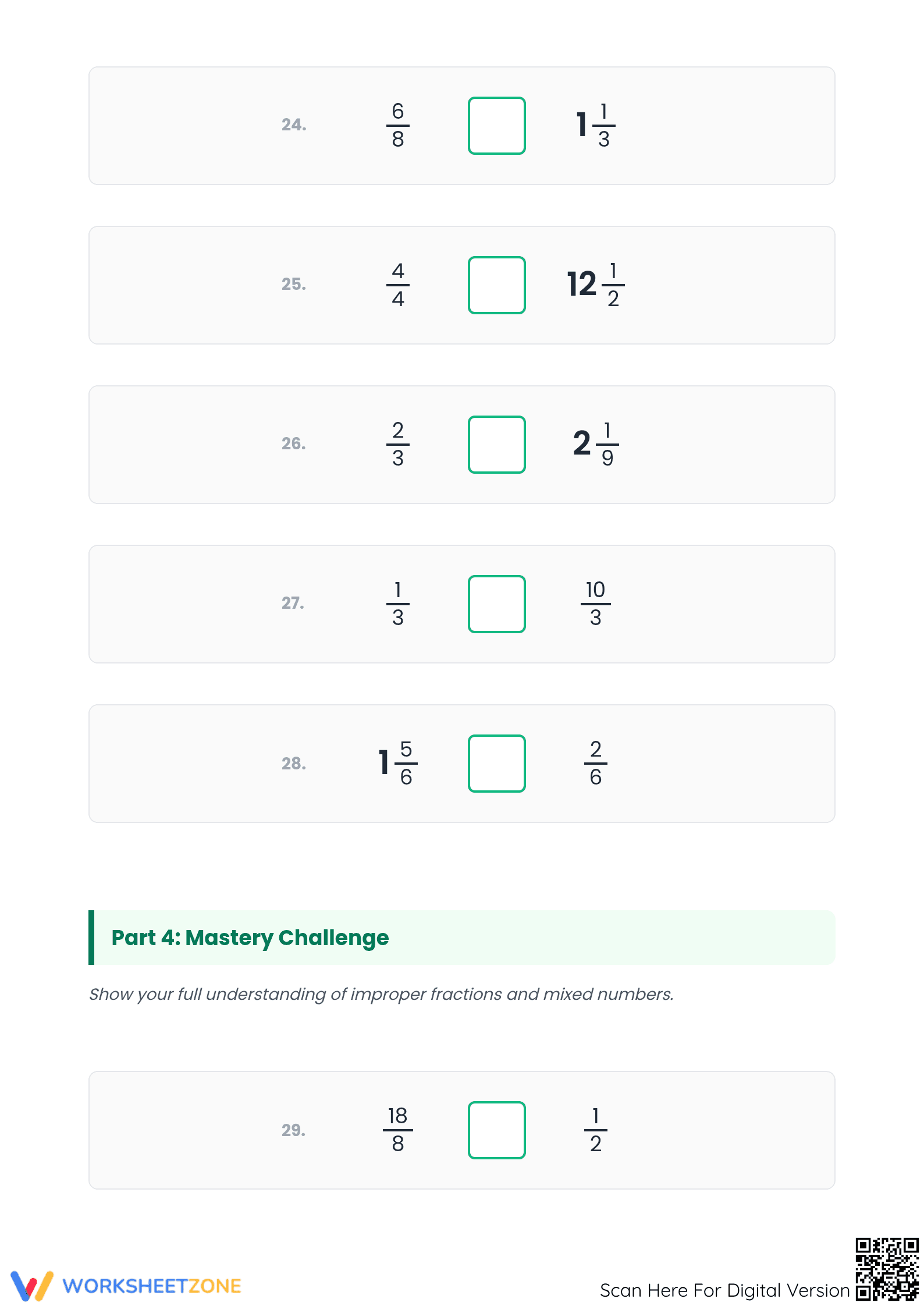
This 5-page printable bundle contains 29 structured comparison problems divided into four strategic parts. Students work through a clear progression starting with basic fraction pairs, moving into mixed number exploration, and concluding with a critical thinking section and a final mastery challenge. Each page includes clear instructions and spacious answer boxes for inequality symbols. A complete answer key is provided for immediate grading.
Skill Progression
- Guided Practice: The initial set of 8 problems introduces the comparison of proper and improper fractions with clear formatting to prompt denominator analysis.
- Supported Practice: Problems 9 through 16 focus specifically on mixed numbers, requiring students to evaluate whole numbers before comparing fractional parts.
- Independent Practice: The final sections present 13 complex scenarios where students must apply logic to diverse fraction types without additional scaffolds.
This worksheet follows a gradual-release model, transitioning from basic comparison to higher-order evaluative tasks.
Standards Alignment
The primary focus is 4.NF.A.2, which requires students to compare two fractions with different numerators and different denominators by creating common denominators or comparing to benchmarks. This resource also supports Grade 5 readiness for complex operations. This standard code can be copied directly into lesson plans, IEP goals, or district curriculum mapping tools.
How to Use It
Use this resource as a summative assessment at the conclusion of a fractions unit to gauge student understanding of relative values. During instruction, teachers can use the first page for a direct instruction demonstration, observing whether students prioritize whole numbers or conversion to improper forms. Most students will complete the full 5-page set in approximately 40 minutes.
Who It's For
This resource is designed for Grade 4 and 5 students who have mastered basic fraction identification and are ready for comparative analysis. It provides excellent support for English Language Learners through the use of mathematical symbols and consistent formatting. Pair this worksheet with a physical fraction tile set or a benchmark anchor chart for students requiring additional visual support.
Effective fraction instruction requires students to move beyond rote procedures toward a deep understanding of magnitude. According to the NAEP framework, the ability to compare fractions of different types—including improper and mixed forms—is a key predictor of success in middle school algebra. Research from Fisher & Frey (2014) emphasizes the importance of a gradual-release instructional design, which this 5-page resource mirrors through its four-part structure from basic comparison to critical thinking. By presenting 29 unique problems that vary in complexity, the worksheet ensures students encounter diverse mathematical structures. This aligns with standard 4.NF.A.2, fostering the benchmark-based reasoning and common-denominator logic necessary for mathematical proficiency. Educators can utilize the included answer key to provide immediate feedback, a practice shown to significantly reduce the persistence of misconceptions in rational number operations.


