


























Views
Downloads

Comparing Fractions Printable Worksheet | Grade 4-6 Math
Paste this activity's link or code into your existing LMS (Google Classroom, Canvas, Teams, Schoology, Moodle, etc.).
Students can open and work on the activity right away, with no student login required.
You'll still be able to track student progress and results from your teacher account.
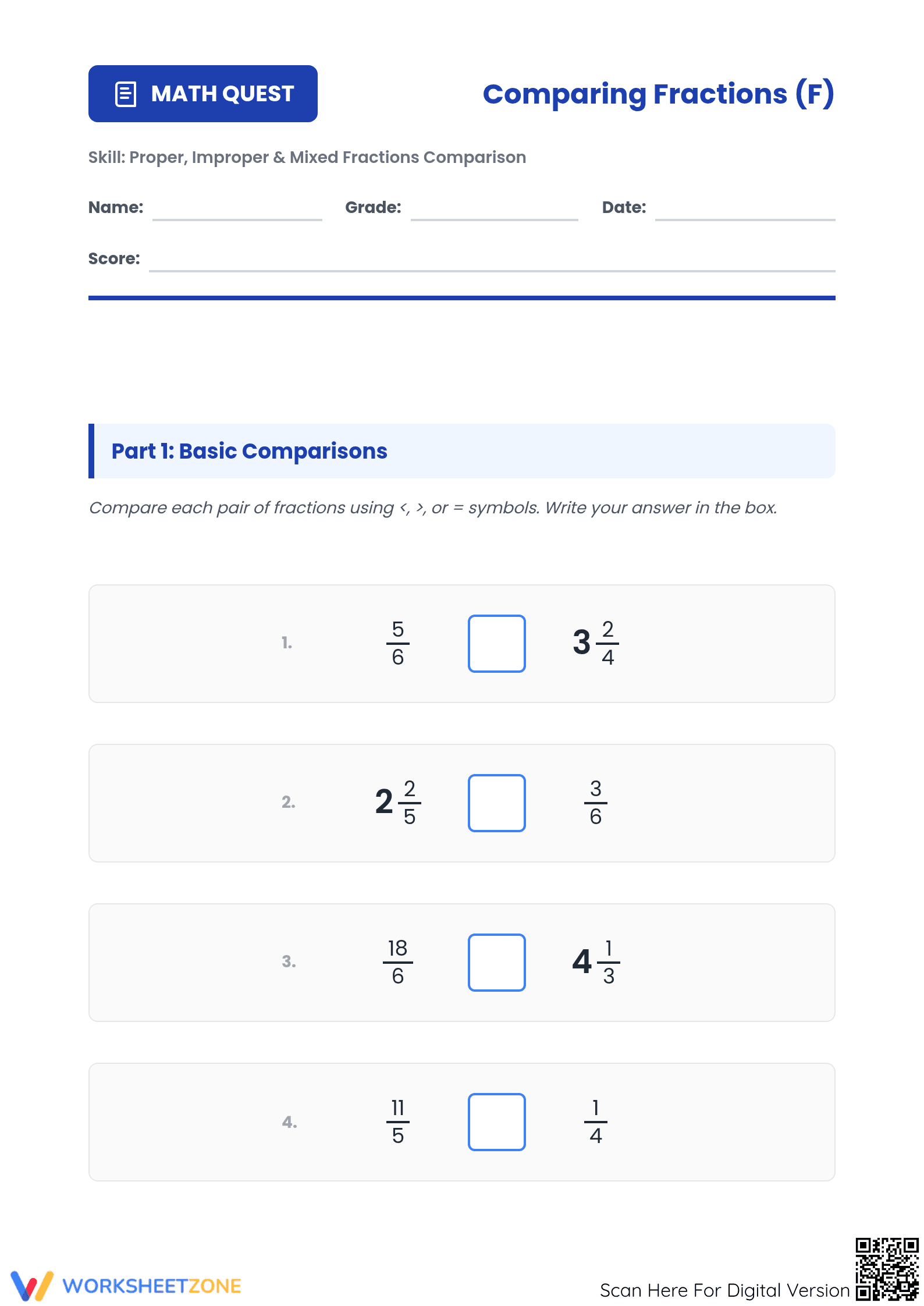
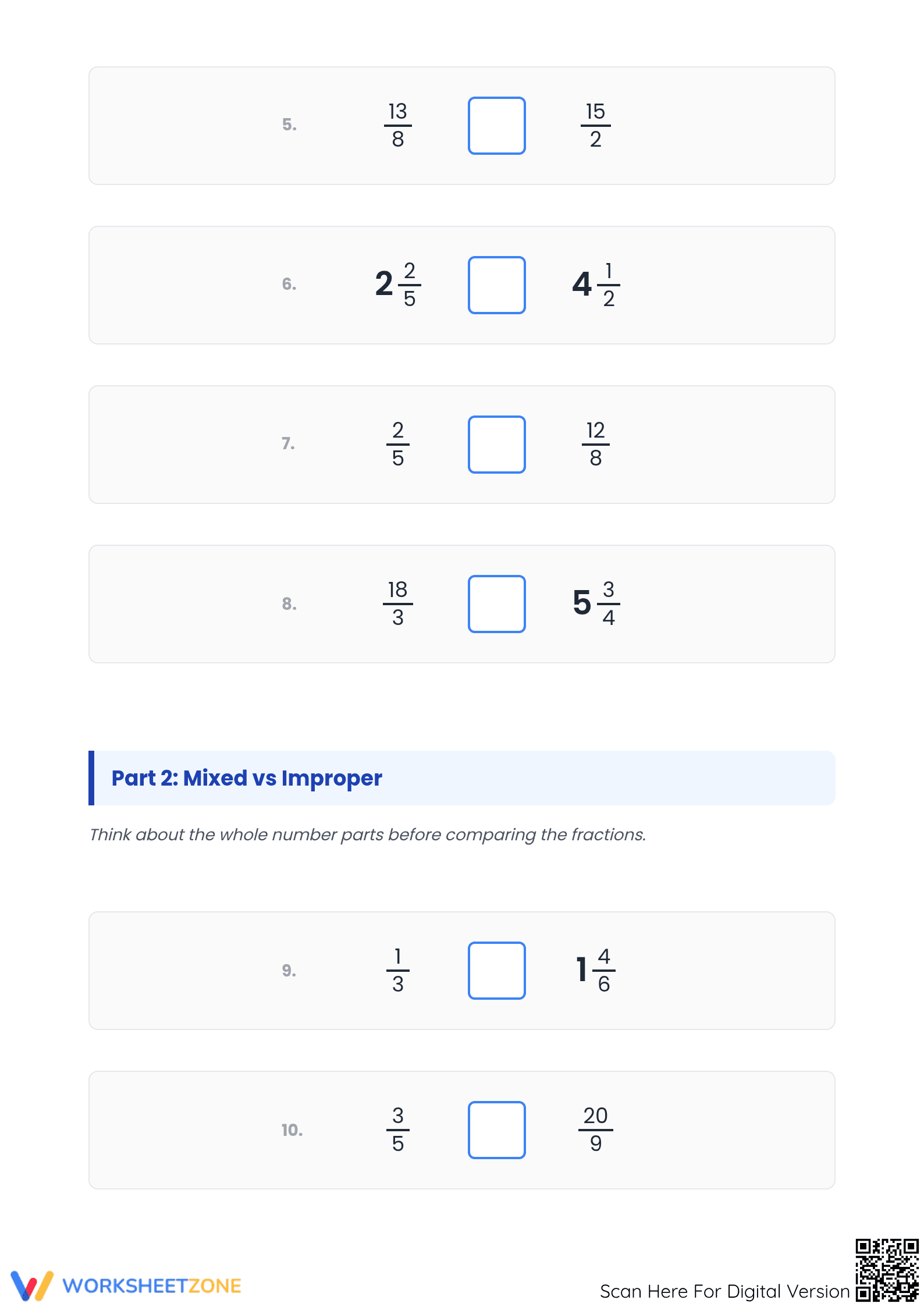
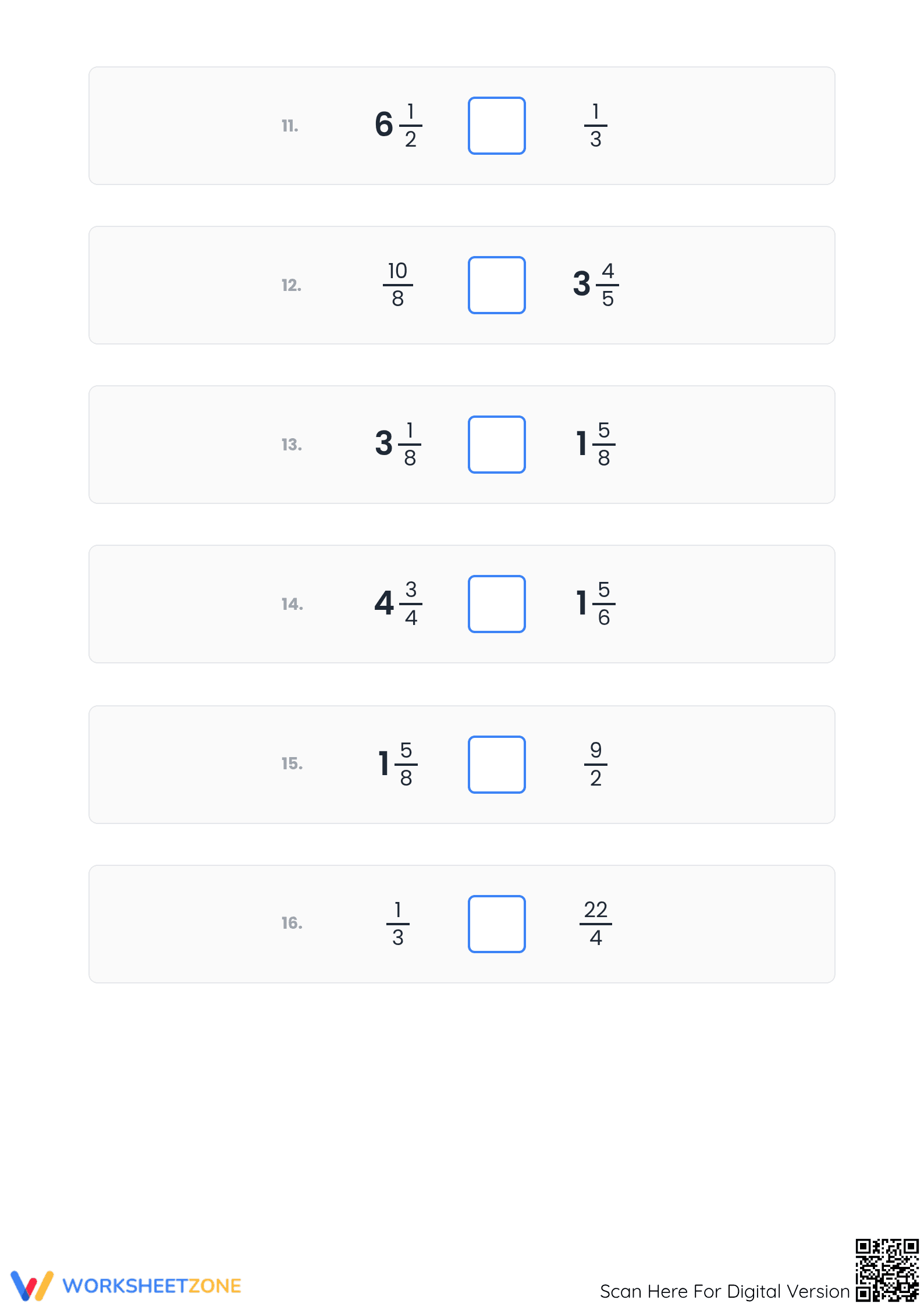
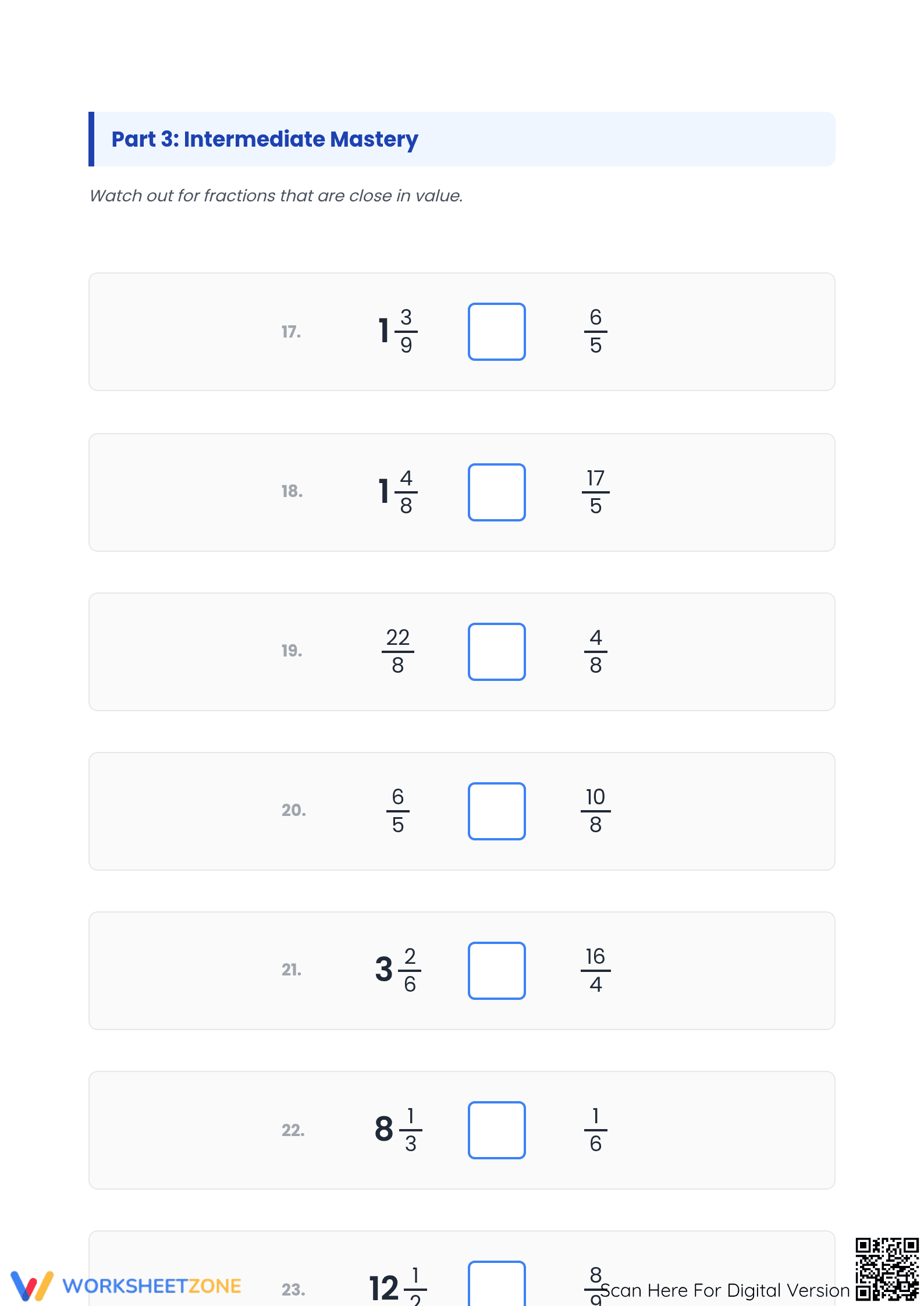
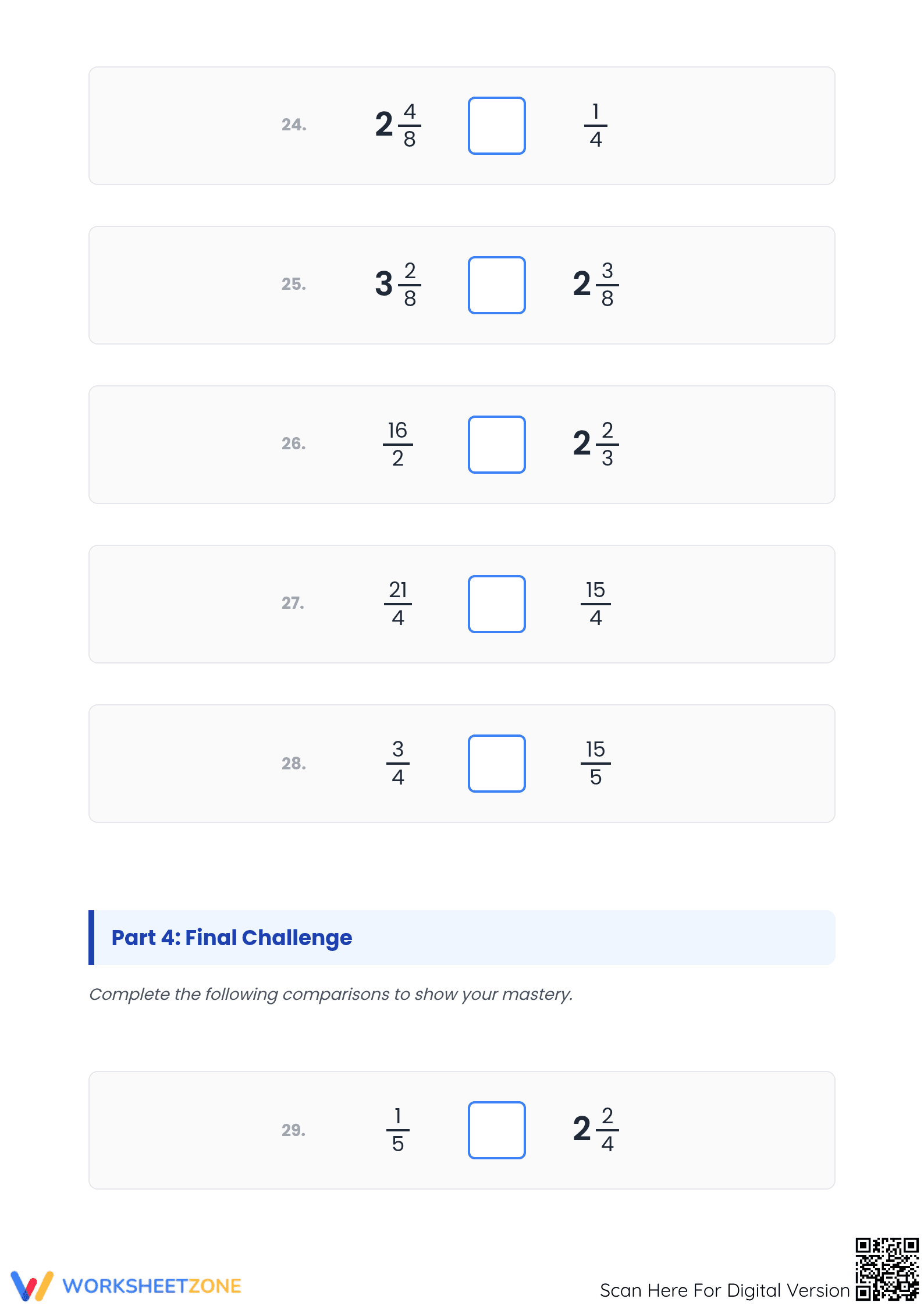
Master the essential skill of comparing various types of fractions with this 29-problem practice set. This worksheet guides students through evaluating magnitude across proper, improper, and mixed fractions. Students will gain the confidence needed to tackle complex mathematical reasoning by applying comparison symbols to diverse numerical representations.
At a Glance
- Grade: 4–6 · Subject: Math
- Standard:
CCSS.MATH.CONTENT.4.NF.A.2— Compare two fractions with different numerators and denominators using symbols- Skill Focus: Proper, Improper, and Mixed Fraction Magnitude
- Format: 5 pages · 29 problems · Answer key included · PDF
- Best For: Conceptual reinforcement and fluency practice
- Time: 30–45 minutes
This 5-page "Math Quest" provides a structured environment for students to practice fraction comparison skills. The document includes four distinct sections that increase in complexity, ensuring a thorough review of numerical magnitude. With a full answer key provided for immediate feedback, this resource is a complete tool for classroom instruction or independent study.
Skill Progression
- Guided practice (8 tasks): Part 1 focuses on basic comparisons, establishing a baseline understanding with minimal scaffolding.
- Supported practice (8 tasks): Part 2 introduces the relationship between mixed numbers and improper fractions, requiring visualization before comparing.
- Independent practice (13 tasks): Parts 3 and 4 present intermediate mastery challenges and a final cumulative task, demanding higher-order reasoning for close magnitudes.
This sequence follows a gradual-release model, moving from structured "I Do" examples to independent "You Do" mastery challenges.
Standards Alignment
This resource is aligned to CCSS.MATH.CONTENT.4.NF.A.2: "Compare two fractions with different numerators and different denominators by creating common denominators or comparing to benchmarks." It also supports 5.NF.B.3 by bridging the gap between fractions and division. Both standard codes can be copied directly into lesson plans, IEP goals, or district curriculum mapping tools.
How to Use It
Use this worksheet as a summative assessment after a unit on fraction equivalents to gauge mastery. Alternatively, assign Part 1 as a guided activity during direct instruction. Teachers should observe students' methods for finding common denominators during the expected completion time of 30 to 45 minutes.
Who It's For
This set is ideal for upper elementary and middle school students who are refining their understanding of rational numbers. It serves as an excellent differentiation tool for Grade 4 students ready for a challenge or Grade 6 students requiring remediation. Pair this resource with a visual fraction wall or a set of fraction tiles to provide concrete support for tactile learners.
The development of fraction proficiency is a critical milestone in middle school mathematics, serving as a foundational predictor for success in algebra and higher-level stem coursework. Research from the RAND AIRS 2024 report indicates that students who master the structural relationship between mixed numbers and improper fractions demonstrate significantly higher accuracy when performing complex operations later in their academic careers. This worksheet addresses this need by providing 29 targeted comparison tasks aligned to CCSS.MATH.CONTENT.4.NF.A.2 that require students to evaluate magnitude across diverse representational forms. By transitioning from basic proper fraction comparisons to challenging mixed number evaluations, students build a robust mental model of numerical value. This practice aligns with evidence-based instructional strategies that emphasize the importance of conceptual understanding over rote memorization. Educators can utilize these findings to justify the inclusion of comprehensive fraction magnitude tasks within their core curriculum, ensuring that every learner achieves the fluency required for advanced mathematical reasoning and problem-solving success.


