


























Views
Downloads

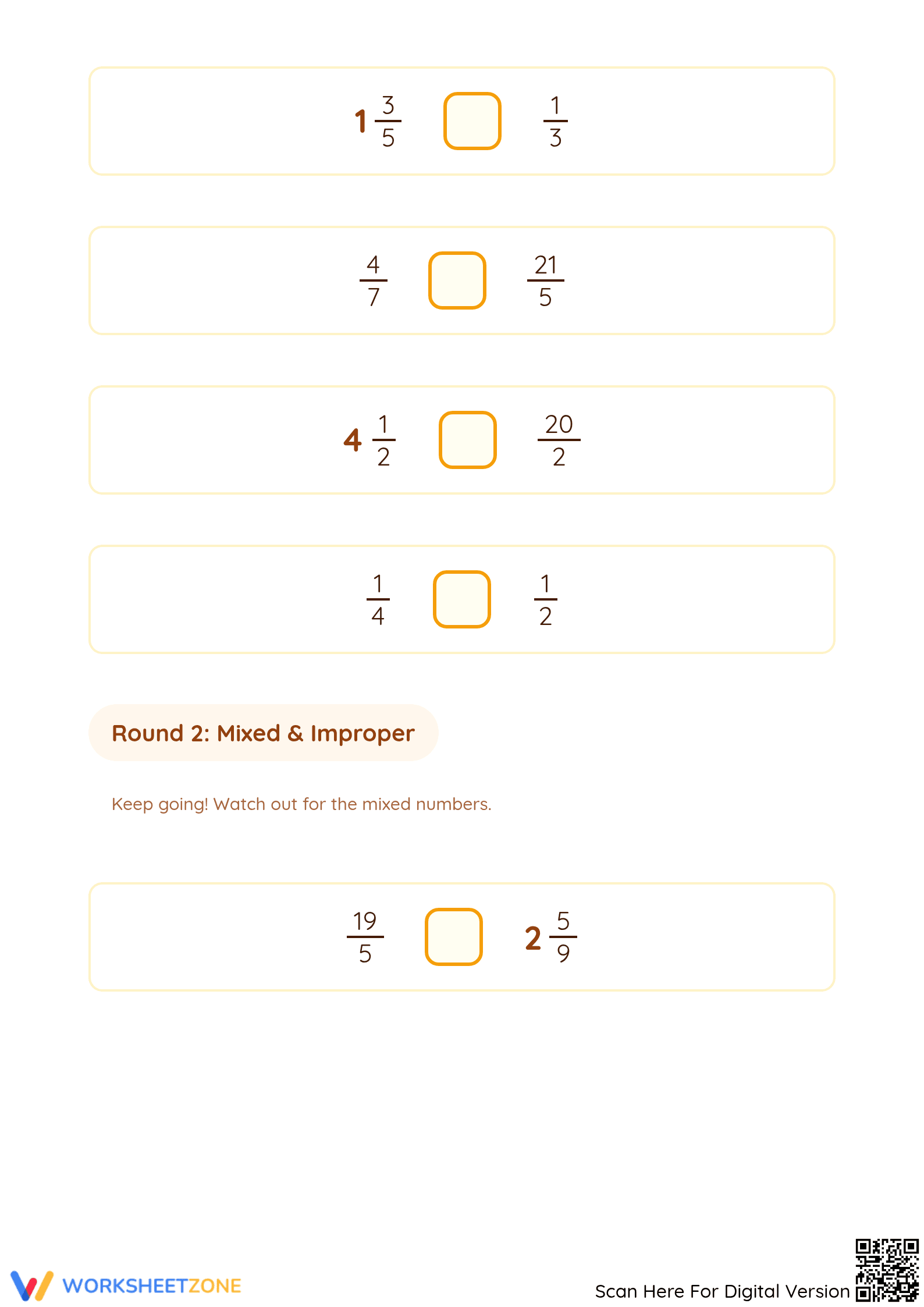
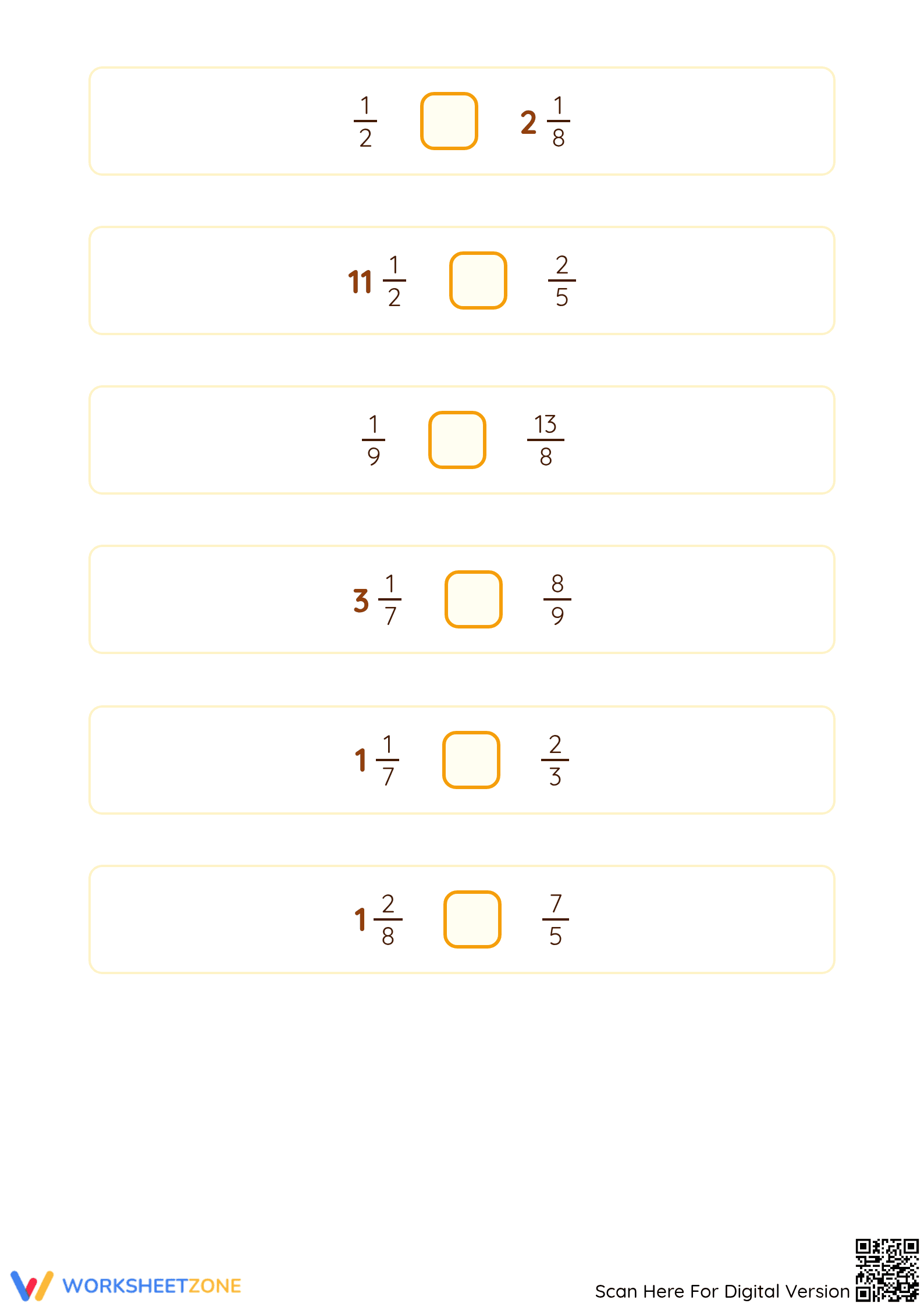
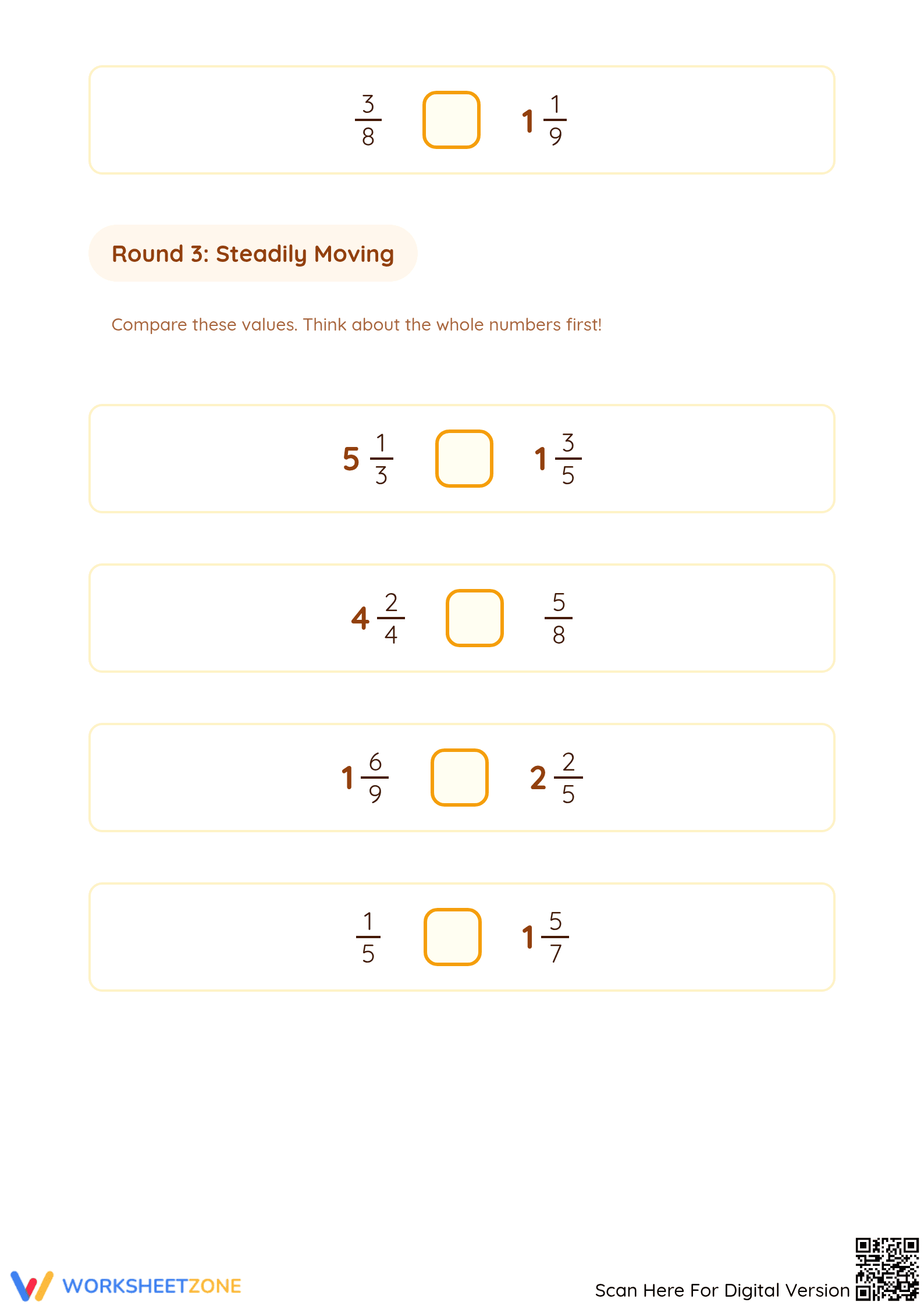
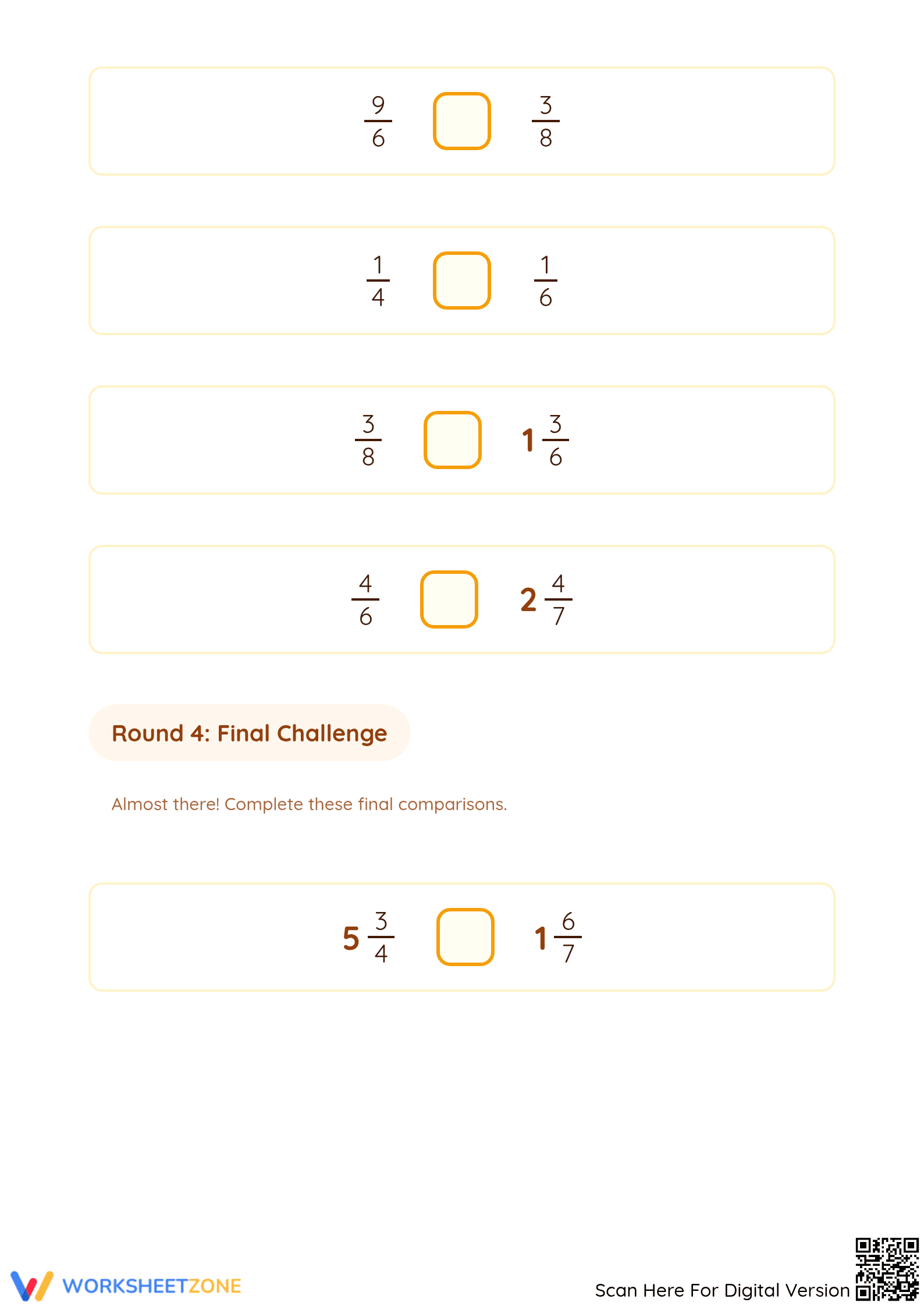

Printable Comparing Simple, Improper & Mixed Fractions
Paste this activity's link or code into your existing LMS (Google Classroom, Canvas, Teams, Schoology, Moodle, etc.).
Students can open and work on the activity right away, with no student login required.
You'll still be able to track student progress and results from your teacher account.
Comparing fractions with different forms is a critical hurdle in elementary mathematics. This comprehensive five-page worksheet set provides students with essential practice in evaluating relationships between simple fractions, improper fractions, and mixed numbers. By mastering these comparisons, learners build the conceptual fluency required for more complex operations with rational numbers and algebraic expressions later.
At a Glance
- Grade: 4–6 · Subject: Math
- Standard:
CCSS.MATH.CONTENT.4.NF.A.2— Compare two fractions with different numerators and denominators by creating common denominators.- Skill Focus: Comparing mixed and improper fractions
- Format: 5 pages · 22 problems · Answer key included · PDF
- Best For: Independent revision and mastery reinforcement
- Time: 25–35 minutes
What's Inside
This document is organized into four distinct "Rounds" that progressively increase in cognitive demand. The 22 tasks are spread across five printable pages, allowing for clear notation. Each problem features a comparison box for inequality symbols. A full answer key is included, enabling students to self-correct and identify misconceptions regarding whole-number parts and fractional remainders.
Zero-Prep Workflow
The zero-prep design ensures this resource is ready for immediate classroom implementation. Teachers can simply print the five-page packet in less than one minute and distribute it to the class without any additional setup or manipulative preparation. Reviewing student work is equally efficient using the included answer key, taking approximately two minutes to check an entire class set for accuracy and common errors.
Standards Alignment
The primary focus of this worksheet is `CCSS.MATH.CONTENT.4.NF.A.2`, which requires students to compare two fractions with different numerators and different denominators. It also supports `CCSS.MATH.CONTENT.5.NF.A.1` by requiring an understanding of equivalent values when converting between improper fractions and mixed numbers. Both standard codes can be copied directly into lesson plans, IEP goals, or district curriculum mapping tools.
How to Use It
This worksheet is most effective when used after initial instruction on converting mixed numbers. Use it as a post-lesson assessment to gauge how well students apply conversion strategies in a comparative context. During the activity, observe if students compare whole numbers first or immediately convert to improper forms, as this indicates their level of number sense and computational efficiency.
Who It's For
This resource is designed for Grade 4 and Grade 5 students who are refining their fraction mastery. It is particularly useful for small-group intervention for students struggling with the visual magnitude of improper fractions. The set pairs naturally with a number line anchor chart or fraction strips to provide visual support for learners who are still developing their mental models of rational numbers.
Research from EdReports 2024 emphasizes that students must move beyond procedural memorization to develop a "sense of magnitude" when working with fractions. This worksheet addresses that need by forcing students to reconcile the different symbolic representations of the same value, such as 22/9 versus 2 4/9. By providing a clear progression from "Initial Comparisons" to the "Final Challenge," the resource aligns with best practices for cognitive load management identified by Fisher & Frey (2014). The inclusion of mixed numbers alongside simple fractions ensures that students do not over-generalize rules that only apply to proper fractions. According to NAEP data, proficiency in comparing rational numbers is one of the strongest predictors of success in middle school algebra. This standards-aligned resource provides the structured, high-volume practice necessary for students to achieve 4.NF.A.2 mastery and move confidently into fractional computation.


