


























Views
Downloads

Essential Comparing Fractions Worksheet | Grade 4-5 Math
Paste this activity's link or code into your existing LMS (Google Classroom, Canvas, Teams, Schoology, Moodle, etc.).
Students can open and work on the activity right away, with no student login required.
You'll still be able to track student progress and results from your teacher account.
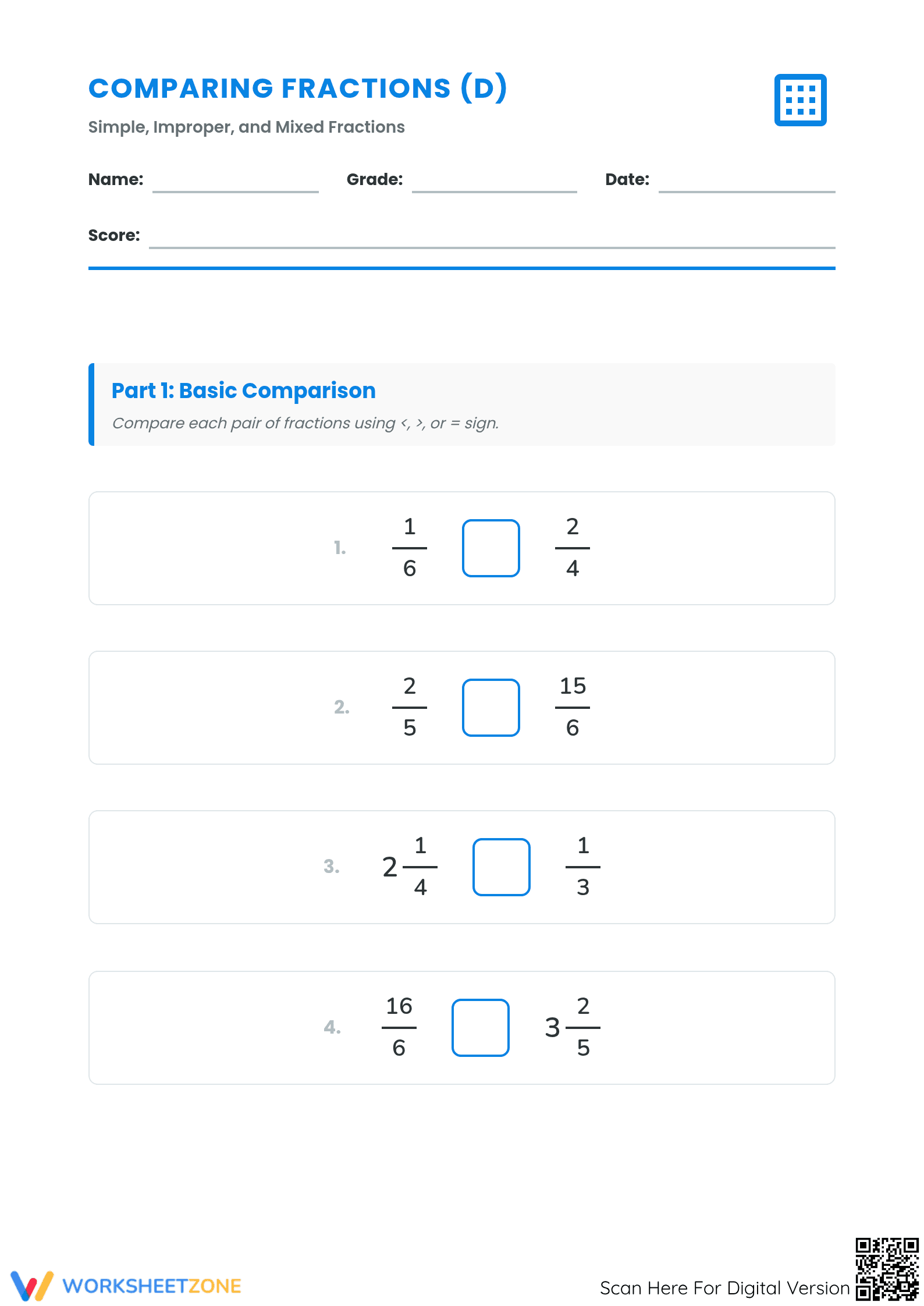
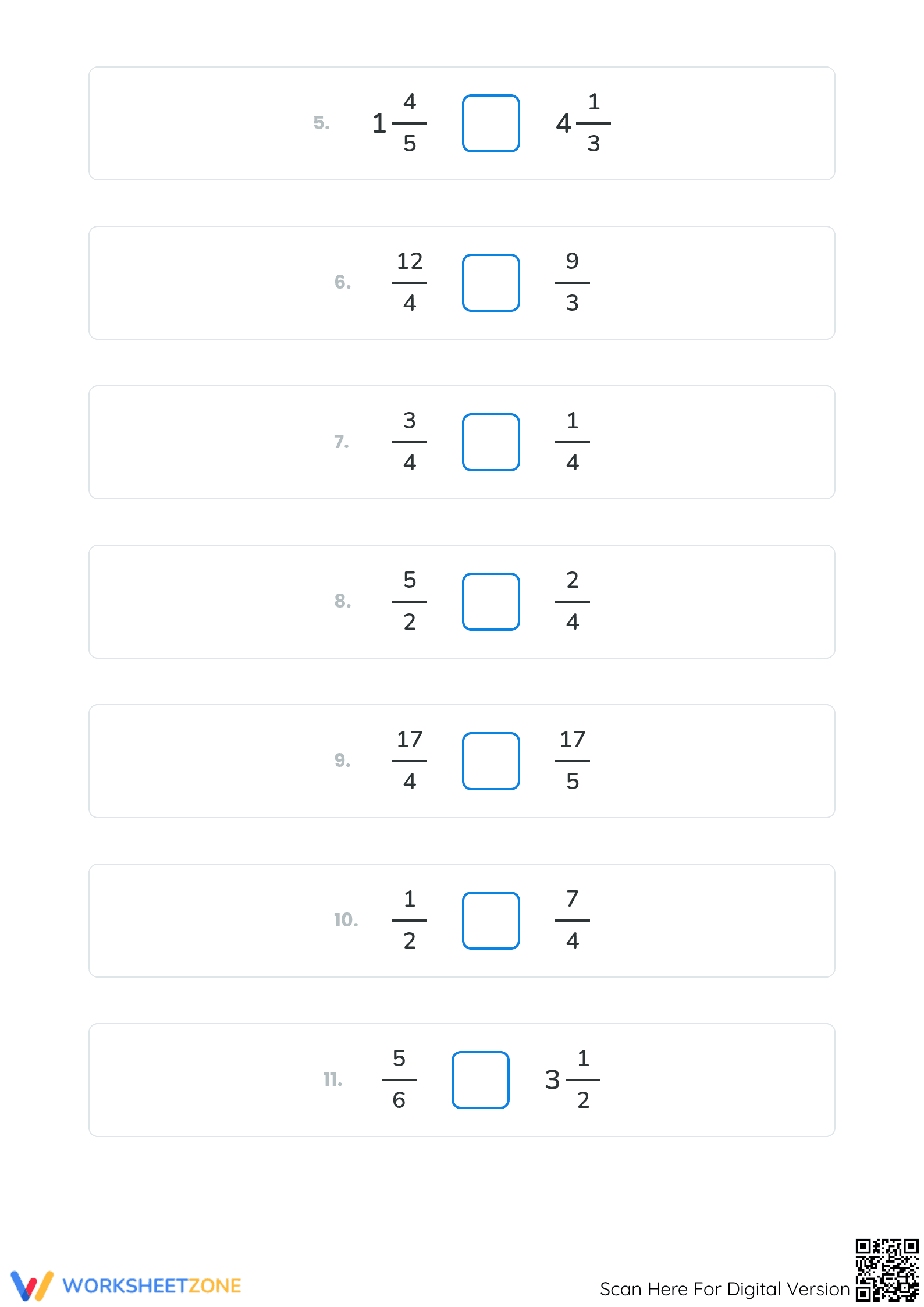
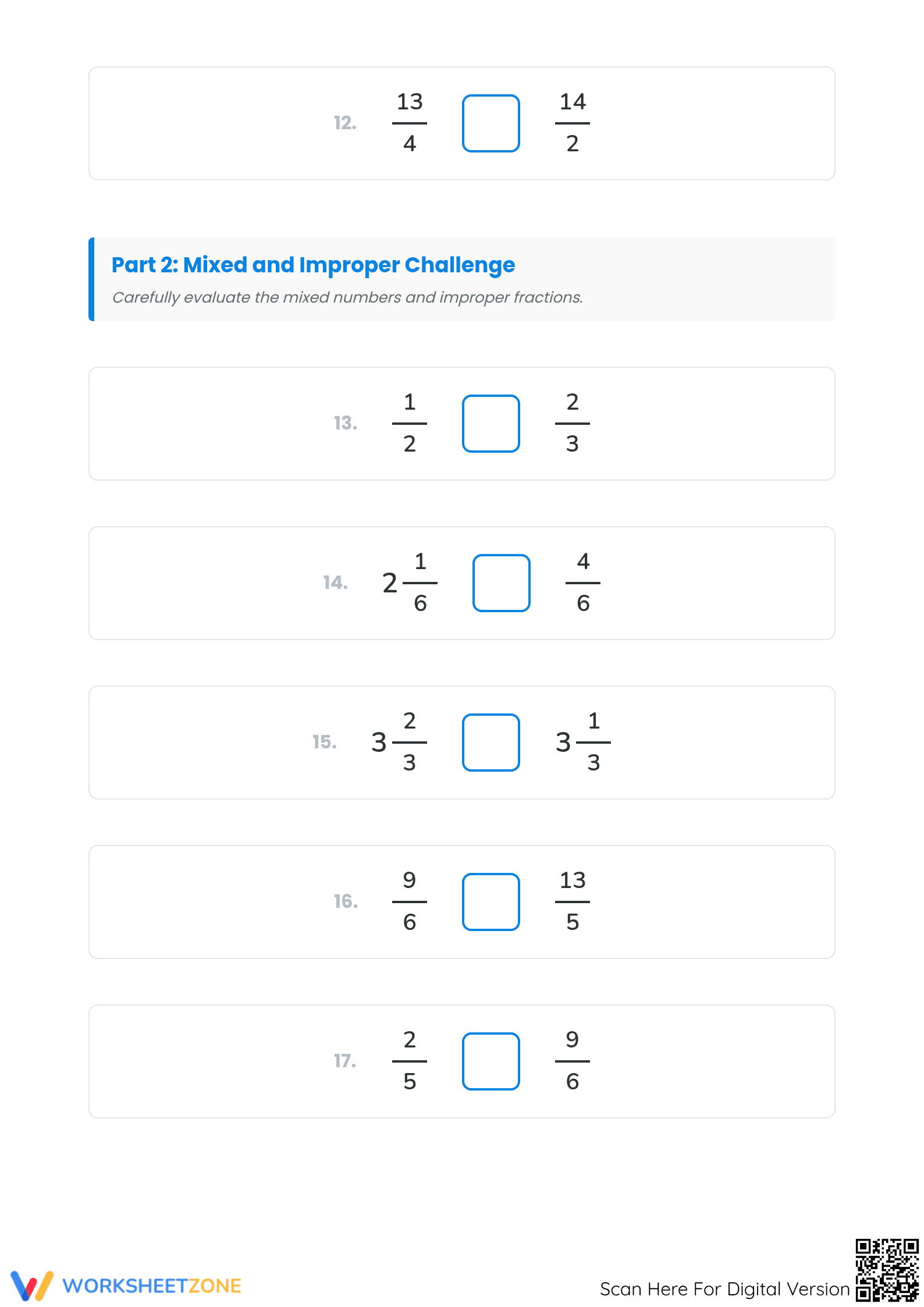
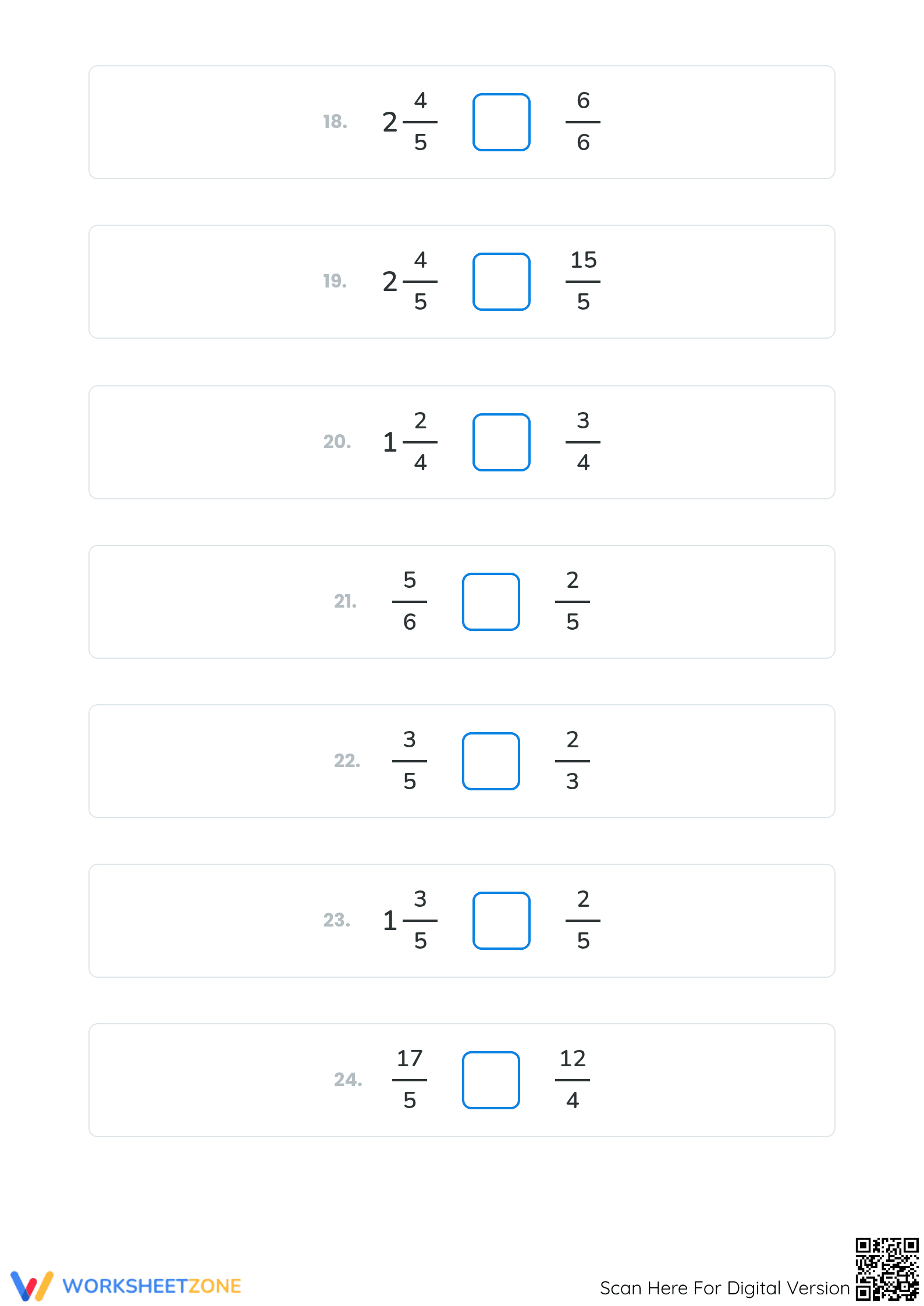
Students will master the critical skill of comparing various fraction types with this comprehensive practice set. This Essential Comparing Fractions Worksheet helps learners evaluate relationships between simple, improper, and mixed numbers. By using inequality symbols to compare 30 distinct pairs, students build the numerical fluency required for advanced operations and real-world mathematical problem-solving.
At a Glance
- Grade: 4–5 · Subject: Math · Fractions
- Standard:
CCSS.MATH.CONTENT.4.NF.A.2— Compare two fractions with different numerators and denominators using inequality symbols- Skill Focus: Comparing simple, improper, and mixed fractions
- Format: 5 pages · 30 problems · Answer key included · PDF
- Best For: Independent practice and fraction fluency review
- Time: 25–40 minutes
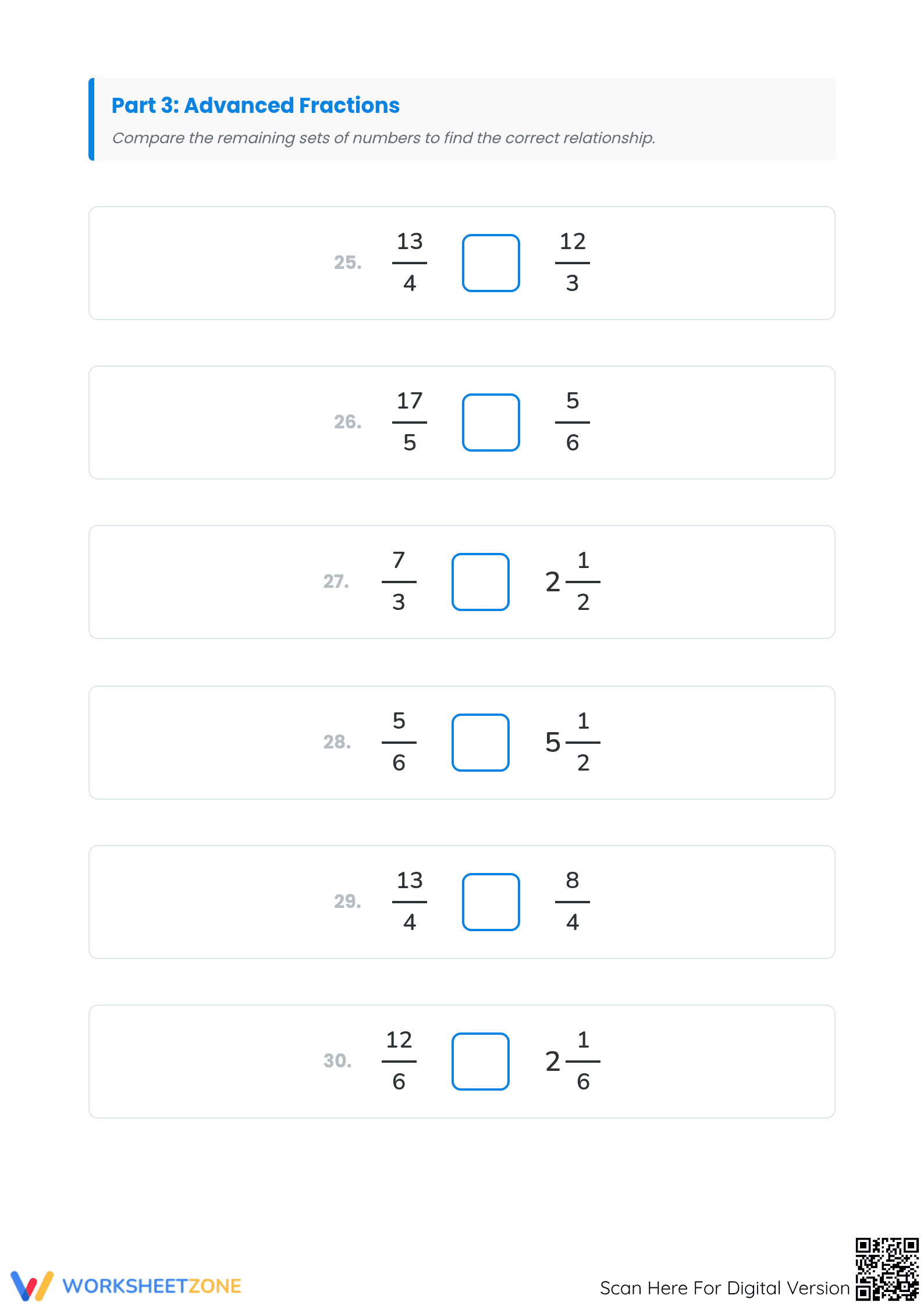
This 5-page PDF contains 30 structured problems divided into three distinct difficulty sections. The resource covers basic fraction comparisons, challenges involving mixed numbers, and advanced improper fraction evaluations. A complete 5-page answer key is included, providing immediate feedback for students or simplified grading for teachers. The clean layout features large, legible fractions and clear comparison boxes.
Skill Progression
This worksheet follows a gradual-release model to ensure student success through 30 targeted repetitions.
- Guided Practice: The first section focuses on basic comparisons between simple fractions and improper fractions with similar denominators to establish baseline competency.
- Supported Practice: Part two introduces mixed numbers, requiring students to convert or find common ground between diverse numerical formats while building fluency.
- Independent Practice: The final advanced section presents complex improper fractions and mixed numbers with unrelated denominators to test mastery and cognitive transfer.
This focused sequence supports an "I Do, We Do, You Do" instructional strategy to build confidence before introducing more complex numerical relationships.
Standards Alignment
The primary focus is CCSS.MATH.CONTENT.4.NF.A.2: "Compare two fractions with different numerators and different denominators, e.g., by creating common denominators or numerators, or by comparing to a benchmark fraction such as 1/2." This resource also supports Grade 5 fraction operations and number sense development. Both standard codes can be copied directly into lesson plans, IEP goals, or district curriculum mapping tools.
How to Use It
Use this worksheet during the "You Do" portion of a lesson after direct instruction on finding common denominators. It serves as an excellent formative assessment to identify students struggling with the conversion between improper fractions and mixed numbers. Expected completion time is 35 minutes; observe if students use benchmark fractions or cross-multiplication strategies to determine relative magnitude.
Who It's For
This resource is designed for Grade 4 and Grade 5 students mastering the Number and Operations—Fractions domain. It provides necessary scaffolding for students with IEP goals related to fraction comparison while offering enough complexity for high-achieving learners in upper elementary grades. Pair this practice set with a visual fraction bar anchor chart for students requiring additional visual support during independent work.
Comparing fractions is a foundational milestone in the elementary mathematics curriculum, directly influencing a student's ability to perform algebraic operations in later grades. Research from the NAEP highlights that conceptual understanding of fraction magnitude is one of the strongest predictors of future math achievement. This worksheet provides the 30 rigorous practice opportunities required to move students from procedural knowledge to conceptual mastery of CCSS.MATH.CONTENT.4.NF.A.2. By requiring students to evaluate simple, improper, and mixed fractions in the same session, the resource forces deeper cognitive processing than single-type drills. This multi-page approach ensures that learners encounter a statistically significant variety of denominator pairs, which Fisher & Frey (2014) identifies as essential for the successful transfer of mathematical skills to novel contexts. This printable PDF serves as a high-utility tool for classrooms prioritizing data-driven instruction and evidence-based fraction pedagogy.


