


























Views
Downloads

Essential Comparing Simple Fractions Worksheet | Grade 4
Paste this activity's link or code into your existing LMS (Google Classroom, Canvas, Teams, Schoology, Moodle, etc.).
Students can open and work on the activity right away, with no student login required.
You'll still be able to track student progress and results from your teacher account.
Students will master the critical ability to evaluate and compare numerical values of fractional parts using this comprehensive practice set. By moving from visual models to abstract calculation, learners build a robust internal number line for fractions. This worksheet ensures students can confidently apply inequality symbols to both simple and complex fraction pairs.
At a Glance
- Grade: 4 · Subject: Math
- Standard:
CCSS.MATH.CONTENT.4.NF.A.2— Compare two fractions with different numerators and denominators by creating common denominators- Skill Focus: Fraction Magnitude Comparison
- Format: 3 pages · 30 problems · Answer key included · PDF
- Best For: Independent practice and formative assessment
- Time: 25–35 minutes
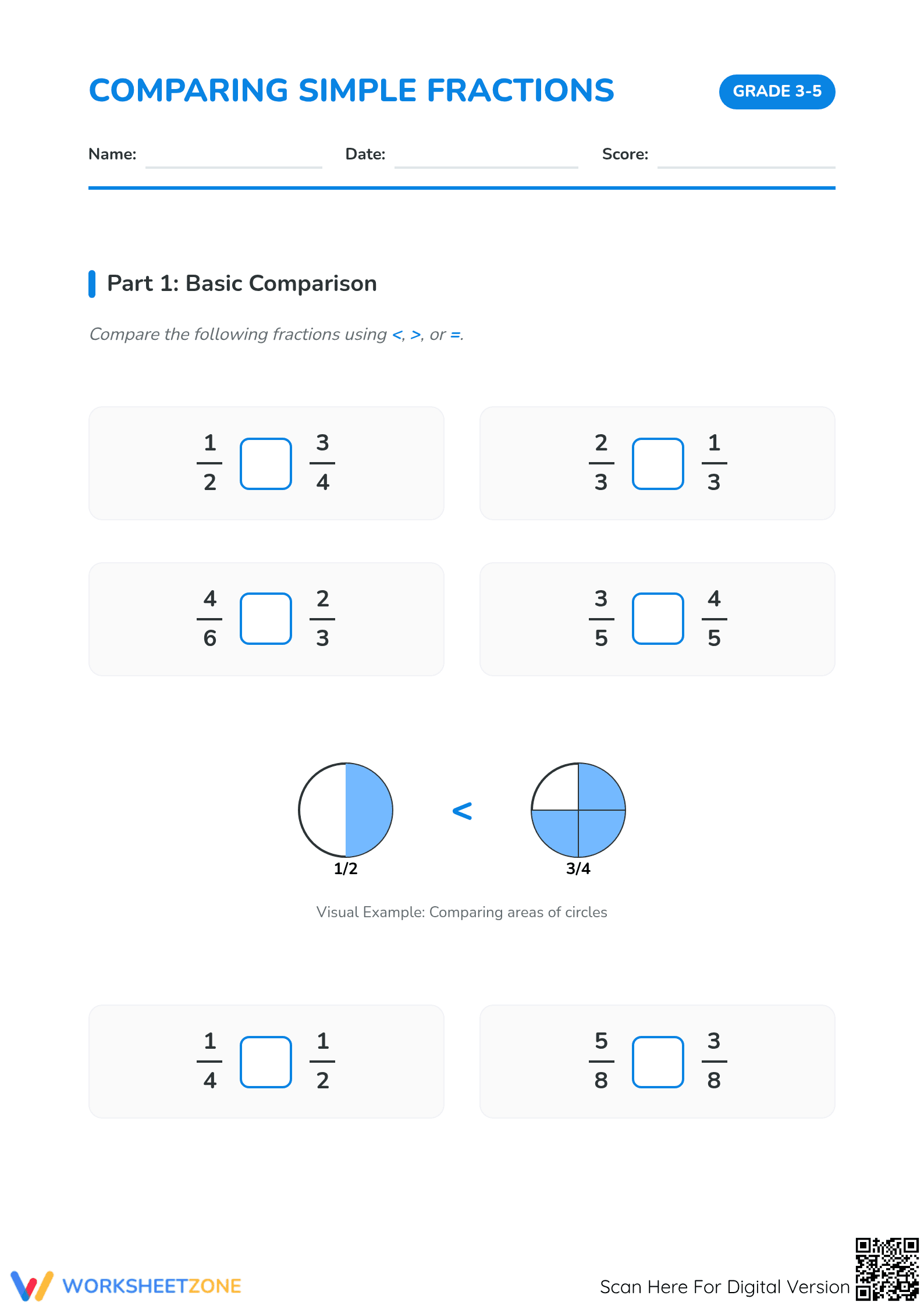
This three-page instructional resource contains a curated sequence of 30 mathematical tasks designed to eliminate confusion between numerator and denominator logic. The packet includes a clear visual example using area models to ground abstract concepts, followed by three distinct sections of increasing complexity. A full multi-page answer key is provided for immediate feedback and self-correction.
Skill Progression and Scaffolding
- Guided Practice: Eight initial tasks focus on basic comparisons using visual support and same-denominator pairs to establish the concept of piece count versus piece size.
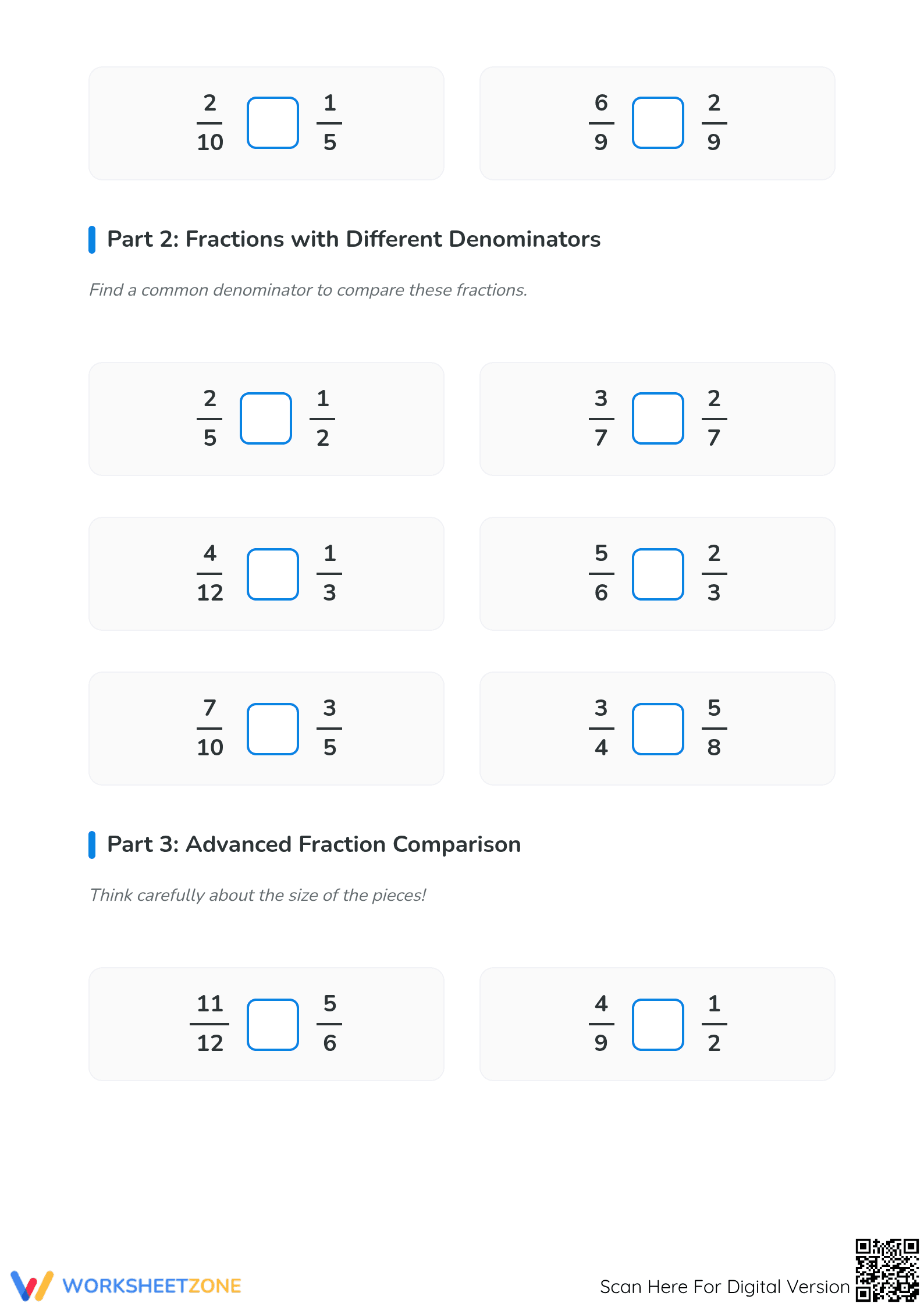
- Supported Practice: Twelve problems in the middle section require students to identify and apply common denominators, transitioning from intuition to algorithmic reasoning.
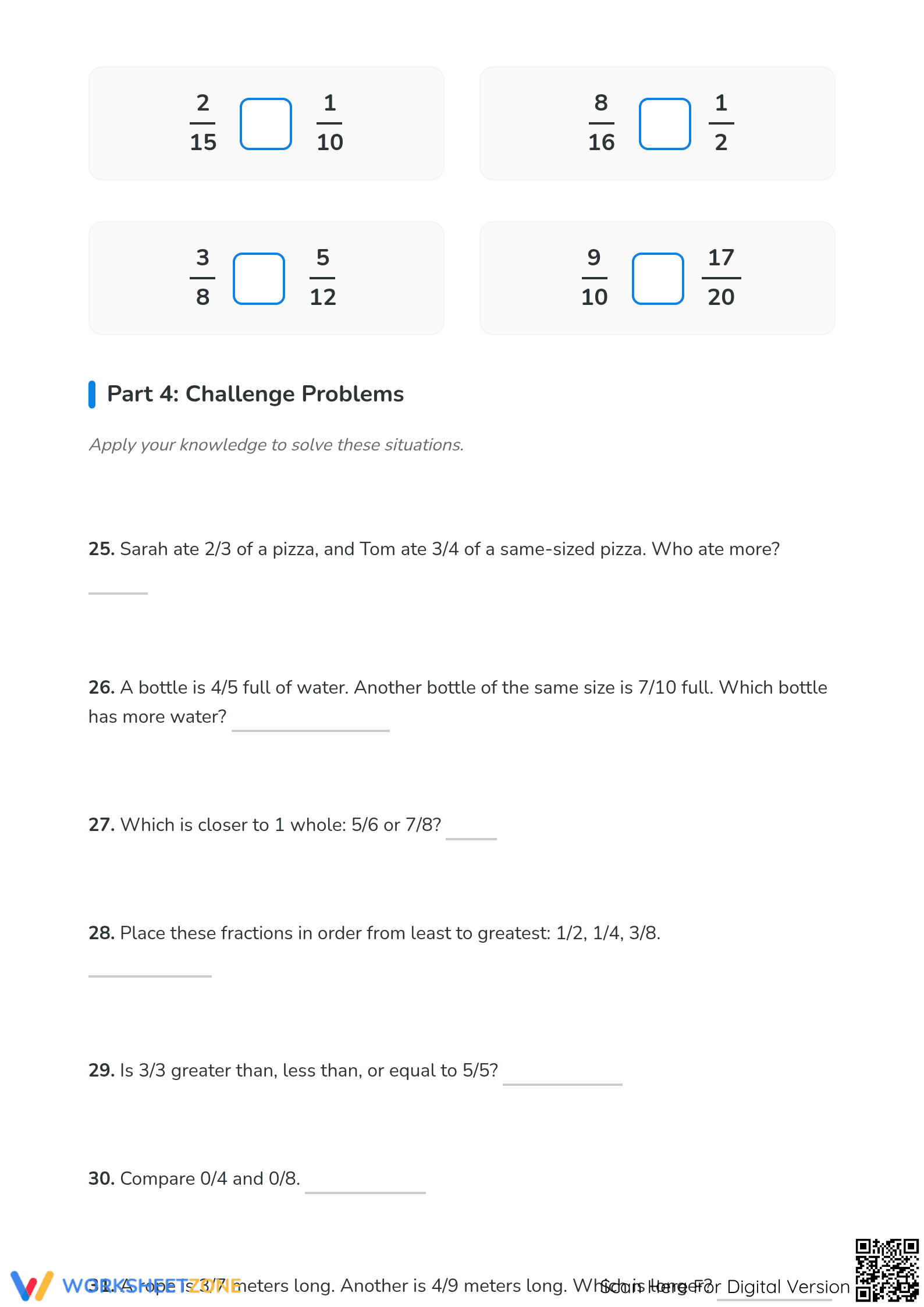
- Independent Practice: Ten concluding challenge problems include advanced numerical comparisons and real-world word problems to ensure high-level application of the skill.
This structure follows the gradual release of responsibility model, moving students from the "I Do" visual phase to "You Do" independent word problem solving.
Standards Alignment
The primary focus is CCSS.MATH.CONTENT.4.NF.A.2: "Compare two fractions with different numerators and different denominators, e.g., by creating common denominators or numerators, or by comparing to a benchmark fraction such as 1/2." It also supports 3.NF.A.3.D for introductory learners. Both standard codes can be copied directly into lesson plans, IEP goals, or district curriculum mapping tools.
How to Use It
This worksheet is ideal for use during the independent practice portion of a math block following direct instruction on common denominators. Teachers should use the middle section as a formative assessment point; observe if students are drawing their own models or successfully calculating common denominators. Expect most Grade 4 students to complete the three-page sequence in approximately 30 minutes.
Who It's For
This resource is tailored for Grade 4 students working toward mastery of the Number and Operations—Fractions domain. It provides necessary scaffolding for Grade 5 students needing remediation and offers an appropriate challenge for advanced Grade 3 learners. It pairs naturally with fraction tiles or circle area model manipulatives for kinesthetic learners.
According to the ScienceDirect TpT Analysis, effective mathematical worksheets must bridge the gap between concrete visual representation and abstract symbolic manipulation to prevent persistent misconceptions in rational number reasoning. This worksheet fulfills that requirement by utilizing standard CCSS.MATH.CONTENT.4.NF.A.2 to guide students through the plain-English skill of determining which of two fractional quantities is larger based on the relationship between the parts and the whole. By providing 30 varied tasks, the resource ensures that students encounter a wide range of denominator relationships, which is a key predictor of success in middle school algebra prep. The inclusion of word problems in the final section facilitates the transfer of knowledge from isolated calculation to contextual application. Educators can use these specific metrics to track progress toward IEP goals or district-wide grade-level benchmarks with high reliability and precision.


