


























Views
Downloads




Essential Comparing Simple Fractions Worksheet | Grades 3-5
Paste this activity's link or code into your existing LMS (Google Classroom, Canvas, Teams, Schoology, Moodle, etc.).
Students can open and work on the activity right away, with no student login required.
You'll still be able to track student progress and results from your teacher account.
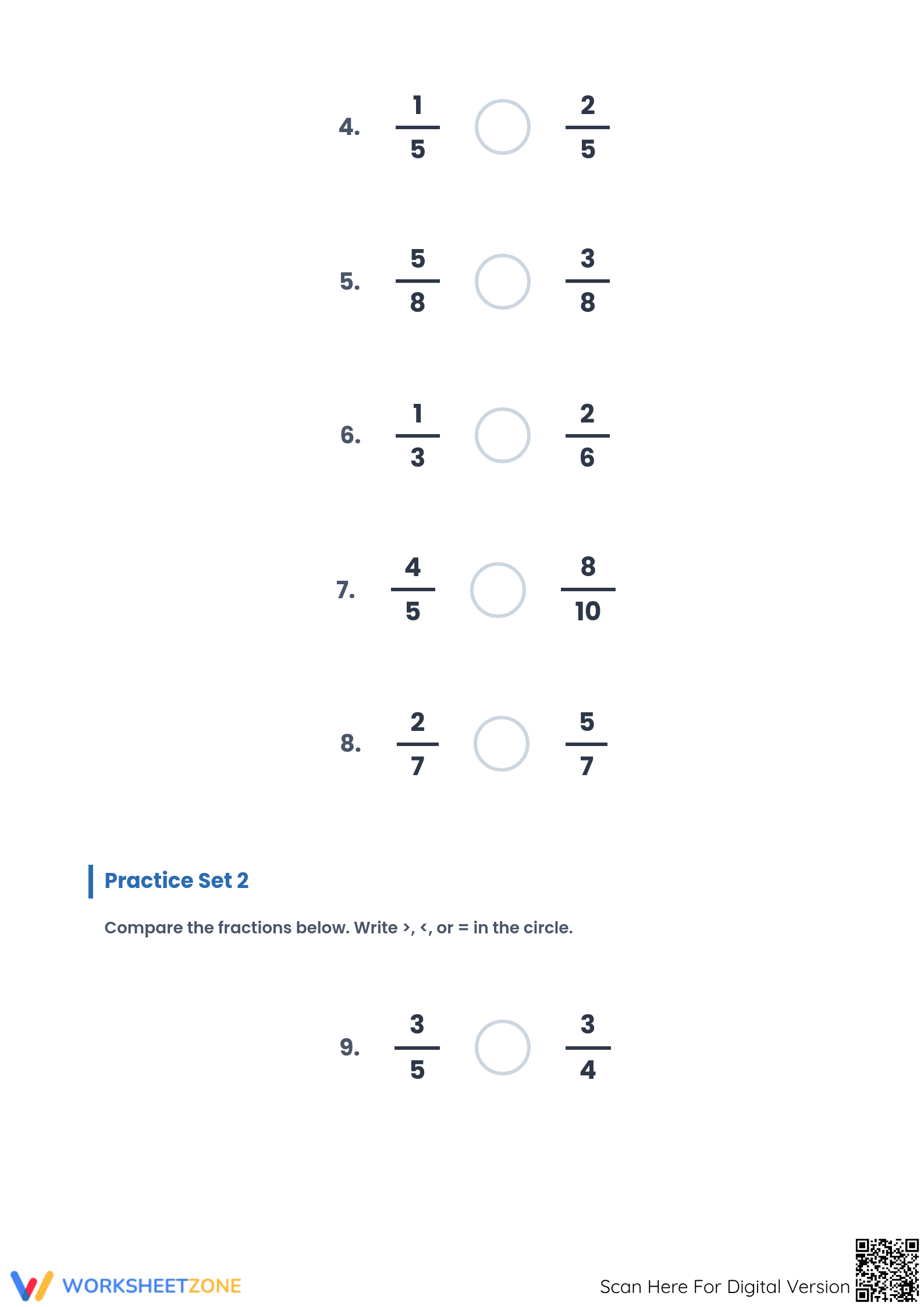
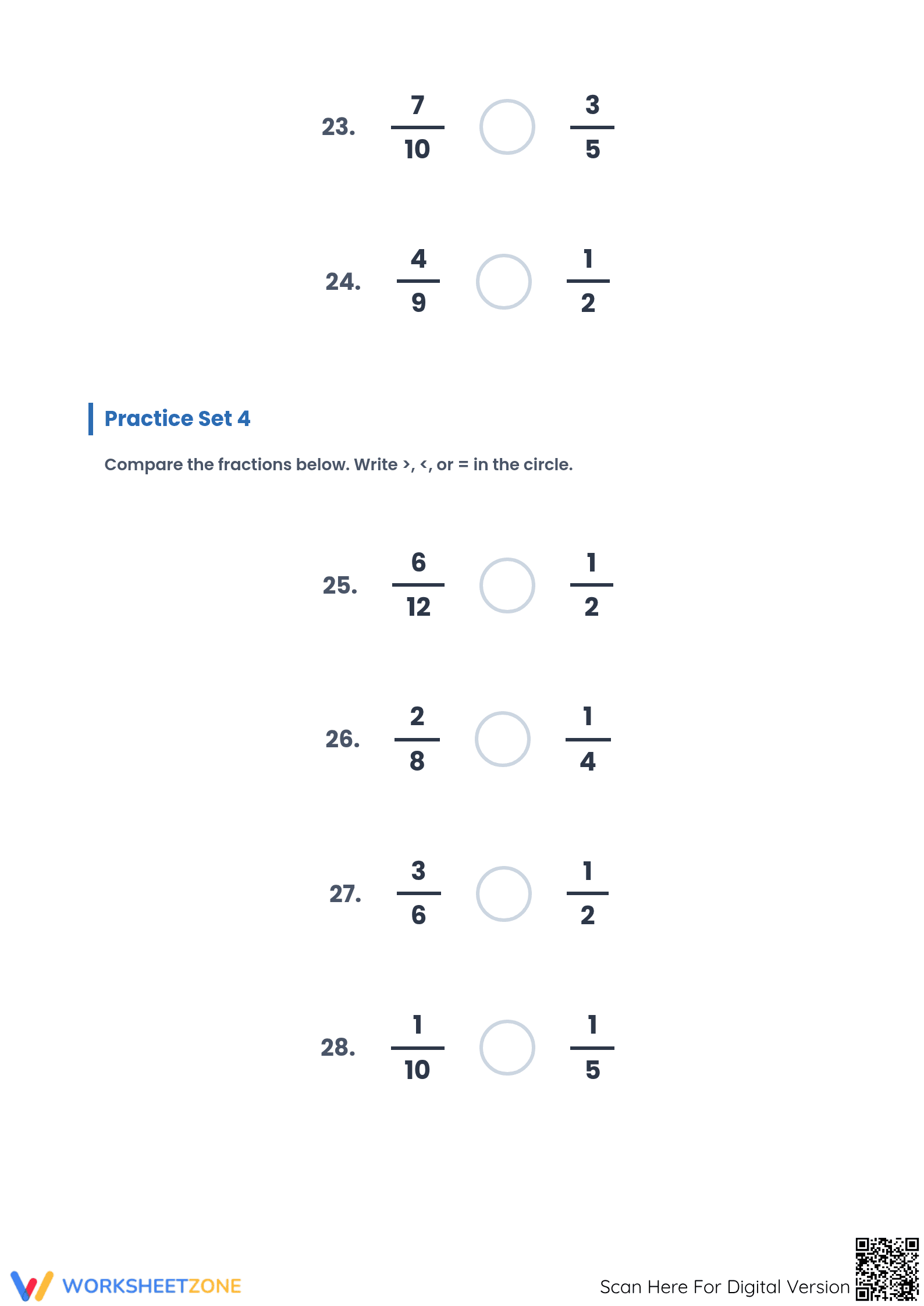
This essential comparing simple fractions worksheet provides students with comprehensive practice in evaluating fractional values using relational symbols. By engaging with 28 structured problems, learners develop the visual and conceptual fluency required to compare fractions with like and unlike denominators accurately. It is a complete resource for building foundational mathematical reasoning.
At a Glance
- Grade: 3–5 · Subject: Math · Fractions
- Standard:
CCSS.MATH.CONTENT.4.NF.A.2— Compare two fractions with different numerators and different denominators by creating common denominators- Skill Focus: Comparing fractions using symbols (>, <, =)
- Format: 5 pages · 28 problems · Answer key included · PDF
- Best For: Independent practice and formative assessment tasks
- Time: 25–35 minutes
The packet contains 28 unique comparison tasks divided into four distinct practice sets. It opens with a visual anchor example that uses circular area models to demonstrate why one-half is greater than one-fourth. Students then transition to purely numerical comparisons, working through five pages of practice. A full answer key is included for immediate feedback and grading.
The zero-prep workflow for this resource is designed for maximum teacher efficiency. First, print the five-page PDF in approximately 30 seconds. Second, distribute the worksheets to students during your fractions unit in under 1 minute. Third, use the included answer key to review student work in 2 minutes. Total preparation time is under two minutes, making it an excellent option for emergency sub plans.
The primary alignment is CCSS.MATH.CONTENT.4.NF.A.2, which requires students to compare two fractions with different numerators and denominators. The worksheet also supports CCSS.MATH.CONTENT.3.NF.A.3.D by providing practice with fractions having common denominators or numerators. Both standard codes can be copied directly into lesson plans, IEP goals, or district curriculum mapping tools.
This resource is ideal as a primary independent practice activity following a direct instruction lesson on finding common denominators. It can also serve as a quick formative assessment to gauge student readiness for more complex fraction operations. Teachers should observe whether students are drawing their own visual models to support their numerical reasoning during completion.
This worksheet is designed for students in grades 3 through 5 who are developing their fractional sense. It provides necessary scaffolding for struggling learners through the initial visual example while offering enough volume for high-achieving students to demonstrate mastery. It pairs naturally with fraction tiles or circular area model manipulatives.
Effective mastery of fractions is a critical predictor of later success in algebra and higher-level mathematics. According to research from EdReports 2024, high-quality practice materials must provide a sufficient volume of problems that bridge the gap between visual representation and abstract numerical manipulation. This worksheet achieves that balance by centering on CCSS.MATH.CONTENT.4.NF.A.2, ensuring students move beyond rote memorization toward a deeper understanding of fractional magnitudes. By requiring students to use relational symbols across 28 diverse problems, the resource reinforces the conceptual framework of part-to-whole relationships. Such structured practice is essential for internalizing the logic of common denominators and benchmarking against one-half. Educators can confidently integrate this tool into their curriculum as a verified means of building fraction fluency and preparing students for the rigorous demands of middle school mathematics.


