


























Views
Downloads
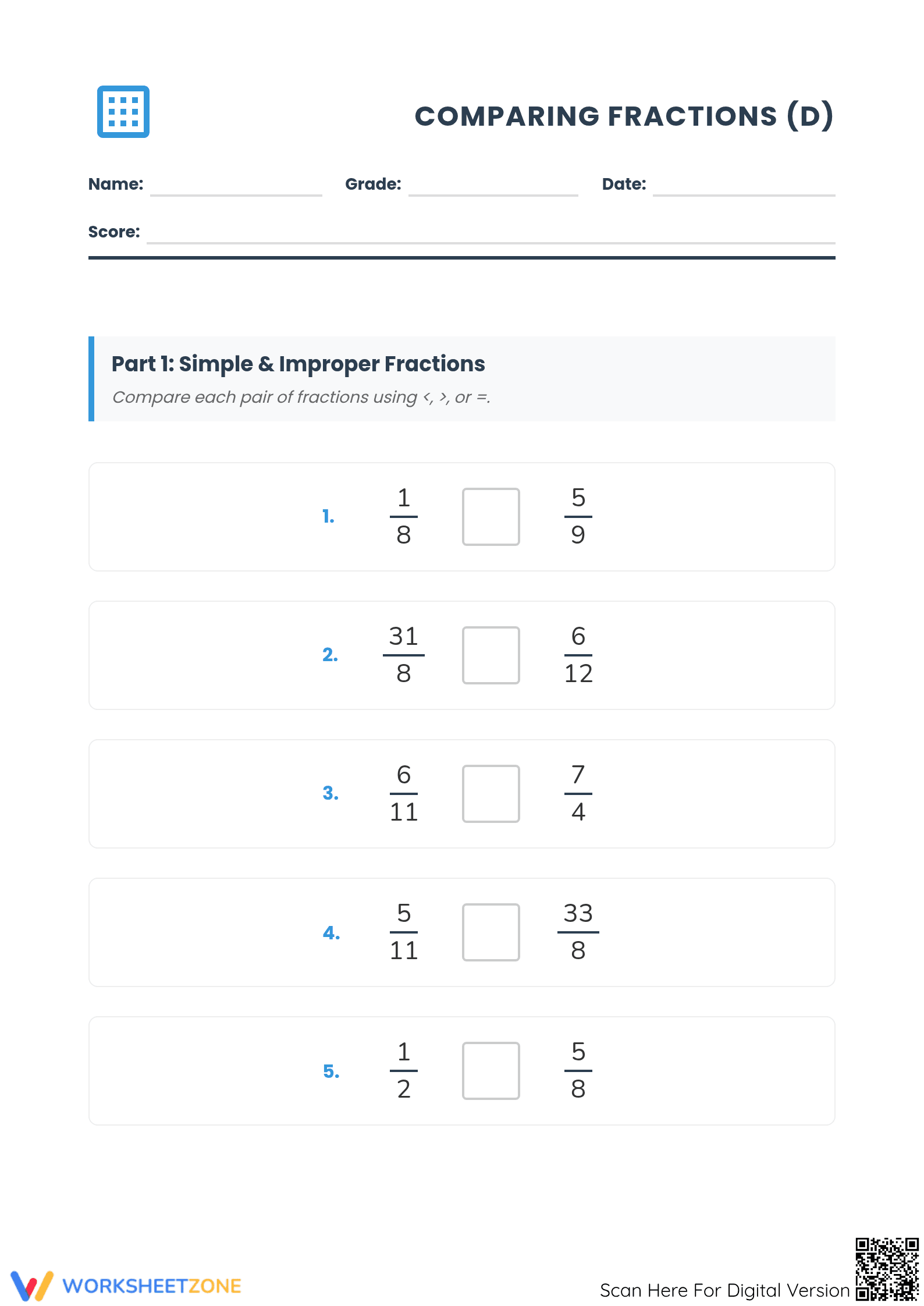
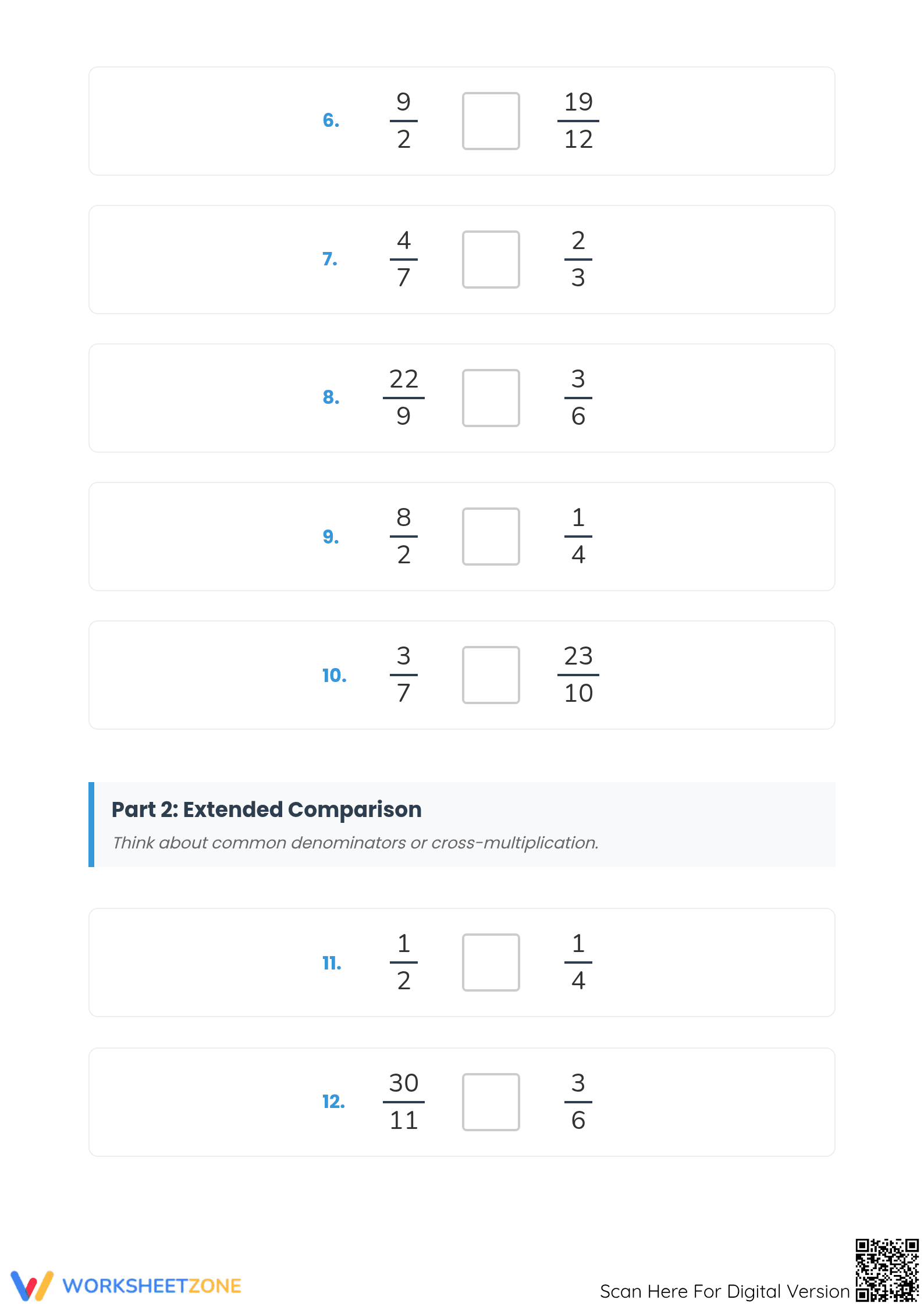
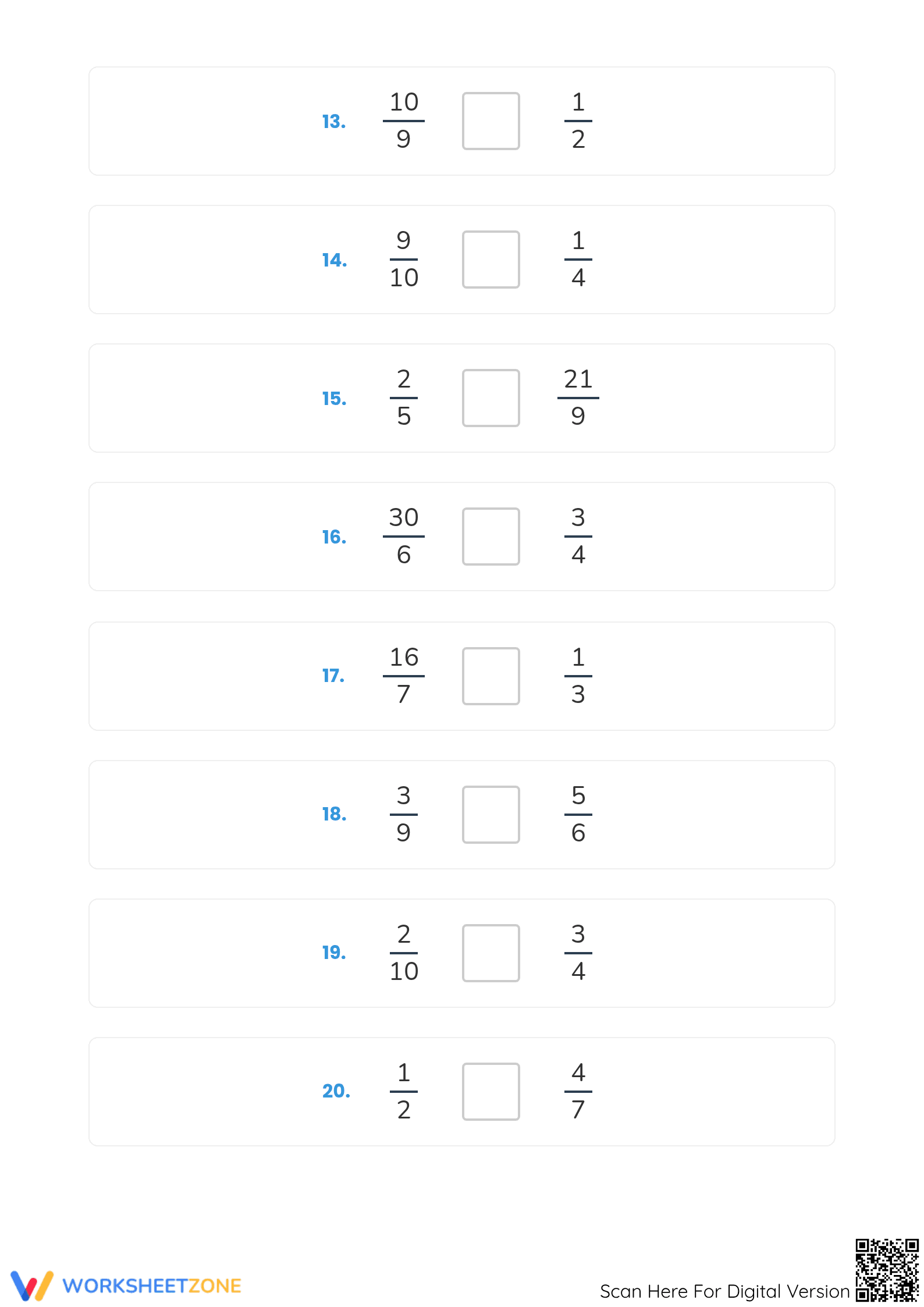
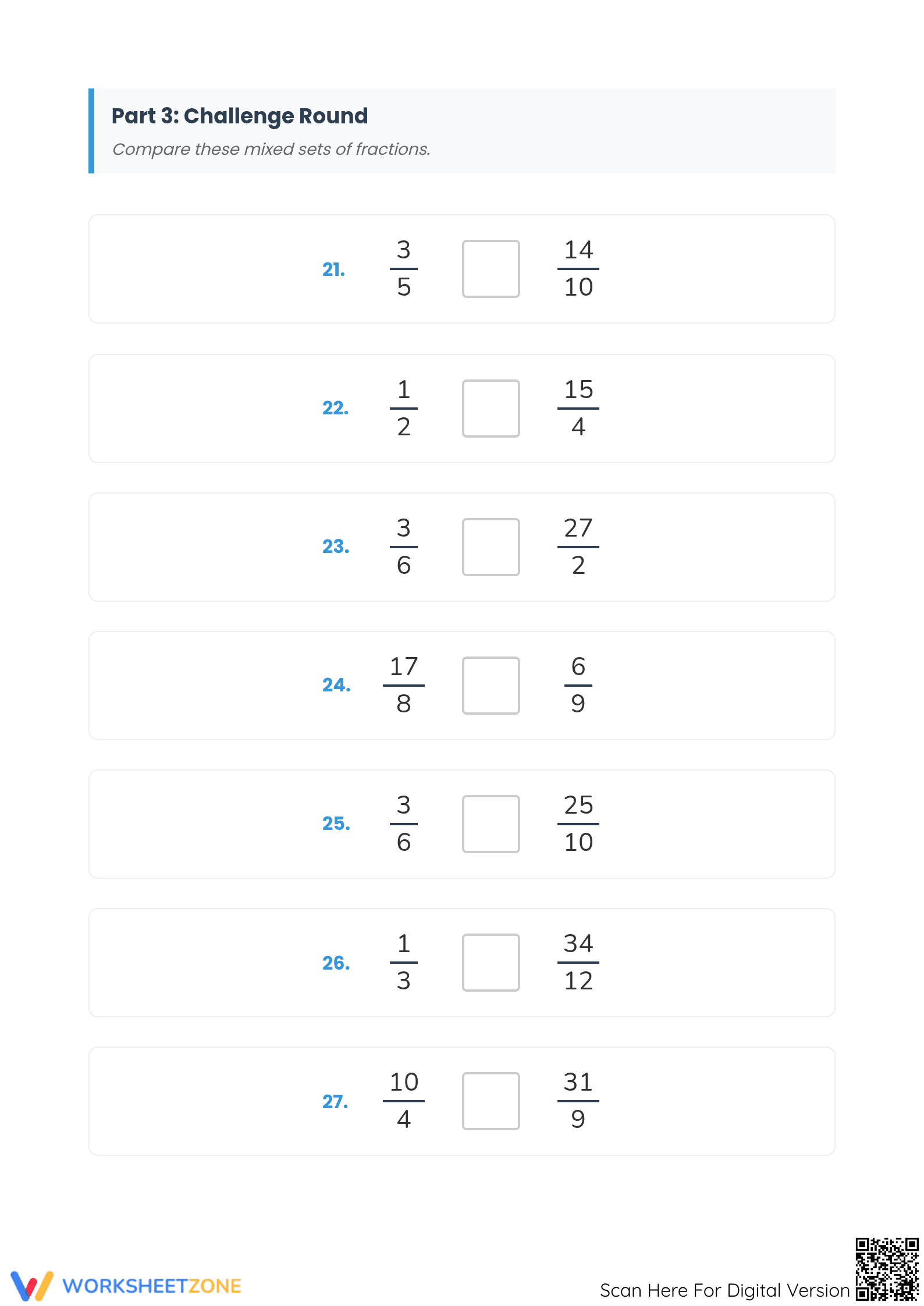
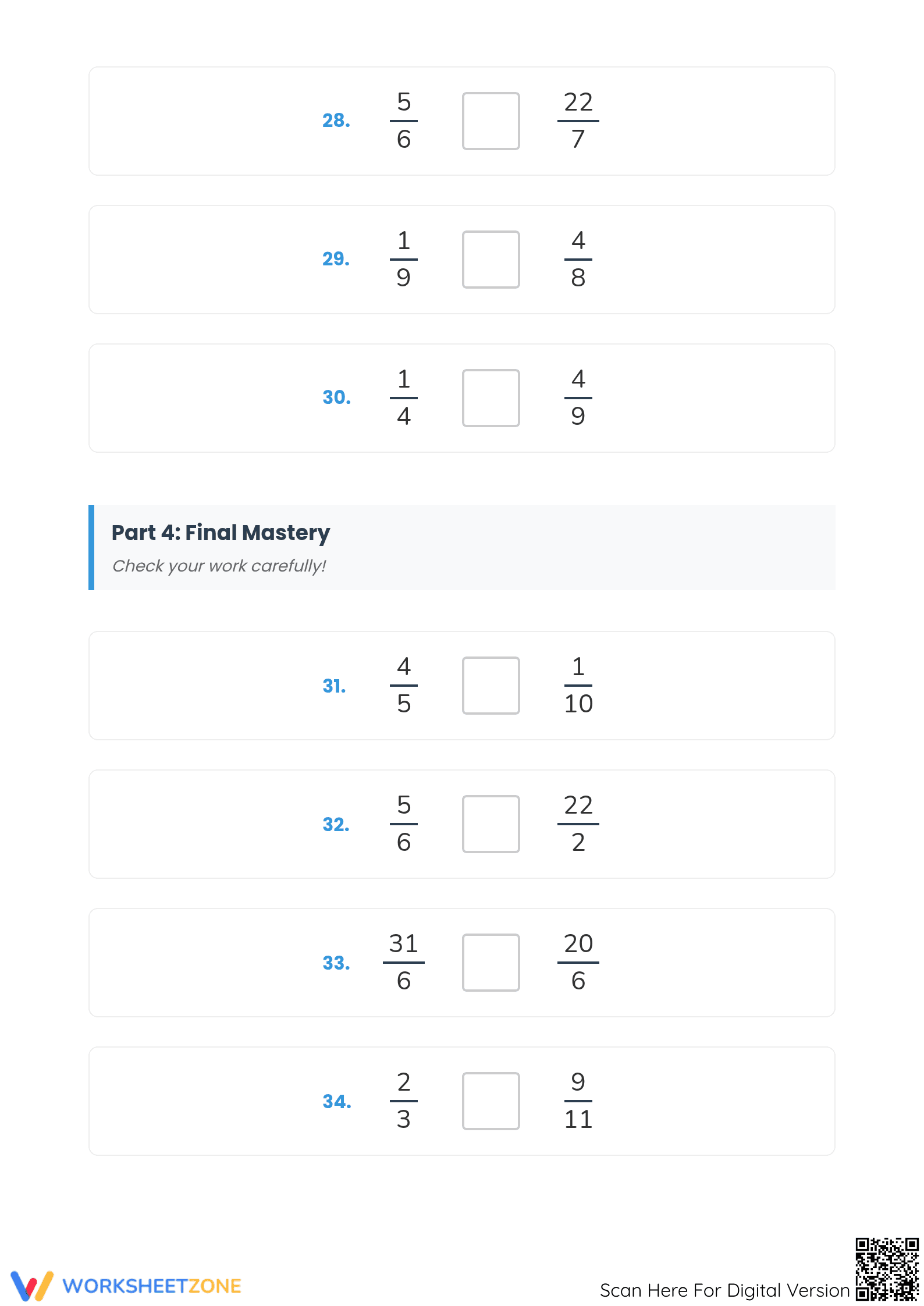

Printable Comparing Simple and Improper Fractions Worksheet
Paste this activity's link or code into your existing LMS (Google Classroom, Canvas, Teams, Schoology, Moodle, etc.).
Students can open and work on the activity right away, with no student login required.
You'll still be able to track student progress and results from your teacher account.
Comparing fractions often stops at proper forms, leaving students unprepared for the complexities of higher-level math. This comprehensive worksheet bridges that gap by requiring students to evaluate and compare combinations of simple and improper fractions. Students develop strong numerical fluency by identifying relative values across 34 structured problems, ensuring mastery of fractional magnitude and proportional reasoning.
At a Glance
- Grade: 4 · Subject: Math
- Standard:
CCSS.MATH.CONTENT.4.NF.A.2— Compare fractions with different numerators and denominators using benchmarks or common denominators- Skill Focus: Comparing Improper and Simple Fractions
- Format: 5 pages · 34 problems · Answer key included · PDF
- Best For: Fraction magnitude practice and mastery
- Time: 25–40 minutes
What's Inside
This 5-page PDF contains 34 unique problems divided into four progressive sections: Simple & Improper Fractions, Extended Comparison, Challenge Round, and Final Mastery. Each page provides ample white space for students to perform cross-multiplication or find common denominators. A complete answer key is provided to facilitate rapid grading and student self-correction during independent work.
Skill Progression
- Guided Practice: Part 1 introduces basic comparisons between proper and improper forms to build confidence and establish a baseline understanding of fractional magnitude.
- Supported Practice: Part 2 expands the scope with 10 extended comparisons requiring more complex denominator manipulation and benchmark reasoning.
- Independent Practice: The challenge and mastery rounds remove scaffolds, forcing students to apply internalized strategies to unconventional and mixed fraction pairings.
This sequence follows a deliberate gradual-release model, moving from initial conceptualization to independent application across various mathematical contexts.
Standards Alignment
The primary alignment is CCSS.MATH.CONTENT.4.NF.A.2: "Compare two fractions with different numerators and different denominators, e.g., by creating common denominators or numerators, or by comparing to a benchmark fraction such as 1/2." This resource also supports Grade 5 fraction operations by reinforcing the underlying logic of fractional value. Both standard codes can be copied directly into lesson plans, IEP goals, or district curriculum mapping tools.
How to Use It
Use this resource during the independent practice phase of a lesson on fraction comparison. It is particularly effective as a tiered assessment; assign the first two pages to verify basic understanding before moving students to the challenge round. Educators should observe whether students rely on visual benchmarks or algebraic methods like cross-multiplication during the 30-minute completion window.
Who It's For
This resource is designed for Grade 4 and Grade 5 students working toward fraction mastery. It is an ideal intervention tool for middle school students who struggle with the concept of improper fractions being greater than one. Pair this worksheet with a visual fraction wall or number line to help students visualize the magnitudes they are comparing numerically.
Research by Fisher & Frey (2014) highlights that the gradual release of responsibility is essential for mathematical proficiency, especially when transitioning between conceptual and abstract representations. This worksheet operationalizes that research by moving students from familiar simple fractions to more abstract improper forms across four phases. By providing 34 opportunities for practice, the resource ensures students encounter enough variety to generalize comparison strategies beyond common denominators. Aligned with CCSS.MATH.CONTENT.4.NF.A.2, the material targets the critical skill of fractional magnitude, which NAEP data identifies as a common stumbling block. The Final Mastery section serves as a summative checkpoint, allowing teachers to collect empirical evidence of student progress. This structured approach reduces cognitive load while maximizing the potential for long-term retention of fractional concepts in diverse classroom settings.


